


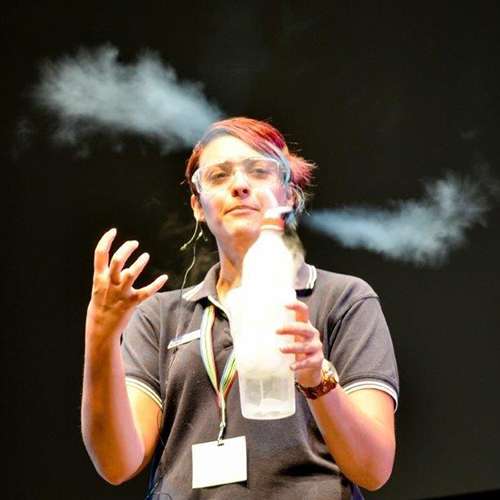
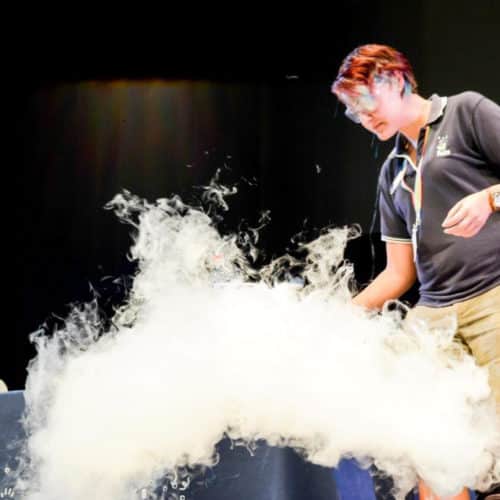
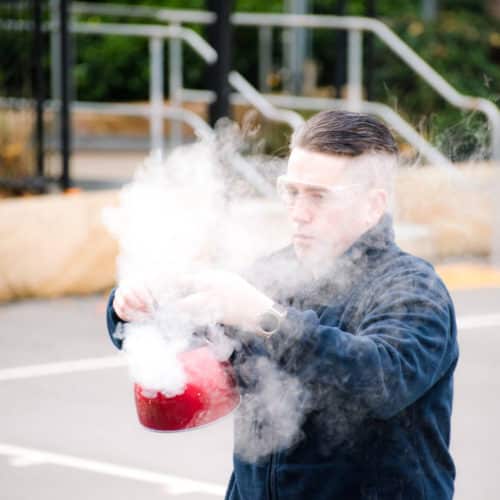
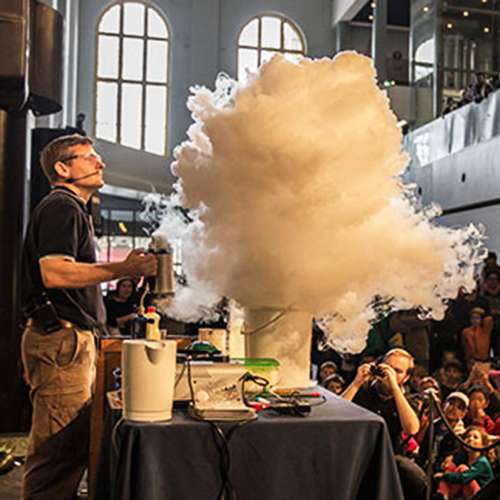

Students have the opportunity to assist in the many cool liquid nitrogen demonstrations
- Find out how solids, liquids and gases change when rapidly heated and cooled.
- Smash a tennis ball! Shrink a balloon instantly!
- What happens to living things if they are frozen?
- How can Newton’s 3rd Law of Motion explain a liquid nitrogen sprinkler?
- Explore Charles Law using popping cans and expanding balloons.
- Just what is the Leidenfrost effect anyway and more…
This science show covers phase changes, expansion and contraction, basic cell theory, air pressure and the weather. This performance can also be viewed as a LIVE web conference anywhere in the world!
 Rated Excellent on Trustpilot – read our reviews
Contact us
Online Class Version
We’ve run live interactive distance programs since 2010 and are highly experienced in making online classes engaging for students on a variety of web conferencing platforms.
- All of the activities listed below will be covered during the conference.
- Upon booking, you will receive a PDF outlining the materials that you can have on hand to make the workshop more interactive. It’s not a problem if you can’t source all of the materials, as we’ll have these on hand for the workshop
- Full child protections are in place
- We usually connect to classes & homes via Zoom, however if you wish to use a different software we can work with you on getting the connection live.
If you connect with us via Zoom
- Full system requirements for Zoom here
- Each student should test their Zoom connection here.
- Once the date & time is arranged we will send you simple connection instructions (one click & you’re in!)
Science Show Demonstrations
- Safety of cryogenic substances – Liquid Nitrogen is – 196˚C, so what equipment must be used?
- Fog breath – Is water present in your breath? Condensation demonstration.
- The shrinking balloon – What happens to gases when rapidly cooled? Air pressure demo
- Balloon blow up – Blowing balloons up from the outside! Transferring heat energy.
- Lid launcher – Expanding gases have a lot of force – why can this be a problem?
- The flying glove – Heating gases causes rapid expansion!
- Ball smasher – Why can rubber shatter? Glass transition phase demonstration
- Banana hammer – Can plant material survive instant freezing?
- Liquid Nitrogen sprinkler! – Rapid expansion of Nitrogen can be utilised – what about water?
- Cool lasers – How are lasers used in atmospheric research?
- Frozen bubbles – Bubbles can give clues about our changing environment.
- Cooling circuits – Proving chemical reactions slow when cooled.
- Leidenfrost effect – Rapidly boiling liquids can hover over surfaces… how?
- Levitating magnets – See the power within superconductors; future research in action

Australian Curriculum Mapping
Australian National Curriculum Mapping for all our science incursions
Australian ACARA Content Outcomes:
Science F-10 Version 9.0
Year 7
- use particle theory to describe the arrangement of particles in a substance, including the motion of and attraction between particles, and relate this to the properties of the substance AC9S7U05
Year 8
- compare physical and chemical changes and identify indicators of energy change in chemical reactions
AC9S8U07 - recognise cells as the basic units of living things, compare plant and animal cells, and describe the functions of specialised cell structures and organelles AC9S8U01
Year 7 & 8
- explain how new evidence or different perspectives can lead to changes in scientific knowledge
AC9S7H01 AC9S8H01 - examine how proposed scientific responses to contemporary issues may impact on society and explore ethical, environmental, social and economic considerations AC9S7H03 AC9S8H03
- develop investigable questions, reasoned predictions and hypotheses to explore scientific models, identify patterns and test relationships AC9S7I01 AC9S8I01
- analyse data and information to describe patterns, trends and relationships and identify anomalies AC9S7I05 AC9S8I05
- construct evidence-based arguments to support conclusions or evaluate claims and consider any ethical issues and cultural protocols associated with using or citing secondary data or information AC9S7I07 AC9S8I07
Year 9 & 10
- explain how scientific knowledge is validated and refined, including the role of publication and peer review
AC9S9H01 AC9S10H01 - Investigate how advances in technologies enable advances in science, and how science has contributed to developments in technologies and engineering AC9S9H02 AC9S10H02
- develop investigable questions, reasoned predictions and hypotheses to test relationships and develop explanatory models AC9S9I01 AC9S10I01
- analyse and connect a variety of data and information to identify and explain patterns, trends, relationships and anomalies AC9S9I05 AC9S10I05
- construct arguments based on analysis of a variety of evidence to support conclusions or evaluate claims, and consider any ethical issues and cultural protocols associated with accessing, using or citing secondary data or information AC9S9I07 AC9S10I07
Australian National Curriculum Mapping for all our science workshops & shows

NSW K-10 Science Syllabus Mapping
NSW Science 7–10 Syllabus (2023)
Stage 4
A student:
- identifies questions and makes predictions to guide scientific investigations SC4-WS-02
– Identify questions and problems that can be investigated scientifically
– Make predictions based on scientific knowledge and observations - describes the effects of forces in everyday contexts SC4-FOR-01
– Conduct a practical investigation on the effects of a range of direct and indirect forces - explains how the properties of substances enable separation in a range of techniques SC4-SOL-01
– Identify the 3 main states of matter and how they are represented in the movement of water on earth
– Represent changes in the state of matter in terms of particle arrangement and movement - explains how energy causes geological and chemical change SC4-CHG-01
– Undertake experiments to identify the indicators of physical and chemical changes
Stage 5
- asks questions or makes predictions using observations SCLS-WS-02
– Ask questions about familiar objects and events based on observations
– Make predictions based on observations

VIC Science Syllabus Content
VIC Curriculum F–10 Version 2.0
For explanatory points & implementation advice for each dot point, please visit the VIC Curriculum F-10 site.
Levels 7 and 8
- the particle and kinetic theories of matter can be used to describe the arrangement and motion of particles in a substance, including the attraction between particles, and to explain the properties and behaviour of substances, including melting point, boiling point, density, compressibility, gas pressure, viscosity, diffusion, sublimation, and expansion and contraction. VC2S8U05
- physical changes can be distinguished from chemical changes; a chemical change can be identified by a colour change, a temperature change, the production of a gas (including laboratory preparation and testing of oxygen, carbon dioxide and hydrogen gases) or the formation of a precipitate. VC2S8U08
- balanced and unbalanced forces acting on objects, including gravitational force, may be investigated and represented using force diagrams; changes in an object’s motion can be related to its mass and the magnitude and direction of the forces acting on it. VC2S8U14
- cell theory describes cells as the basic units of life; organisms may be unicellular or multicellular and have specialised structures and organelles (including cell walls, cell membranes, cytoplasm, nuclei containing DNA, mitochondria, ribosomes, chloroplasts and vacuoles) that perform specific functions. VC2S8U02
- investigable questions, reasoned predictions and hypotheses can be developed in guiding investigations to identify patterns, test relationships and analyse and evaluate scientific models. VC2S8I01
- scientific methods, conclusions and claims can be analysed to identify assumptions, possible sources of error, conflicting evidence and unanswered questions. VC2S8I06
- evidence-based arguments can be constructed to support conclusions or evaluate claims, including consideration of ethical issues and protocols associated with using or citing secondary data or information. VC2S8I07
Levels 9 and 10
- Newton’s laws of motion can be used to quantitatively analyse the relationship between force, mass and acceleration of objects. VC2S10U17
- investigable questions, reasoned predictions and hypotheses can be used in guiding investigations to test and develop explanatory models and relationships. VC2S10I01
- the validity and reproducibility of investigation methods and the validity of conclusions and claims can be evaluated, including by identifying assumptions, conflicting evidence, biases that may influence observations and conclusions, sources of error and areas of uncertainty. VC2S10I06
- arguments based on a variety of evidence can be constructed to support conclusions or evaluate claims, including consideration of any ethical issues and cultural protocols associated with accessing, using or citing secondary data or information. VC2S10I07
Requirements
- Appropriate for Years 7 to 10.
- Maximum of 60 students per session.
- Two tables in a well ventilated area.
- Chairs are not required.
- Duration 45 minutes.
- Set up time 30 minutes and pack up time 30 minutes.






