



A hands-on workshop relevant to modern living.
Students investigate electrical energy production from renewable and non-renewable resources.
The activities cover a range of topics including wind farms, the Snowy Mountains Scheme, how to reduce energy consumption in the home and the difference between ozone depletion and the enhanced greenhouse effect.
Students will develop a better understanding of the different sources of energy and gain insight into current research being undertaken into energy production. This performance can also be viewed as a LIVE web conference anywhere in the world!
Online Class Version
We’ve run live interactive distance programs since 2010 and are highly experienced in making online classes engaging for students on a variety of web conferencing platforms.
- All of the activities listed below will be covered during the conference.
- Upon booking, you will receive a PDF outlining the materials that you can have on hand to make the workshop more interactive. It’s not a problem if you can’t source all of the materials, as we’ll have these on hand for the workshop
- Full child protections are in place
- We usually connect to classes & homes via Zoom, however if you wish to use a different software we can work with you on getting the connection live.
If you connect with us via Zoom
- Full system requirements for Zoom here
- Each student should test their Zoom connection here.
- Once the date & time is arranged we will send you simple connection instructions (one click & you’re in!)
Science Show Demonstrations
- Hand generators – Create a buzz with different dynamos
- Hydropower – Harness the kinetic energy of moving water.
- Lights & lux meters – Which light wastes more electrical energy?
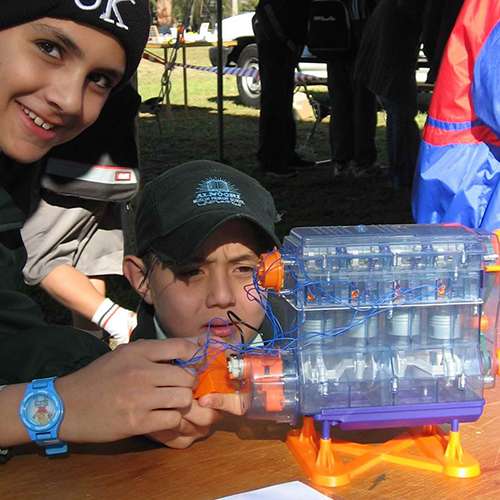
- Measure that motor! – How much greenhouse gas is produced by cars?
- Ozone depletion – Make a phosphorescent screen glow with UV light
- Radiometer – Energy in the palm of your hand. How does it work?
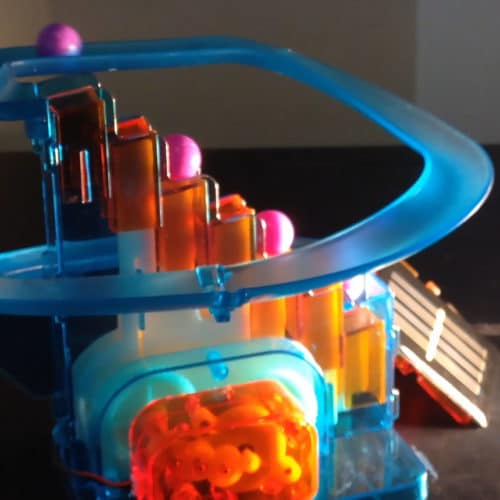
- Storing Energy – Can you guess which car will win the race?
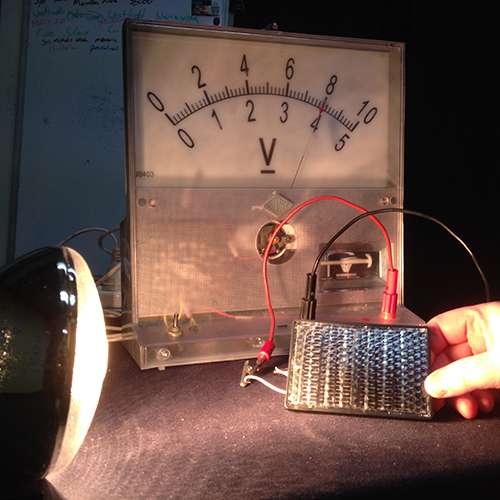
- Solar Power – Convert light energy into kinetic energy with these solar toys.
- The greenhouse effect – Do we really need it? Is it getting hot in here?
- Wind turbine – Windy days can blow you away!

Australian Curriculum Mapping
Australian National Curriculum Mapping for all our science incursions
Australian ACARA Content Outcomes:
Science F-10 Version 9.0
Year 7 & 8
- explain how new evidence or different perspectives can lead to changes in scientific knowledge
AC9S7H01 AC9S8H01 - examine how proposed scientific responses to contemporary issues may impact on society and explore ethical, environmental, social and economic considerations AC9S7H03 AC9S8H03
- develop investigable questions, reasoned predictions and hypotheses to explore scientific models, identify patterns and test relationships AC9S7I01 AC9S8I01
- analyse data and information to describe patterns, trends and relationships and identify anomalies AC9S7I05 AC9S8I05
- construct evidence-based arguments to support conclusions or evaluate claims and consider any ethical issues and cultural protocols associated with using or citing secondary data or information AC9S7I07 AC9S8I07
Year 9 & 10
- explain how scientific knowledge is validated and refined, including the role of publication and peer review
AC9S9H01 AC9S10H01 - Investigate how advances in technologies enable advances in science, and how science has contributed to developments in technologies and engineering AC9S9H02 AC9S10H02
- develop investigable questions, reasoned predictions and hypotheses to test relationships and develop explanatory models AC9S9I01 AC9S10I01
- analyse and connect a variety of data and information to identify and explain patterns, trends, relationships and anomalies AC9S9I05 AC9S10I05
- construct arguments based on analysis of a variety of evidence to support conclusions or evaluate claims, and consider any ethical issues and cultural protocols associated with accessing, using or citing secondary data or information AC9S9I07 AC9S10I07
Australian National Curriculum Mapping for all our science workshops & shows

NSW K-10 Science Syllabus Mapping
NSW Science 7–10 Syllabus (2023)
Stage 4
A student:
- identifies questions and makes predictions to guide scientific investigations SC4-WS-02
– Identify questions and problems that can be investigated scientifically
– Make predictions based on scientific knowledge and observations
Stage 5
- asks questions or makes predictions using observations SCLS-WS-02
– Ask questions about familiar objects and events based on observations
– Make predictions based on observations - evaluates current and alternative energy use based on ethical and sustainability considerations SC5-EGY-01
– Conduct an investigation to compare the energy transformed over time in model circuits or appliances
– Evaluate ways to optimise current energy use
– Examine data to identify past trends in energy use, and predict possible future demands, at a state, national and global level
– Explain reasons for the development of alternative sources of energy
– Use data, evidence and research to evaluate the development of alternative energy sources to meet and reduce global energy demand - analyses the impact of human activity on the natural world SC5-ENV-01
– Identify the principles and goals of sustainability
– Apply scientific understanding to propose valid solutions to identified problems relating to sustainability
– Explain how the natural greenhouse effect influences global climate
– Analyse data on global emissions and atmospheric temperatures to explain the enhanced greenhouse effect and its impact on climate and ecosystems
– Identify the advantages and limitations of methods used to reduce greenhouse gas emissions
– Analyse data that shows the relationship between industrialisation and the rise in global temperatures
– Identify the characteristics of climate change
– Investigate and report on the consequences of climate change

VIC Science Syllabus Content
VIC Curriculum F–10 Version 2.0
For explanatory points & implementation advice for each dot point, please visit the VIC Curriculum F-10 site.
Levels 7 and 8
- the sustainable use of Earth’s resources is influenced by whether the resources are renewable or non-renewable; the processes involved in resource extraction and energy production come with both benefits and risks to sustainability. VC2S8U09
- electrical circuits transfer energy when current flows and can be designed for diverse purposes using different components; the operation of circuits can be explained using the concepts of voltage and current. VC2S8U17
- investigable questions, reasoned predictions and hypotheses can be developed in guiding investigations to identify patterns, test relationships and analyse and evaluate scientific models. VC2S8I01
- scientific methods, conclusions and claims can be analysed to identify assumptions, possible sources of error, conflicting evidence and unanswered questions. VC2S8I06
- evidence-based arguments can be constructed to support conclusions or evaluate claims, including consideration of ethical issues and protocols associated with using or citing secondary data or information. VC2S8I07
Levels 9 & 10
- electricity can be generated as alternating current (AC) using magnets (via turbines turned by wind, water, tides or steam that is generated by the combustion of oil, gas or coal or by nuclear energy) or as direct current (DC) using photovoltaic cells or batteries. VC2S10U16
- carbon is cycled on Earth through key processes including photosynthesis, respiration, fire, weathering, vulcanism and the combustion of fossil fuels; these processes change the composition of Earth’s interrelated systems (atmosphere, biosphere, hydrosphere and lithosphere) over time. VC2S10U10
- the dynamics of global climate change can be modelled and explained by examining the interactions between greenhouse gas emissions and energy exchanges within and between Earth’s systems; mitigating human-induced climate change requires addressing various activities including power generation, deforestation, manufacturing, transportation, food production and resource consumption. VC2S10U11
- investigable questions, reasoned predictions and hypotheses can be used in guiding investigations to test and develop explanatory models and relationships. VC2S10I01
- the validity and reproducibility of investigation methods and the validity of conclusions and claims can be evaluated, including by identifying assumptions, conflicting evidence, biases that may influence observations and conclusions, sources of error and areas of uncertainty. VC2S10I06
- arguments based on a variety of evidence can be constructed to support conclusions or evaluate claims, including consideration of any ethical issues and cultural protocols associated with accessing, using or citing secondary data or information. VC2S10I07
Requirements
- Appropriate for Years 7 to 10 with a maximum of 30 students per class
- Access to 3 electrical power sockets and 7 tables. Chairs are not required.
- Duration 30 – 60 minutes, set up time 45 minutes and pack up time 45 minutes






