Transcript
[00:00:00] Announcer: You’re listening to the Fizzics Ed Podcast. For hundreds of ideas, free experiments and more, go to fizzicseducation.com.au. And now, here’s your host, Ben Newsome.
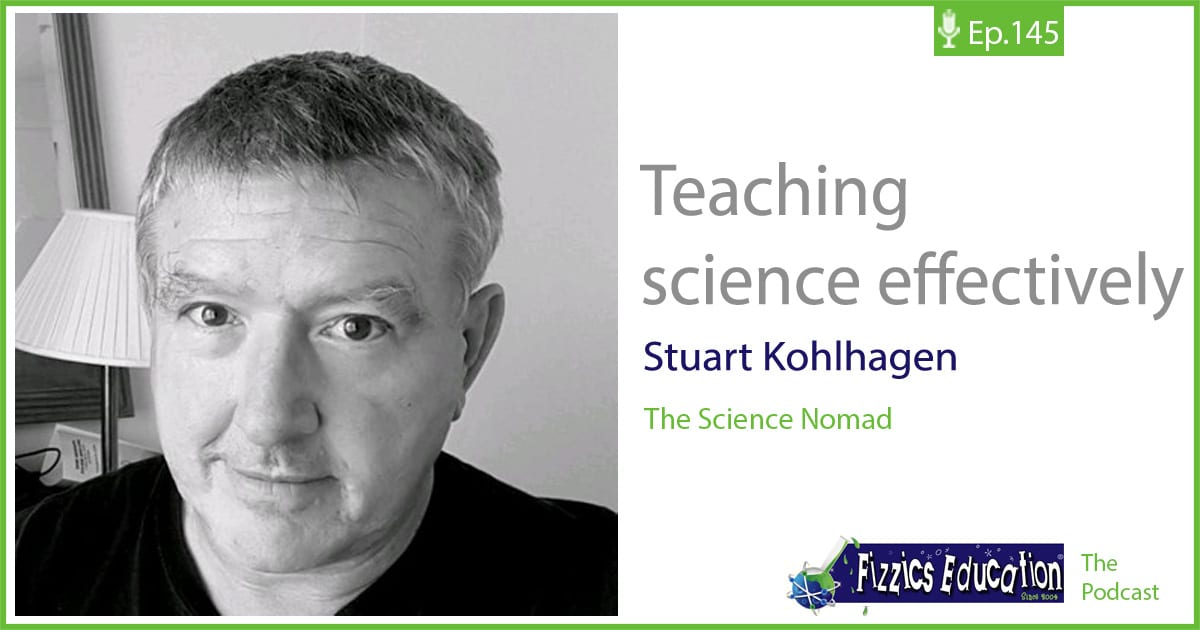
[00:00:18] Ben Newsome: Yes, welcome again for another Fizzics Ed Podcast. Glad to have you again for another chatter around STEM, and in this particular case, we’re hanging out with someone who really knows how to make science inquiry happen. Stuart Kohlhagen is well known as the Science Nomad. And for the last 35 years he’s been working in science inquiry in many, many different ways, having previously worked as the Director of Science and Learning at Questacon, Australia’s National Science and Technology Centre.
[00:00:43] Ben Newsome: However, recently he’s been working in many, many schools right across the world in South Africa, Indonesia, Korea, Brunei, Vietnam, Thailand, you name it. He has been working with science centre staff, science educators, many places where you can really get science inquiry to happen, and more importantly, using simple materials. We’re going to hang out and learn just how he thinks, and how we should be thinking when we’re teaching science. Let’s head right into it.
[00:01:08] Announcer: This is the Fizzics Ed Podcast. We’re all about science, EdTech and more. To see 100 fun free experiments you can do with your class, go to fizzicseducation.com.au. That’s physics spelt F-I-double-Z-I-C-S, and click 100 free experiments.
[00:01:26] Dr Stuart Kohlhagen: Well, obviously the most important thing to start with is I’m very old. So, I’ve had a chance to do quite a few things, but really I’ve only kind of done two things, three things maybe in my life. Certainly went through university and did the science degree PhD stream. But while I was doing that, at exactly the same time, I was also working with the founding director of Questacon at that stage, a community-run, volunteer-based science centre here in Canberra.
[00:01:56] Dr Stuart Kohlhagen: Which over eight years grew from a small community project to the point where, at Australia’s bicentennial, the Japanese government joined with the Australian government and kind of waved the magic wand and we got transformed from a community-run science centre to the National Science and Technology Centre based here in Canberra. The National Science and Technology Centre operates as Questacon, which pretty much everyone in Australia will have heard of.
[00:02:22] Dr Stuart Kohlhagen: So, I worked with Mike Gore, the founding director there, and segued from my academic studies into the role as exhibit designer. So Questacon is a fully hands-on, participative, learn-by-doing science centre. It’s not a collecting science museum. And so I cut my teeth for eight years during the foundation of Questacon, us finding out what interactive learning was, and it was not theory-based stuff. We were practitioner-learners at that stage.
[00:03:06] Dr Stuart Kohlhagen: And the exhibits in the small disused school became so popular that at some stage we had to try and get people off the floor, so we started doing science shows. And Mike Gore was a gifted thespian as well as a physicist, and so he started doing science shows and I was the first of the younger volunteers at that stage, that’s how long ago it was, started joining in, picking up his shows, developing new shows.
[00:03:34] Dr Stuart Kohlhagen: Probably one of the greatest insights that Mike had as a founder of this project was not to be arrogant. And even when we became the National Science Centre, that was just the headquarters. And two-thirds, three-quarters of the work that we’ve always done has always been outreach. Has been work out from the main building. We don’t expect everyone can or should or needs to come to the big shiny white building in Canberra. So outreach and engagement has always been part of our practice and part of our DNA literally from the get-go.
[00:04:11] Dr Stuart Kohlhagen: And so while I started work as the first exhibit designer and spent much of my first decades at Questacon helping design and develop and prototype and think about exhibitions and individual exhibits, later, even someone like me inevitably gets eventually promoted. So I was put in charge then of eventually, as Director of Science and Learning, was also put in charge of our outreach and education programmes.
[00:04:45] Dr Stuart Kohlhagen: For kind of the last decade of my time at Questacon, I was working very actively with the great team that we had at Questacon, working with universities and other research organisations just to pull the two together. For a lot of that early time as Questacon, we wanted, we needed to present ourselves as we’re not school, we’re something different, and that’s true. But that kind of also made us think that there was kind of a significant air gap between formal schooling and informal learning, which really there isn’t.
[00:05:28] Dr Stuart Kohlhagen: So, I understand and was part of going, no, we’re different to school, and we certainly were and are. But during that last 10 years of working at Questacon, because of my academic or university training and my position there, I got to work as one of the investigators on a number of very interesting projects that Questacon was an industry partner on ARC research grant projects.
[00:05:58] Dr Stuart Kohlhagen: One of those was working with something which is called the Science of Learning project, which is about four or five universities. That brought together neuropsych, brain imaging folk, educational practitioners and theorists, and behavioural cognitive scientists, and brought all of these together in sort of a multi-university, multi-year research programme to try and understand not the teaching of science, but the science of how learning happens.
[00:06:33] Dr Stuart Kohlhagen: And they were interested in working with Questacon because in terms of research and school, we’re kind of a very fluid learning environment. We try lots of things, and this is common for those of us in informal education. We’ll try things. We’ve got freedoms that a curriculum-bound school doesn’t have. So we tend to think about what’s going to work, not what does the curriculum tell me I should be talking about today. So we can innovate, we can try things, we can prototype, we can fail, we can adjust. It’s a more fluid environment to look at learning in, which is one of the things the Science of Learning research group were particularly keen to be working with us because of that characteristic that we had.
[00:07:26] Dr Stuart Kohlhagen: That was where I was talking in my usual bumbling fashion about the importance and the passion I had for hands-on learning and how I saw it was great and valuable. This is someone who was formally trained as a biochemist and studied parasites, talking about the brain and learning. And the psych guy that I was talking to on this day was sort of nodding along and going, “Oh, you feel the same way? That’s good.” He said, “Yeah, yeah, that’s all called embodied cognition.” And I’m going, “There’s a word for this?” And it was just one of those things which I was expecting to contribute and to learn a lot from the programme, but just that gateway that those connections had into a universe of research into how learning happens.
[00:08:21] Dr Stuart Kohlhagen: And it wasn’t just us practitioners’ trial and error intuition that we were doing. Lots of this stuff gets studied, you should get across it. And that process, which kind of started 10, 15 years ago, sort of gave me a lot of confidence in not me just feeling what we’re doing looked good. Through that process, I also got to understand just how it’s good, and which bits of it are powerful and why. And so it’s not just I reckon, it’s me and a couple of thousand cognitive research scientists also reckon that there is power in engagement, there is power in curiosity. It is significant and it’s deep and it’s real.
[00:09:17] Dr Stuart Kohlhagen: And that was one of the things which has given me a lot of courage and comfort, I guess, once I’d left Questacon and with my contacts and interest in helping those people that I could help. It wasn’t just, “Oh, I think this will be fun, they’ll enjoy it, I’ll enjoy it, that’s a good thing.” I was able to feel I had backing and grounding in research that supported these methodologies. One of the other big projects that I worked on was ELSA, Early Learning STEM Australia, that was run out of the University of Canberra.
[00:10:00] Dr Stuart Kohlhagen: I worked on that project for a while helping develop materials and learning apps that instructed people to get off the app and go into the real world and do some observations and be real, so curated and managed and supported through the app. But that was a process working with the researchers at SERC, the Science Education Research Centre in University of Canberra. Helping develop that programme again gave me that connection with the researchers that really didn’t quite blow my mind, but gosh, it was a candy store of great corroboration, not only collaboration, but corroboration of these things really work and there is a science behind some of it.
[00:11:00] Dr Stuart Kohlhagen: And that kind of crystallised into an approach that I’ve been using since I’ve left Questacon and started the Science Nomad project, which is really looking at impact. Looking at impact: how do you make a difference? I have a number of t-shirts and one of them says, “Activity is easy, impact takes planning.” And that’s one of the big parts of my process. I’m not saying that the other informal educators and SciComm communicators don’t also think that way, but for me it’s become as formal as I get on anything, which is not very.
[00:11:51] Dr Stuart Kohlhagen: That’s become a very structured part of my process of, before I start a project, what are the outcomes? What do I want to achieve? What’s achievable? I’m pretty tough on myself when I work sometimes training other mentees and doing occasional seminars in universities, I’m pretty tough on other SciCommers about that. Don’t use the word awareness in my presence. You’re allowed to, but I start that way: don’t talk to me about awareness. Awareness is nothing. I’m not interested in awareness. And that can be a little shocking for some people.
[00:12:32] Dr Stuart Kohlhagen: They go, “Oh no, but we want to get somewhere big and we want to change the planet, so people aren’t behaving the right way.” It’s this idea that if I give you enough knowledge or awareness about this, then you’ll change. And sometimes I’m giving these lectures to academics or having discussions with universities that are doing teacher training, for example, because I very much like to work in those places which I see are points of influence. There’s just one of me, largely self-funded, and so if I’m going to do some work, I’d like it to have a legacy.
[00:13:17] Dr Stuart Kohlhagen: So choosing projects where I can hope to have an influence, a positive influence and leave a legacy, are the ones which I cherry-pick because I’m at that stage of life now where I don’t have to do this, I choose to do this, so I choose the projects where I can have some impact. So I’ll often work with teacher training universities, student teachers, more than working directly with students. As I said before we started, I’m just back from the Balkans, and there, in Serbia for example, I think smoking is almost mandated. It’s very prevalent.
[00:14:11] Dr Stuart Kohlhagen: And so if I’m having a chat to people about awareness and impact, I go, “So how many people here are aware that smoking’s bad?” And of course everyone will put their hand up, pretty much 99.9%. I go, “Who here smokes or knows someone that smokes?” Same number of hands are up there. And so I just leave that there to go, “So that’s awareness.” And so if you are stating that you are doing your STEM engagement because you want students to do better at this or choose different careers or go further, then awareness, and this comes from the Science of Learning and behavioural change theory, awareness is not the powerful magic wand that we would hope it is.
[00:15:00] Dr Stuart Kohlhagen: There are barriers that are going to stop awareness progressing to behaviour change. And that’s the stuff that I look at, is going, “Okay, I’m going to come in, I can get them engaged.” Most of us can do that, and most of us do a really good job on that. And we get them from point A to point B, we get them excited, and then for most of us running our programmes, we disengage, either completely or mostly, and often for a very long time. If I was using blunt language, we kind of abandon them at that point.
[00:15:37] Dr Stuart Kohlhagen: And so, okay, we’ve got them excited. Where do they go after you stop, I stop working with them? What happens next week that’s different? And if it’s just awareness, that could in fact be a negative. They’re now aware of just how bad their school is, how crap their educational experience has been to date, and how good it could be, but it’s not. And for the next three years they don’t see your programme, they don’t see my programme, they don’t see any programmes, but they’re aware that things could be much better. And I’m going, that doesn’t feel like a great outcome.
[00:16:17] Dr Stuart Kohlhagen: That’s as plausible as a narrative going, “Oh, the kids were really excited about that and they committed to going on to become astrophysicists.” If they’re going to go somewhere, you don’t have to carry them all the way. Your project can’t and doesn’t have to walk with them all the way, but if you can’t give them a tangible next place to go, next thing to do, next person to connect with, if you can’t do that, there’s probably no chance that they’ll find that connection. And so it’s looking at, “I’m going to get you, I’m going to wake you up, I’m going to get you curious about stuff, and now as I leave, what have I done? Even a little thing, what have I done?”
[00:17:01] Dr Stuart Kohlhagen: Do I leave you with a multimeter? Do I leave you with a box of dice? In some of the schools I go to, if I leave them with pen and paper, that’s a big enabler for them to continue doing what I’ve done with them. That’s again one of the reasons I love to use, as I say, humble materials. Very humble materials, because when I leave, they’ve got at least a chance of accessing those materials and continuing that experience. So if I visit and show some great robots, they’ll have a wonderful day, and then when I take the robots away, they’re just disappointed for the rest of the year.
[00:17:46] Ben Newsome: 100%. I love the word enabling honestly, and frankly the iterative approach that you’ve gone into. It’s the way it should work really. I mean as you were describing the humble side of resources, I was just thinking of a previous episode we’re talking with Godwin Morris who does Engineering with Paper, and there’s a lot of these programmes out, but paper is so ubiquitous. It’s everywhere and so simple, and the fact that you can actually make simple machines out of this stuff, you can make something that’s rather complex actually if you start putting these machines together, that’s fantastic.
[00:18:18] Ben Newsome: And I think the idea of you looking at the enablement side, not the awareness side, is frankly useful. It really is. I mean, and I imagine this transcends cultures. So you were in Thailand, you’re in the Balkans and whatnot. Everyone wants to be able to go, “Right, I’ve got this knowledge, now what?” And without the “now what,” we’re not going anywhere.
[00:18:35] Dr Stuart Kohlhagen: Yeah. So, one of the benefits of hands-on learning, hands-on engagement as our community practices it, one of the benefits is the more hands-on it is, the less time you have to spend talking. In fact, that’s the worst thing to be doing. You need to talk enough to get them started, and then as hard as it is, shut up.
[00:19:06] Ben Newsome: Yes, 100%. I was at a regional council holiday programme, because hey, this is what we do, we do outreach. And I was having a chat with one of the librarians there and she asked, “So is it working?” I said, “It is because we’re having this chat.” It literally is the main thing.
[00:19:21] Dr Stuart Kohlhagen: Exactly, exactly. So for me, the two big pillars of my approach and I guess what I focus on is, “Okay, where have I got you ready to go next, and have I done what I can to remove the barriers or get you connected?” And I spend a lot of time designing the project and spending time to get to understand the community that I’m going to work with as much as I can to go, “Okay, what’s your situation? You say you want to do STEM. Why are you doing that? What do you think STEM is? What have you done in the past? Why isn’t that working?” So it’s trying to identify the barriers.
[00:20:00] Dr Stuart Kohlhagen: And with a lot of school systems, you get 80% the same answers. The curriculum is either bad and busy, the teachers are ill-prepared or ill-resourced, the students and the teachers and the parents are all focusing on exam results, so the school is locked into that kind of mode. So you turn up, it’s a happy day, a happy afternoon, but they don’t see that there’s a lot of scope to integrate what you’ve done. It was just a reward for the kids behaving well that week, and the ones that misbehaved didn’t get to the gig. And that’s a reality. Now, I’m not happy that many school systems around the world still operate like that, but one of me is not going to change that quickly.
[00:20:52] Dr Stuart Kohlhagen: And so I will work with the teachers then to go, “Okay, so you’ve seen some of the stuff I’m doing and the way, not only what I do but how I do it.” Also very much kind of works backwards. I’m dyslexic, which means doing things backwards for me is absolutely a natural thing to do. And so a lot of demonstrations, and I did them for 20, 30 years, you’ll get up there going, “Hi, this is what this is, I’m explaining what this is, we’re going to show you what this is, and this will behave in a surprising way, and that will prove that what I said was happening is happening, and now I’ve done some teaching or you’ve done some learning.”
[00:21:38] Dr Stuart Kohlhagen: And it was fun and a little bit surprising. Now, that’s all good, but at the top of just about every curriculum document in every country in the world, the top-level stuff is we want to prepare our students to be problem solvers, critical thinking, ready for a changing dynamic world. And then the science class is, “How do you clean the microscope slides and put the microscopes away at the end of the lesson?”
[00:22:04] Dr Stuart Kohlhagen: And these things are just disconnected in a horrible, dramatic fashion. Those things just don’t turn up. And look, that’s not the teacher’s fault per se, but they just haven’t been shown ways in which you can bring problem solving and critical thinking. Everyone goes, “Oh, they’ll do that later,” but that’s the wrong point. You should be starting with that as much as all the core content. It should be all together.
[00:22:32] Dr Stuart Kohlhagen: So, my approach, talking about is it working, you and I can tell it’s working because there’s a buzz in the room and everyone’s focused and talking about what’s in front of them, not checking their phones, not trying to leave. We know that it’s working, the magic’s happening, and we can stand back from it. And so I will be quite demanding, quite focused on asking questions. I might be showing things, but asking questions, and I will often, depends on the group and the teacher and the subject, I may or may not ever give an answer.
[00:23:13] Dr Stuart Kohlhagen: Which for some students literally blows their mind. I had a group of four young Indian girls that attended a presentation that I was doing. And I sort of said, “As my gift to you, I’m not going to explain this.” And they were as polite and engaged and as passionate as anyone I’ve ever had. But all four of them in unison screamed, “But sir, you have to, it’s your job!”
[00:23:38] Dr Stuart Kohlhagen: And I then sort of, it didn’t surprise me, it was a great opportunity for me to then really explain. I’m not explaining it to you because the answer is not important. Your comfort with persisting and thinking and solving problems is the important thing. So if I give you the answer, I actually take away the gift of that learning.
[00:24:01] Dr Stuart Kohlhagen: And they thought about it for a while and they accepted it. And I was doing that same brutal introduction to, “Here is something which is curious and simple in terms of materials, but a real puzzle for your brain and I’ll let you stew on it for a week or so.” And one of the heads of the schools came in whilst I was in Thailand. And we got to the point I’d already given the girls, this was a girls-at-risk school in Thailand run by Buddhist nuns, and they’d never done any STEM at all and very little science.
[00:24:32] Dr Stuart Kohlhagen: So I got them to collect all the broken office equipment from the school and said, “Before we start anything, here are the tools, we’re going to strip all this stuff down.” So we were taking apart computers, we were getting out motors, we were dissecting DVD drives. They were getting comfortable with tools, they were seeing how things went together. This is new for them. And whilst they’re doing that, I’m going, “Oh, that’s a different kind of motor, that one’s really hard to use, this one’s a simple motor like the one in the toy cars that we’ve got over here.”
[00:25:01] Dr Stuart Kohlhagen: And then after about three days of that, the head of the school was with me and I just dropped these unassembled loose parts of some robot kits that I bought, because I couldn’t avoid them at some point making some robots. I sort of popped them on the table and through my translator sort of said, “Okay, you need to put these together.” And the head of the school said, “Alright, I’d better let you go so you can give them the instructions to get this put together.” I said, “No, no, they’re good.”
[00:25:27] Dr Stuart Kohlhagen: And five minutes later, all of the tables, all of the groups, and I work with teachers and students at the same time often in Southeast Asia because it’s good for both just to learn together and to see each other. The head of the school’s jaw just continued to drop and drop and drop as these kids and teachers who’d never done anything like this, successfully without instructions, assembled and got their robots put together. And she just couldn’t believe that they were doing it. And I’m going, “That’s what you get when you get them comfortable solving problems for that.”
[00:26:04] Dr Stuart Kohlhagen: So there are strategies to get these kind of 21st-century skills integrated into the current curricula as teachers feel they have to teach it. And it’s more a question about the approach, not the topics.
[00:26:18] Ben Newsome: Yeah, I mean I was actually thinking about throughout that it’s extrinsic versus intrinsic. Like what is your motivation? Are you going to be involved in this? I mean, if I want to learn for example, we’re on a podcast, right? I had no idea how to do podcasts a couple of years ago. No idea whatsoever. But I knew I wanted to chat with people and I was actually on a mission to be able to solve a teacher’s problem who was saying, “Hey, I’d love to hear from people. That’d be really cool if you could record said conversations.”
[00:26:41] Ben Newsome: I didn’t know how to do it, but I did have motivation to learn it, and so that’s how that works.
[00:26:48] Dr Stuart Kohlhagen: And that’s what STEM is. You know, that’s why STEM started was because people that were intrinsically motivated don’t know where they’re going, they’re trying to solve a problem. Picking up the skills and the knowledge to solve the problem is acceptable to them. They get persistence, they get resilience, they get that motivation, they get retention because it’s their problem.
[00:27:14] Dr Stuart Kohlhagen: And one of the issues with how some STEM, not a lot, some STEM, is introduced, particularly in some countries, and it’s more of a problem with the more money you have probably the worse it’s done, is they’ll go, “Oh, it must be 3D printing and a laser printer.” And you’re going, it’s not the tools, it’s the approach. And so you get a pre-assembled line-following robot and after 10 minutes of getting it to follow the line, you’re pretty much bored with it if you’re not careful.
[00:27:43] Dr Stuart Kohlhagen: Because again, it’s not your problem, it’s not your robot. You know, “What else can I get to do with this?” So we had a day in Thailand where I called it “Ugly Robots.” And so we just used the motors out of the DVD drives and cardboard from some cardboard boxes, and they didn’t work very well, but they made them. And if they wanted to change them, they’d just get out the knife and cut it up and start doing again, which is the skills that we want to see, not “I can unbox something and power it up.”
[00:28:17] Ben Newsome: Well that’s exactly right. I mean you speak with a lot of people in the startup community. I mean austerity produces elegance. I mean you have to. I mean you cannot… Okay, yes you can buy if you’ve got massive deep pockets, of course you’re going to be able to buy the things that might solve your problem. But if that’s all you know, if it doesn’t come out of the box you’re in trouble.
[00:28:38] Dr Stuart Kohlhagen: Yeah, exactly. And nothing and none of the really transformative things are going to come out of the box because they’re already here. Someone else has unboxed them.
[00:28:46] Ben Newsome: Well that’s right. I mean by definition it doesn’t exist yet.
[00:28:48] Dr Stuart Kohlhagen: Exactly, exactly. So there’s a lot which can be done when you just sort of come back and you think about… Where do I want to get these people to? What’s realistic in the time and with my skills and within their circumstances? What’s realistic? But what’s a real change that’s possible? What are the barriers to that? And what can I do to minimise the barriers and maximise the chance?
[00:29:13] Dr Stuart Kohlhagen: So when I’m doing a something which you might loosely call professional development with teachers, I don’t just show them, “Oh, here are some interesting things to do.” If at all possible, even on Zoom sessions, I can come back a week later, which is one of the benefits of Zooming in. Visiting is cheap. And I can sort of say to them going, “Alright, I’ve shown you this. Tomorrow I want you to tell me which of these activities you’re going to use in a class. And in a week’s time, I want you to come back and just give me five minutes on how it went.”
[00:29:42] Dr Stuart Kohlhagen: Because everything I do is aimed to going, “I’m going to get you excited, motivated, show you a new way of doing it.” I may get you to do it with some of the other students in the group that I’m working with during the professional development, but I want you to try it in class. And more than that, I will almost insist, I will design the process so part of it means you doing it in class.
[00:30:00] Dr Stuart Kohlhagen: Because it’s well known to all of us, you go to a PD session, if you don’t apply it next week, you’re unlikely to apply it next month, and if you haven’t done it next month you ain’t ever going to do it. So with that kind of development stuff, getting it connected so they’ve actually tried it as part of your engagement with them, it doesn’t have to be on the day, but as part of that engagement, is one of the things which gets it happening. And that’s why we try to do this stuff.
[00:30:30] Ben Newsome: So I’d love to know, so you’re bouncing around the world, and what a great way to do early retirement by the way. Fantastic. But apart from seeing the world and changing hearts and minds, you can’t be everywhere. You just can’t. And so people listening into this may have to apply said ideas without having ever met you or seen a recording or anything. So imagine those groups of people, those cohorts that exist out there, and you had to give just some simple words of wisdom or advice to start creating the actual top-line problem solvers that these curricula tell us about in the first place. What would be the initial steps that you’d suggest, irrespective of budget?
[00:31:12] Dr Stuart Kohlhagen: Yeah, look, and budget, too much budget is a problem. It’s easier to have impact with less money with that. Simple advice, problem solving: show them the phenomena and ask questions. Stop telling them things, start asking them things. And for many of us which come from education backgrounds, our deepest mental model of what helping someone learn looks like is someone telling you the facts. That’s what teaching is.
[00:31:44] Dr Stuart Kohlhagen: And that’s how the teachers have been taught to teach often. And that’s certainly how they were taught at school. That’s the mental model. And it’s really hard to learn to pose the question and have an awkward silence. And that’s one of the things, the kids learn in classes, there’s a whole lot of peer pressure, we understand all that. “I’m not going to answer the question because I might get it wrong and look stupid.” And the teacher doesn’t want that awkward silence either and so they step in and will give you the answer.
[00:32:19] Dr Stuart Kohlhagen: And that kind of stops the thinking process. So for me, break them up into small groups, ask them questions. So in the smaller groups they can have those conversations, it’s less vulnerable, they feel less vulnerable. Create the safe space, ask the questions, keep emphasising it’s about the process, it’s not about the answer. And every idea is a good idea. And when they come back with, “Oh, maybe it’s this?” going, “Yeah, so how could we test that idea?” Not “That’s not it, has anyone else got the right idea?”
[00:32:48] Dr Stuart Kohlhagen: And it feels like, “I don’t have time to teach like that.” And going, you can do this stuff, you can provoke this sort of thinking in five minutes. And doing five minutes of that a week is at least five minutes in an experience that many of these kids that I work with have never had in their entire schooling life. And so that can be powerful, even that can be powerful.
[00:33:09] Dr Stuart Kohlhagen: And one of the things which the Science of Learning, it’s a bit of fortunate perverse brain science, is if I get you curious about something through one of those processes, you’re going to retain boring information given to you with direct instruction afterwards better. And it doesn’t have to be on the same subject. So I can get you puzzling and thinking about anything for five minutes at the start of the day, we’ve got research science that shows that you’re going to retain the boring stuff that comes after that better.
[00:33:45] Dr Stuart Kohlhagen: And again, this is one of the things which gives me confidence in going, “No, keep them curious, keep them sweating a little bit, keep them asking questions,” because that really means when they do get to an answer, they’re actually going to both understand the process, the real scientific process of how you ask questions and solve them, and will remember the answer at the end of it. And so you can do that in five minutes.
[00:34:08] Ben Newsome: Oh, fantastic. And I suppose there’ll be people going, “No, I’m not going to sort this out completely by myself, I’d love to have Stuart on board, I’d love to have him come out.” How would they get in touch with you to do that?
[00:34:20] Dr Stuart Kohlhagen: Look, easiest find me in the socials. Twitter, Facebook, just look for Science Nomad. Or if anyone wants to kind of follow up on any of the particular details, they can just send me an email at [email protected]. So thesciencenomad one word. But happy anyone sort of follows me on Facebook, I’m very open source. The stuff I do I share on there, and happy to get people looking and trying and feeding me ideas. We’re all here to learn.
[00:34:53] Ben Newsome: Absolutely. And as usual we’ll have this all on the show notes as well, so click away, go find out more. Look, thank you very much Stuart for hanging out. You’ve got a bike ride or something coming up if I remember.
[00:35:02] Dr Stuart Kohlhagen: Indeed, this weekend I’m doing something slightly perverse, I’m driving 3000 kilometres to go and cycle 1000 kilometres over on the Munda Biddi Trail over in Western Australia. So up through the jarrah and tuart forests over there for a few weeks.
[00:35:17] Ben Newsome: Oh, fantastic. Well, enjoy that.
[00:35:19] Dr Stuart Kohlhagen: I shall.
[00:35:21] Ben Newsome: Oh, much appreciated. It was awesome hanging out with you.
[00:35:23] Dr Stuart Kohlhagen: Great. Great to talk with you, Ben. All the best to everyone.
[00:35:27] Announcer: We hope you’ve been enjoying the Fizzics Ed Podcast. We love making science make sense. Why don’t you book us for a science show or a workshop in your school? If you’re outside of Australia, you can connect with us via a virtual excursion. See our website for more.
[00:35:44] Ben Newsome: Well, there we go. We just heard from Dr Stuart Kohlhagen, who really loves his STEM inquiry and importantly, making it accessible in many, many ways. So it is well worth hitting up Stuart Kohlhagen through the social media things. Type in The Science Nomad. I guarantee you’ll find him. And you’ll be able to reach out and work out how can you work with him to really make science work in your particular area, no matter where you are. So that is the end of this particular episode, all about STEM inquiry. And yet again, you’ve been listening to me, Ben Newsome at Fizzics Education. I hope you’ve been enjoying the Fizzics Ed Podcast and I’ll catch you another time.
[00:36:23] Announcer: You’ve been listening to another Fizzics Ed Podcast. We’re excited about science. Subscribe to us on iTunes to download the next episode as soon as it’s released. And don’t forget, for hundreds of ideas, free experiments, our new Be Amazing book and more, go to fizzicseducation.com.au. That’s physics spelt F-I-double-Z-I-C-S.
[00:36:49] Announcer: This podcast is part of the Australian Educators Online Network, aeon.net.au.
Frequently Asked Questions
What is ’embodied cognition’ in the context of science learning?
Embodied cognition is a concept from cognitive science suggesting that learning is deeply linked to physical actions and sensory experiences. In science education, this validates the power of hands-on engagement; when students physically interact with phenomena, they build deeper mental models and are more likely to retain complex information.
Why does Stuart Kohlhagen advocate for using ‘humble materials’ in STEM?
Stuart emphasises the use of humble materials—like cardboard, paper, or salvaged electronics—because they are accessible. High-tech tools can create barriers; if a student only learns with expensive robots, the learning often stops once they leave the classroom. Using everyday items ensures students can continue their enquiry at home independently.
Why is ‘awareness’ considered insufficient for educational impact?
Awareness alone rarely leads to behaviour change. Stuart uses the example of smoking: many people are aware of the risks but continue to smoke. In STEM, simply making a student ‘aware’ of a concept isn’t enough; educators must provide a tangible next step or a connection that enables them to apply that knowledge and change their practice.
How can teachers encourage problem-solving without giving away the answers?
The key is to pose curious questions and then embrace the ‘awkward silence’ that follows. By refusing to provide the answer immediately, teachers give students the ‘gift’ of solving the problem themselves. This builds persistence and resilience, shifting the focus from memorising facts to understanding the scientific process.
What is the benefit of starting a lesson with a five-minute enquiry puzzle?
Research into the Science of Learning shows that piquing a student’s curiosity at the start of a session primes the brain for learning. Even if the following instruction is more traditional or ‘boring’, students are statistically more likely to retain that information if their brains were activated by a puzzling phenomenon first.
Extra thought ideas to consider
The ‘Ugly Robots’ Philosophy
Consider the value of ‘Ugly Robots’—machines built from salvaged parts like DVD drive motors and scrap cardboard. Unlike pre-assembled kits that work perfectly out of the box, these creations require students to troubleshoot, iterate, and truly understand the mechanics and electronics involved. This ‘austerity’ often leads to more elegant and deeply understood solutions.
The Legacy of Outreach
Activity is easy, but impact takes planning. When designing a science intervention, educators should consider what happens ‘next week’. Without a clear pathway or leaving behind the tools for continued exploration, even the most exciting science show can lead to long-term disappointment rather than a sustained interest in STEM.
Discussion points summarised from the FizzicsEd Podcast, verified and edited by Ben Newsome CF