
Ocean in a bottle activity
Model an ocean in a bottle with this classic science activity for kids. Easy to setup and mesmerizing! Part of >150 free science experiments.
Adult supervision for setup
You will need
- Vegetable oil
- Water
- A clear bottle with a screw-top lid
- Blue food colouring
- A funnel
- Paper towels for any spills
Method
-
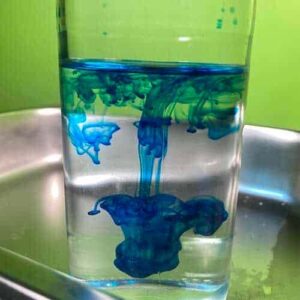
Fill the bottle halfway with water. Add some blue food colouring into the water.
NB: Notice how the food colouring drops through the water? This is because food colouring is denser than water. Density drives ocean currents around the world, here’s another science activity that explores this further.
-
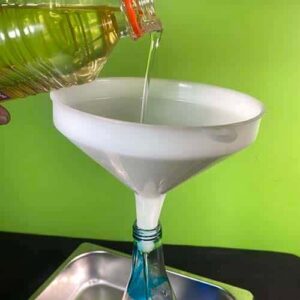
Insert a funnel into the bottle and place this into the tray to catch any spillage. Carefully add the vegetable oil into the bottle so that it fills the bottle up to the very top without spilling.
-
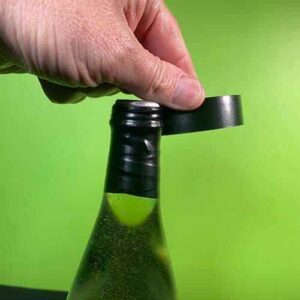
Screw the lid tightly onto the bottle. Seal the bottle with tape… you don’t want any oil spills!
-
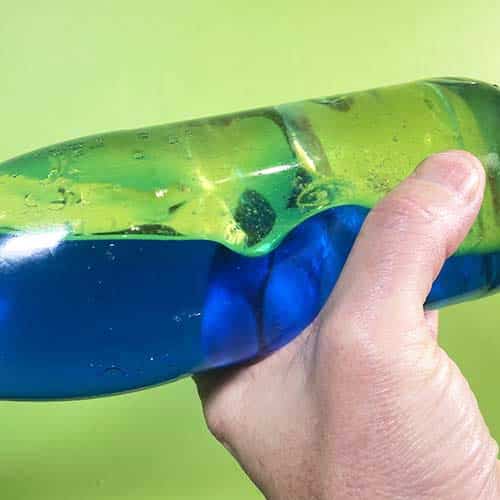
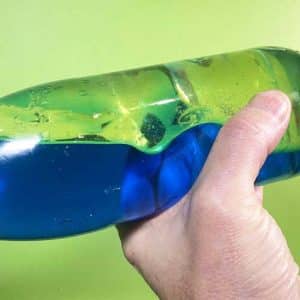
Tip the bottle from side to side and you get simulated ocean waves!
-
School science visits since 2004!
– Curriculum-linked & award-winning incursions.
– Over 40 primary & high school programs to choose from.
– Designed by experienced educators.
– Over 2 million students reached.
– Face to face incursions & online programs available.
– Early learning centre visits too!

-
Get the Ocean Science Unit of Work!
Dive into ocean science as we look at the abiotic factors that affect life in our oceans.
- How far does light pass through water?
- How does pressure change as we go deeper underwater?
- How do ocean currents form and more!
Includes cross-curricular teaching ideas, student quizzes, a sample marking rubric, scope & sequences & more

-

The science behind it
What's going on?
The Science of an Ocean in a Bottle
The ocean in a bottle activity is a classic demonstration that takes advantage of density and molecular mixtures. Firstly, oil is less dense than water, which means a specific volume of oil has less mass than the same volume of water. This lower density makes the oil more buoyant, causing it to float consistently on top.
Secondly, oil and water are immiscible, meaning they cannot mix. This is due to their electrical charges:
- Water (H2O) is polar: One side of the molecule has a slight negative charge and the other has a slight positive charge. These molecules act like tiny magnets, where the negatively charged oxygen atom of one molecule is strongly attracted to the positively charged hydrogen atoms of another.
- Oil is non-polar: There is no difference in charge across an oil molecule. Because they lack these “magnetic” poles, they are hydrophobic (literally “water-fearing”). The water molecules are so attracted to each other that they effectively push the oil molecules out of the way, keeping the layers separate.
The waves you see in the bottle mimic the turbulence of the real ocean. In nature, ocean waves are primarily created by the friction of wind moving across the water’s surface. The more energy the wind transfers to the water, the larger the waves become!
Variable testing ideas
Find out more about variable testing here.
-
Salinity
Does adding salt to the water change the experiment? (Hint: Salt increases the density of water—does the oil float even higher?) -
Emulsification
What happens if you add a squirt of dish detergent to the mix? Detergents are emulsifiers; they have one polar end and one non-polar end, which might just allow the oil and water to finally hold hands and mix. -
Thermal Energy
If the water is warm, does it flow differently? Heat changes the viscosity (thickness) of liquids, which may change the “smoothness” of your waves.

Teacher's note
Curriculums change, and so does the way you implement them in your classroom. Please use your own experience and knowledge of your students to use these resources to best effect for student learning.
Still want the curriculum links?
Here are the suggested links:
Australian Curriculum (ACARA) Science:
NSW Science syllabuses:
Victorian Curriculum Science:
Want this experiment — and many more — running in your classroom?
Have us visit your school — every student gets three hands-on experiments in 60–90 minutes with a qualified presenter.








