
Can you fit through a business card?
Can you squeeze through a business card? With a few cuts with scissors you can! Learn about perimeter vs area in this fun maths activity…
Adult supervision for setup

You will need
- One 3.5 x 9cm Business card
- One pair of scissors
Method
-
Fold the index card in half lengthwise.

-
Make a cut at each end of your card from the folded edge. Cut as close to the edge as you can without cutting through it. In the image, you’ll see small cuts either side of the Fizzics Education logo.

-
When you open your index card you should now have two slits on either end of the card.
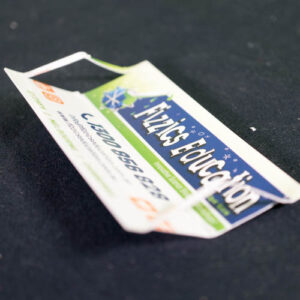
-
From one of the slits, cut along the fold to the other slit.
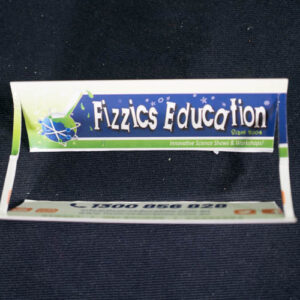
-
Fold the index card in half lengthwise again.
-
Add more slits to your card alternating between the edge that you cut from. from the folded edge and the open edge, do not cut through the card. Again try to cut as close as you can to the edge of the card.
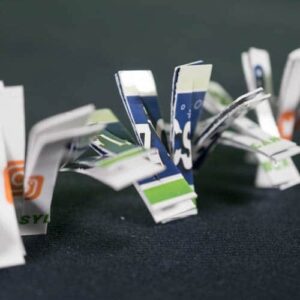
-
With care, unfold your index card and pull it open. It should form a ring. Taking care to not break the ring, step through it. Work it from your feet and over your head!
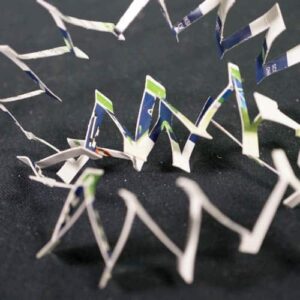
-
School science visits since 2004!
– Curriculum-linked & award-winning incursions.
– Over 40 primary & high school programs to choose from.
– Designed by experienced educators.
– Over 2 million students reached.
– Face to face incursions & online programs available.
– Early learning centre visits too!

-

The science behind it
What is happening?
You created a loop!
Whilst you cannot change the area of the business card, you can very much change its perimeter. By making your alternating cuts really close together you maximised the length of your loop. As long as there was enough of the business card to hold together you can create a surprisingly wide loop out of not much material.
If you think about it, the shape with the smallest perimeter for its area is a circle. For every other shape, you get more perimeter compared to a circle, even if they have the same area. You can always add more perimeter to a shape by cutting it to get more length along it edge. The same thing works in 3D too! A sphere has a very small amount of surface area compared to its volume, whereas a rectangular prism can have the same volume but is effectively more spread out and so you get more of a surface.
Applications
- Think about when you cook. If you add a whole onion to your soup, very little of the onion actually mixes through the soup as most of the onion is trapped inside the onion’s surface. If you chop up the onion, you get more surface area of the ion to mix though the soup to spread out that flavour.
- This works with heat too. If you need ice to melt, break it up! This gives more surface area for heat to enter the ice. Conversely, if you don’t want your ice to melt quickly, don’t break it up. This idea is used with heat dissipators on engines and radiators too, where you find that the metal is spread over a larger area using raised edges or tubes to allow air to get to as much of the surface as possible.
- If you want to dissolve a solid faster, spread it out as well! Try mixing sugar cubes vs teaspoon of sugar in some water… which dissolves first?
Variables to test
- How small does a piece of paper have to be before you can’t fit through it?
- Is there another way to cut the business card to produce the same result?
Can you predict how big you can make a piece of paper become using mathematics?
Teacher's note
Curriculums change, and so does the way you implement them in your classroom. Please use your own experience and knowledge of your students to use these resources to best effect for student learning.
Still want the curriculum links?
Here are the suggested links:
Australian Curriculum (ACARA) Science:
NSW Science syllabuses:
Victorian Curriculum Science:
Want this experiment — and many more — running in your classroom?
Have us visit your school — every student gets three hands-on experiments in 60–90 minutes with a qualified presenter.








