
Mysterious marbles
Science lesson resources for kids from Preschool and Secondary school. Make science fun with Fizzics
Adult supervision for setup
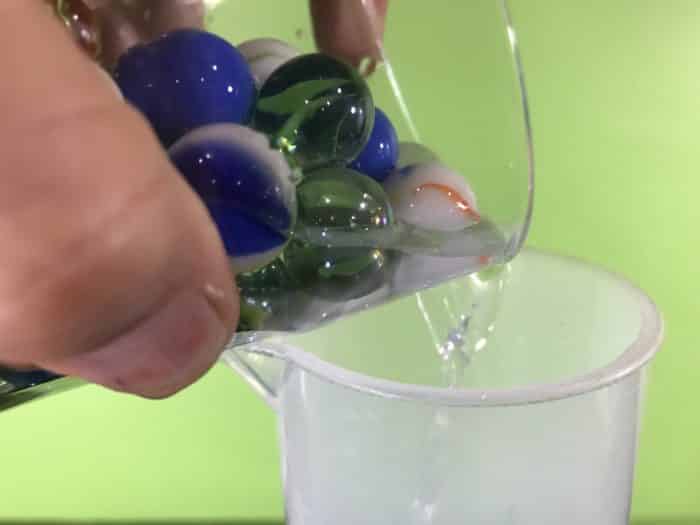
You will need
- Marbles of two different sizes.
- Two plastic glasses of identical size
- Measuring beaker and water.
- Pad, pen and paper.
- Vernier callipers
Method
-
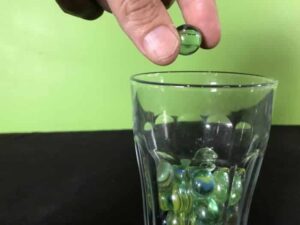
Fill one glass up to the brim with the small marbles, counting each one as you put it inside.
-
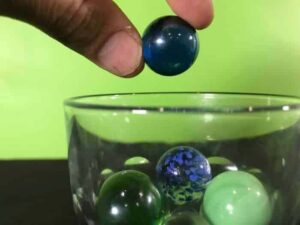
Repeat using the larger marbles in the other glass.
-
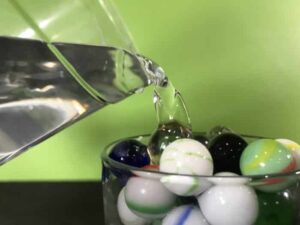
Fill both glasses full of water.
-
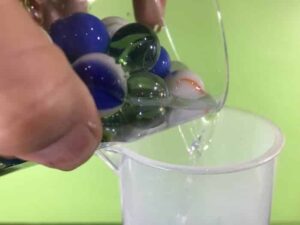
Gently tip the water of one container into the beaker and note the volume.
Repeat for the other container. Are the volumes of the glasses the same?
-
Troubleshooting:
- How accurately did you measure your marbles and glass?
- Did you fill both glasses to the same equal height – of course, in practice it would be very hard to be exactly accurate?
- This is a good demonstration of experimental design often showing differences between theoretical results and practical results, known as theoretical and practical yields.
- Your job is to work out why your results differ from what you have on paper!

-
School science visits since 2004!
– Curriculum-linked & award-winning incursions.
– Over 40 primary & high school programs to choose from.
– Designed by experienced educators.
– Over 2 million students reached.
– Face to face incursions & online programs available.
– Early learning centre visits too!
-

The science behind it
Why Does This Happen?
There Is Fair Amount Of Geometry In This Problem!
Allowing for you filling the glass up to exactly the same height, i.e. just about to overflow, you should have found that both glasses hold the same amounts of water.
The reason? The spaces around the large marbles are larger, so you would expect that more water should be able to fit into the glass. However even though the glass with the smaller marbles had smaller spaces to fit the water, there were many more of them. It turns out that the total volume of spaces between the two glasses works out to be the same.
Now, you’ve got to prove it! Use the following to help you out:
You need to work out the volume of the marbles within the glasses.
Marbles are spheres, so use the volume of a sphere can be calculated:
Where π = 3.145 and r is the radius of the sphere.
You can get the radius by using vernier callipers.
Don’t forget your answer is a cubic measurement e.g. cm3.
Now multiply the volume of each marble by the number of marbles used.
Now you have to work out the volume of the glass. Really, all this is the amount of water that filled the glass + the total volume of marbles within the glass. But, for the sake of ‘previous’ your experiment using mathematics, you can do the calculation to get a prediction of what the volume of water was going to be before you even do the experiment.
Each glass is going to be different, so the sake of making the calculation easier, let’s assume that your glass is a cylinder
The volume of a cylinder can be worked by calculating the area of the base and multiplying that number by its height.
So, the base of the cylinder is a circle, therefore the area of the circle can be worked by the following:
Where π = 3.145 and r is the radius of the circular base.
Don’t forget your answer is a cubic measurement e.g. cm3.
Now just multiply this number by the height of your glass
Now you know the total volume of the glass and the total volume taken up by the marbles. So, the final calculation to find the volume of water surrounding the marbles is:
The volume of water = volume of glass – volume of marbles
Teacher's note
Curriculums change, and so does the way you implement them in your classroom. Please use your own experience and knowledge of your students to use these resources to best effect for student learning.
Still want the curriculum links?
Here are the suggested links:
Australian Curriculum (ACARA) Science:
NSW Science syllabuses:
Victorian Curriculum Science:
Want this experiment — and many more — running in your classroom?
Have us visit your school — every student gets three hands-on experiments in 60–90 minutes with a qualified presenter.








