
Liquid nitrogen + balloon
What would happen if you put liquid nitrogen in a balloon? Make sure you have a parent with you because this could get fun and dangerous!
Adult supervision for setup
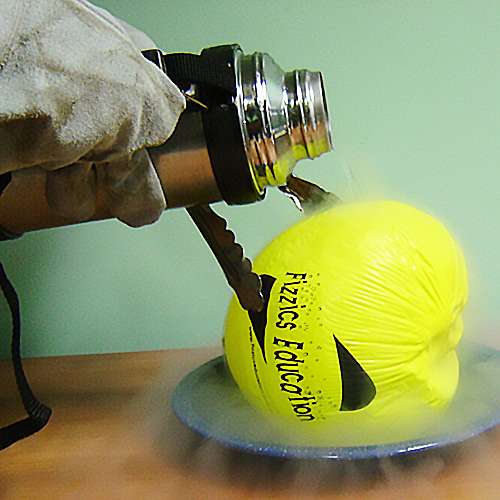
Method
-
Put on the safety glasses and gloves.
Holding the balloon with metal tongs, carefully pour the liquid nitrogen over the surface of the balloon.
Watch what happens.

-
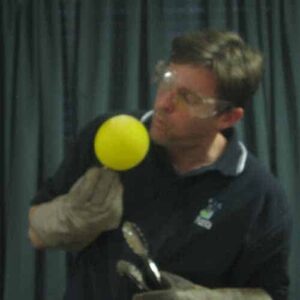
Hold balloon up and allow the balloon to drip the liquid nitrogen off it.
Watch what happens as the balloon warms up! Blow on it to transfer more heat.
-
Get the Unit of Work on States of Matter here!
- What are the different states of matter?
- How does heat affect the size of materials?
- How does liquid nitrogen affect materials and much more!
Includes cross-curricular teaching ideas, student quizzes, a sample marking rubric, scope & sequences & more
-
School science visits since 2004!
– Curriculum-linked & award-winning incursions.
– Over 40 primary & high school programs to choose from.
– Designed by experienced educators.
– Over 2 million students reached.
– Face to face incursions & online programs available.
– Early learning centre visits too!
-

The science behind it
Why Does This Happen?
The Science of Liquid Nitrogen and Balloons
Safety Note: Do not try this at home or school unless you have formal training and the correct safety equipment for handling liquid nitrogen.
Watching a balloon shrivel up in liquid nitrogen looks like magic, but it is actually a perfect demonstration of Charles’s Law. This law states that the volume of an ideal gas is directly proportional to its absolute temperature (when pressure is kept constant).
V₁ / T₁ = V₂ / T₂
The “Squashing” Effect
Liquid nitrogen is extremely cold, sitting at -196°C. When a balloon is submerged, the air molecules inside lose their kinetic energy almost instantly. They slow down and huddle closer together, taking up much less space.
- Pressure Drop: As the air inside cools, it exerts much less pressure against the inside walls of the balloon.
- Atmospheric Push: The air outside the balloon is still at room temperature and high pressure. Because the inside pressure has vanished, the outside air “squashes” the balloon flat.
Once the balloon is removed and warmed up (even just by blowing on it), the molecules speed up and the internal gas pressure increases, and the balloon “inflates” back to its original size!
Variables to test
Find out more on variables here.
-
Thermal Energy Gradient
Does this work with regular ice (0°C)? While the air will contract slightly, is the temperature difference large enough to make a visible difference in the balloon’s size? -
Dry Ice Comparison
What about dry ice (-78.5°C)? This is much colder than regular ice but warmer than liquid nitrogen. Will the balloon shrink, or is it still not cold enough to liquefy the air inside? -
Standard Refrigeration
Will you see this effect in your freezer (-18°C)? Try measuring the circumference of a balloon before and after 30 minutes in the freezer to see if Charles’s Law is measurable at home. -
Gas Type
Does a balloon filled with Helium behave differently than a balloon filled with air when exposed to extreme cold?

Teacher's note
Curriculums change, and so does the way you implement them in your classroom. Please use your own experience and knowledge of your students to use these resources to best effect for student learning.
Still want the curriculum links?
Here are the suggested links:
Australian Curriculum (ACARA) Science:
NSW Science syllabuses:
Victorian Curriculum Science:
Want this experiment — and many more — running in your classroom?
Have us visit your school — every student gets three hands-on experiments in 60–90 minutes with a qualified presenter.








