
Grow yeast experiment
Do you know what yeast is? Do you know how to grow it? Well lucky you in this fun experiment you can learn how to grow yeast and learn about chemical side!
Adult supervision for setup
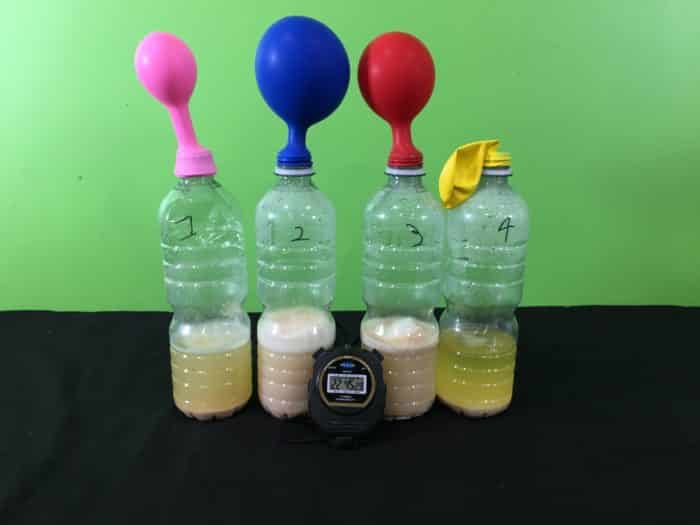
You will need
- 4 packets of dry yeast
- 4 water bottles, chilled in the fridge
- 4 balloons
- 1 funnel
- 1 spoon
- 1 large jug
- 4 measuring cups
- 4 thermometers (one will do)
- Sugar
- Access to boiling water plus adult supervision
- 1 stopwatch
- A pen to mark the water temperature on each water bottle
- A shelf to leave the science experiment to run
- A notebook for your observations
Method
-
Pour out the 4 chilled water bottles into the large jug and discard the rest of the water (maybe water your school garden!)
Carefully measure out the water into the four measuring cups as per the measurements below;
Cup 1 – 200mL of chilled water
Cup 2 – 150mL of chilled water
Cup 3 – 100mL of chilled water
Cup 4 – 50mL of chilled water
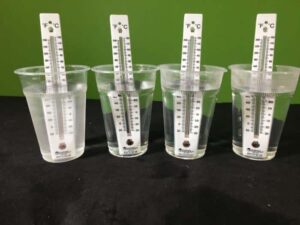
Use the thermometers to take a measurement of the water temperature in each cup (write this in your notebook).
With an adult, boil a jug of water and then top up cups 2, 3 and 4 so that they too have 200mL of water as per cup 1. You will be testing the effect of temperature on the growth of yeast by measuring how much gas is released by the yeast under 4 different temperature conditions (variable testing).
-
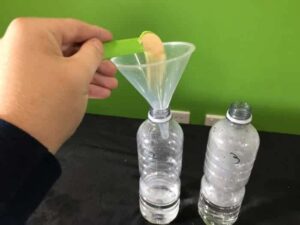
Using a funnel, carefully pour each cup of water into the four separate water bottles. Use the pen to mark the starting temperature of each water bottle.
-
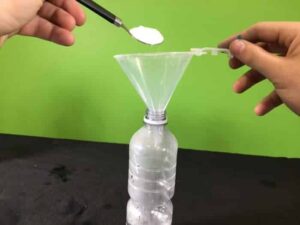
Add a spoonful of sugar per water bottle and then swirl the bottle to dissolve the sugar.
-
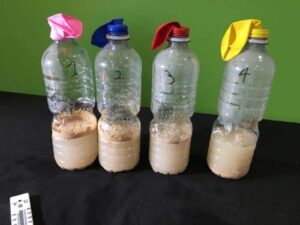
Add a yeast packet into each bottle and quickly stretch a balloon of the opening of each bottle.
-
4 yeast growth experiments started, showing a distinct change already!
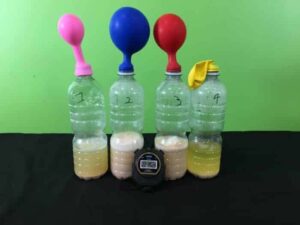
Start the stopwatch and take notes of when each balloon rises!
OPTIONAL: you could also keep each bottle in the yeast experiment at the same temperature and vary the amount of sugar added instead.
-
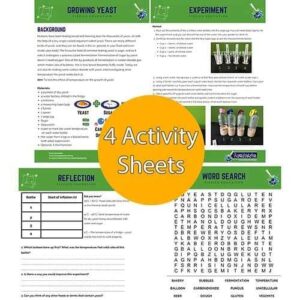
Go further – buy 4 x student activity sheets as extension worksheets.
This student science booklet has been created by experienced science educators from the Fizzics Education team.
Use these student worksheets as blackline masters for your science class!

-
School science visits since 2004!
– Curriculum-linked & award-winning incursions.
– Over 40 primary & high school programs to choose from.
– Designed by experienced educators.
– Over 2 million students reached.
– Face to face incursions & online programs available.
– Early learning centre visits too!
-

The science behind it
What is going on?
The Science of the Grow Yeast Experiment
Yeast are amazing microscopic, single-celled fungi. While they are kept dry and cool in a packet, they stay dormant (asleep). However, once you provide them with water and “food” (sugar) in a warm environment, they wake up and begin to grow and divide rapidly.
The yeast cells produce an enzyme called invertase, which acts as a biological catalyst to break down sucrose into glucose. Once glucose is available, a process called fermentation begins. The yeast “eats” the sugar and releases ethanol and carbon dioxide gas as by-products.
Glucose → Ethanol + Carbon Dioxide
C6H12O6(aq) → 2C2H5OH(aq) + 2CO2(g)
In this experiment, the balloon traps the escaping carbon dioxide. The more active the yeast, the faster the balloon inflates! Temperature plays a critical role here:
- 55°C – 60°C: This is the thermal death point. The heat is too intense, and the yeast cells die.
- 41°C – 46°C: The “Goldilocks” zone! This is the ideal temperature for rehydrating dry yeast.
- 4°C (Fridge Temp): The yeast is too cold to be active and remains in a state of suspended animation.
The most common species used in kitchens is Saccharomyces cerevisiae. While yeast loves simple sugars (monosaccharides), it cannot break down complex starches on its own. This is why brewers use germinating barley—the grain provides the enzymes needed to turn starch into the simple sugars that yeast can finally digest.
Variables to test
Find out more on variables here.
-
pH Sensitivity
Try adding different concentrations of vinegar. Can the yeast survive in an acidic growth medium, or does it stop the fermentation process? -
Fuel Supply
Vary the amount of sugar used. Is there a point where adding “more food” no longer increases the speed of gas production? -
Solvent Volume
Does the total volume of water make a difference to the concentration of the sugar? Does a more dilute solution change the rate of growth? -
Alternative Sweeteners
Can yeast ferment honey, maple syrup, or artificial sweeteners? This tests which molecular structures the yeast enzymes can actually break down.
Classroom Activity Sheets
Create, reflect, and extend your learning with our student worksheets!



Teacher's note
Curriculums change, and so does the way you implement them in your classroom. Please use your own experience and knowledge of your students to use these resources to best effect for student learning.
Still want the curriculum links?
Here are the suggested links:
Australian Curriculum (ACARA) Science:
NSW Science syllabuses:
Victorian Curriculum Science:
Want this experiment — and many more — running in your classroom?
Have us visit your school — every student gets three hands-on experiments in 60–90 minutes with a qualified presenter.








