
Bottle fountain science activity
A great experiment for kids for exploring air pressure. This uses easy to get materials and has step by step instructions. Find out more…
Adult supervision for setup
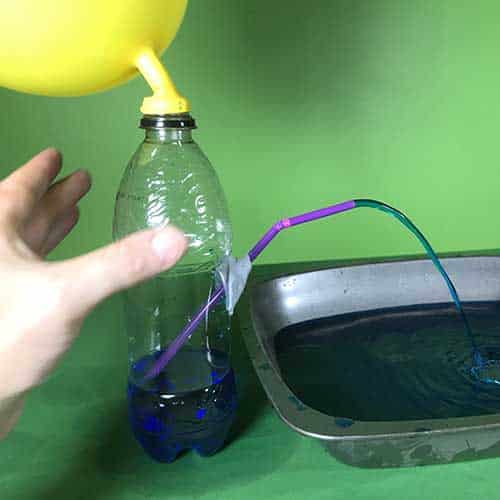
You will need
- 1 soda bottle
- Water
- 1 funnel
- 1 balloon
- Blu Tack
- 1 straw with a bend in it
- 1 tray to catch excess water
- Optional: blue food colouring
- A boxcutter (with adult help)
Method
-
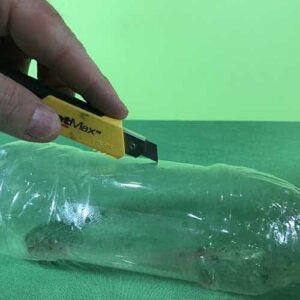
With adult help, carefully make a small hole in the side of the plastic bottle with the boxcutter.
-
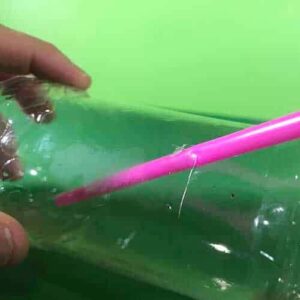
It can be worth cutting away some of the plastic completely rather than making an ‘X’ shape, this will allow the straw to sit easily in the hole.
-
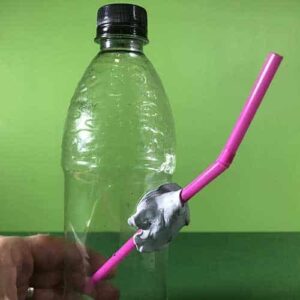
Seal around the straw with Blu Tack or modelling clay. make sure that the bottle is dry here or the Blu Tack won’t stick as well. Keep the star pointed upwards.
-
Optional: add some food colouring to your water
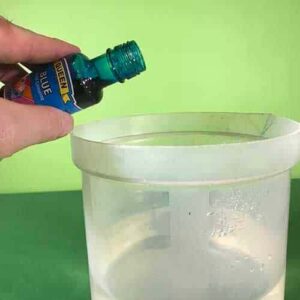
-
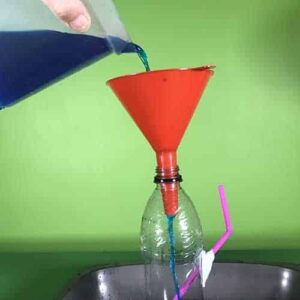
Add the funnel to your bottle and carefully pour your water into the bottle.
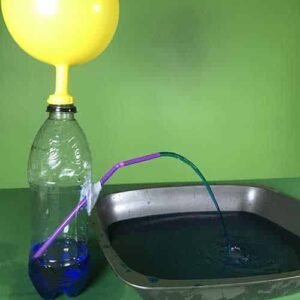
You’ll notice that water will rise up through the straw to the same height as the water inside the bottle. This is due to equal air pressure pushing downwards through the opening of the straw and the bottle.
-
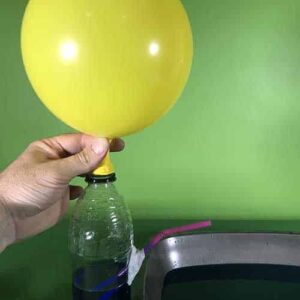
Blow up a balloon and pinch the opening tightly. Carefully stretch the opening of the balloon over the mouth of the bottle without letting go of the neck of the balloon.
-
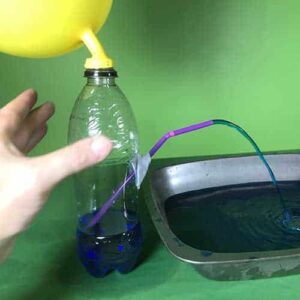
Quickly release the balloon and watch the fountain stream out!
-
The water will continue to stream outwards as long as both the end of the straw is in the water inside the bottle and that the balloon continues to push air into the bottle.
-
Get the Unit of Work on Pressure here!
- Want to dive into air pressure?
- It’s all about air pressure in many ways!
From how storms form to how planes fly, this unit covers many concepts about air pressure.
Includes cross-curricular teaching ideas, student quizzes, a sample marking rubric, scope & sequences & more
-
School science visits since 2004!
– Curriculum-linked & award-winning incursions.
– Over 40 primary & high school programs to choose from.
– Designed by experienced educators.
– Over 2 million students reached.
– Face to face incursions & online programs available.
– Early learning centre visits too!
-

The science behind it
Why Does This Happen?
The Science of the Bottle Fountain
This experiment is all about air pressure! When the bottle was open, the atmospheric pressure pushing down into the neck of the bottle and the straw opening was exactly the same. This is why the water level remained at the same height in both the bottle and the straw, even if you filled it past the straw’s internal opening.
By adding an inflated balloon and releasing the air into the bottle, you created a significant pressure differential. The balloon’s elastic skin squeezes the air inside, increasing its pneumatic pressure. When this high-pressure air enters the sealed bottle, it pushes down on the surface of the water.
Because the water is practically incompressible and has nowhere else to go, it is forced up through the straw and out into the air. The water continues to stream out until the air pressure inside the bottle drops back down to match the air pressure outside.
Variables to test
Find out more on variables here.
-
Orientation
What happens when you turn the straw upside down? Try this when the water level is above the straw opening height. Does gravity change the result? -
Potential Energy
Would the stream of water be a different length with a larger or smaller balloon? Does more air volume equal more pressure? -
Atmospheric Conditions
What would happen if this was done on a mountaintop (low altitude) vs sea level (high altitude)? -
Friction and Flow
Try adding a curly-shaped straw. Does the extra surface friction inside the straw slow down the fountain? -
Distribution
What would happen if you had two or three straws attached? Does the water pressure divide equally between them?

Teacher's note
Curriculums change, and so does the way you implement them in your classroom. Please use your own experience and knowledge of your students to use these resources to best effect for student learning.
Still want the curriculum links?
Here are the suggested links:
Australian Curriculum (ACARA) Science:
NSW Science syllabuses:
Victorian Curriculum Science:
Want this experiment — and many more — running in your classroom?
Have us visit your school — every student gets three hands-on experiments in 60–90 minutes with a qualified presenter.








