




Science Show Activities
- The Vortex – Race the coins down the spiral!
- Mirror Mirages – What makes the image hover in the air?
- X-rays sleuth – Can you identify the animal?
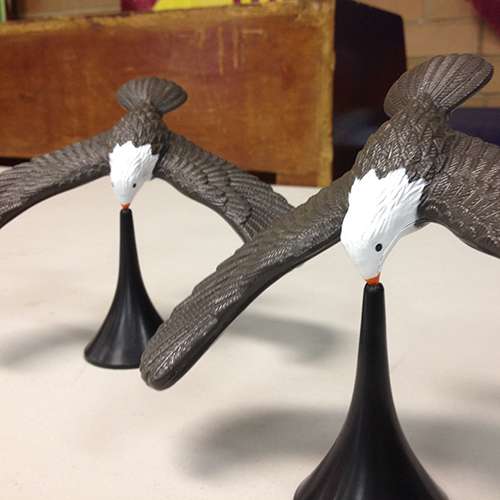
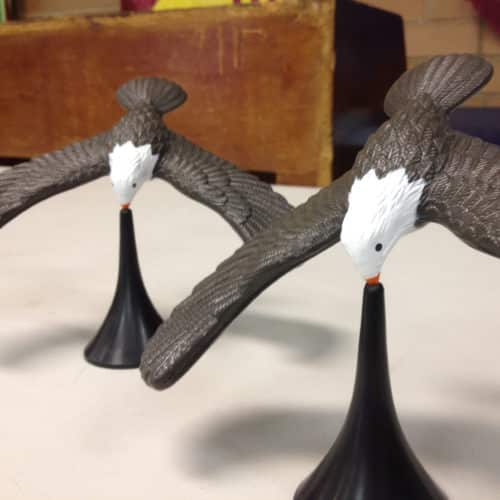
- Balancing Birds – Perch the birds on your head, shoulder, hand or foot
- Tornado Twister – Create a tornado in a bottle!
- Slippery Snakes – Try to hold onto these little critters
- Frog Flip Out! – Push these frogs and watch them hop!
- Magic Microphones – Make a sound, see the vibrations.
- Pin Head – Make a 3D model of your body
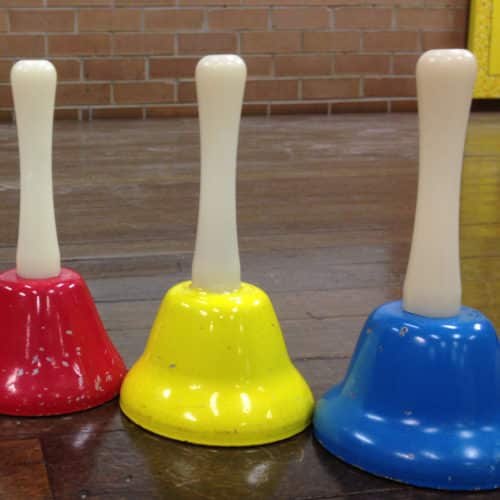
- Rainmakers – Make the balls spiral down, how does the noise happen?
- Marvelous Magnets – Identify which items will stick to the magnetic wands
- Gyro-Fly Wheels – How fast can you make the magnets spin?
- Optical Illusions – How does your brain work
- Mega sphere – This ball grows from 1 to 4 foot… it;s all about levers!
- Mixing your words – A classic demonstration on psychology – can you beat the test?
- Magic glasses – View the entire visible light spectrum through these cool glasses
- Vortex fog rings – Shoot them across the room!
- Bicarb rocket – Launch a film canister high!
- Nail chair – See a demonstration on how forces can be spread out.
Science workshop content
What Students Experience: The Science of Toys
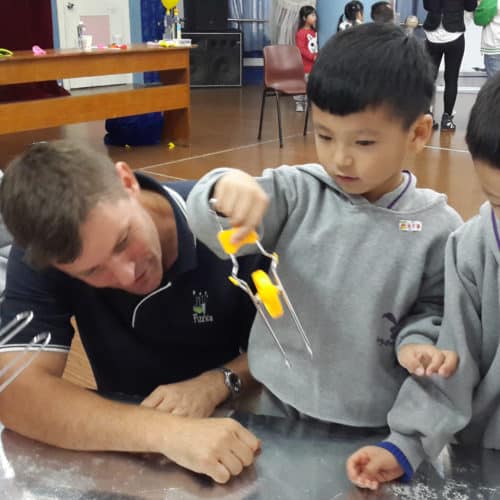
Students step into a world of play-based discovery, where their favourite toys become scientific specimens. This workshop is highly structured to move from dramatic demonstrations of physical forces to individual, station-based inquiry.
1. The Science of Play
The session opens with a high-energy show that challenges students to look at toys differently. We demonstrate how to predict and analyse movement, introducing the invisible forces acting through solids, liquids, and gases.
2. Station Investigations
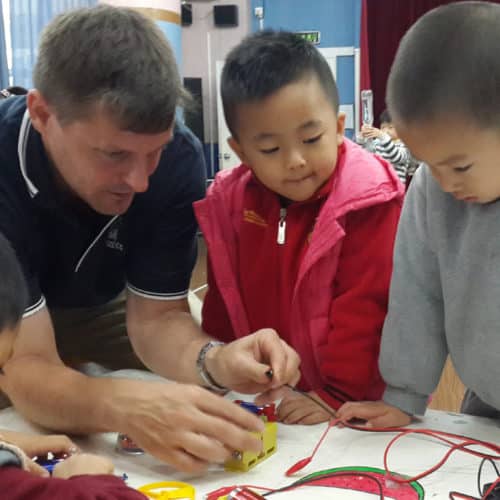
Students rotate through hands-on stations to explore energy storage and release, gravity, and friction. They investigate spinning toys, magnets, and objects that use vibrations to create sound or manipulate light.
3. Vortex Finale
We wrap up with a collaborative debrief on how toys work. The session concludes with a dramatic demonstration of vortex fog rings, showing a clear and visible transfer of forces and energy through the air.
Our students were captivated! A brilliant way to explore forces and energy. The hands-on stations allowed every student to investigate the science behind toys they use every day.
View on FacebookWhat a fantastic session! The girls loved the “Science of Toys” workshop. It was great to see them applying scientific thinking to their play and discovering the mechanics involved.
View on FacebookThank you for the amazing workshop! It was wonderful to see our junior students so engaged with physics through play. The vortex finale was a huge hit!
View on FacebookOur Commitment to Quality Science Education
A Trusted School Partner for 20 Years
Fizzics Education delivers reliable, syllabus-aligned visits that engage students and meet the practical requirements of the Australian classroom.
Using safe, relatable materials to teach rigorous scientific concepts.
Highly rated by teachers for classroom management and student engagement.
Experienced educators trained to facilitate student investigation.

Australian Curriculum Mapping
Australian National Curriculum Mapping for all our science incursions
Australian ACARA Content Outcomes:
Science F-10 Version 9.0
Foundation
- describe how objects move and how factors including their size, shape or material influence their movement AC9SFU02
- recognise that objects can be composed of different materials and describe the observable properties of those materials AC9SFU03
- explore the ways people make and use observations and questions to learn about the natural world AC9SFH01
- pose questions and make predictions based on experiences AC9SFI01
Year 1
- describe pushes and pulls in terms of strength and direction and predict the effect of these forces on objects’ motion and shape AC9S1U03
Year 2
- explore different actions to make sounds and how to make a variety of sounds, and recognise that sound energy causes objects to vibrate AC9S2U02
- recognise that materials can be changed physically without changing their material composition and explore the effect of different actions on materials including bending, twisting, stretching and breaking into smaller pieces AC9S2U03
Year 1 & 2
- describe how people use science in their daily lives, including using patterns to make scientific predictions AC9S1H01, AC9S2H01
- pose questions to explore observed simple patterns and relationships and make predictions based on experiences AC9S1I01, AC9S2I01
- compare observations with predictions and others’ observations, consider if investigations are fair and identify further questions with guidance AC9S1I05, AC9S2I05
Australian National Curriculum Mapping for all our science workshops & shows

NSW K-10 Science Syllabus Mapping
NSW K – 10 Science Syllabus mapping
NSW Science Syllabus Content
A student:
- STe-5PW-ST observes the way objects move and relates changes in motion to push and pull forces
- ST1-8PW-S describes common forms of energy and explores some characteristics of sound energy
- ST1-9PW-ST investigates how forces and energy are used in products
NSW Science and Technology K–6 Syllabus (Implementation from 2027)
For explanatory points & implementation advice, please visit the NESA Science and Technology K–6 Curriculum site.
Early Stage 1
STE-SCI-01 identifies and describes characteristics of living things, properties of materials, and movement
- Recognise that properties of materials can be observed using the senses
- Observe and manipulate materials to describe their properties using Tier 2 vocabulary
- Test how the movement of an object is affected by its shape
- Experiment to observe how an object’s movement is affected by its material
STE-PQU-01 poses questions based on observations to collect data
Stage 1
ST1-SCI-01 measures and describes changes in living things, materials, movement, Earth and the sky
- Recognise that light and sound can travel through air, water and some solids and are affected by those materials
- Pose questions, test and describe how light can be reflected, refracted, dispersed or absorbed by materials
- Recognise that sound is created and carried by vibrations
- Test how different materials and actions affect the volume and pitch of sound
- Recognise that a force is a push or a pull that can make things either start moving, stop moving, change speed, direction or shape
- Pose questions and test the effects of forces on an object’s movement
- Test how frictional forces affect moving objects
- Test how the force of magnetism affects objects
ST1-PQU-01 poses questions based on observations and information to investigate cause and effect

VIC Science Syllabus Content
VIC Curriculum F–10 Version 2.0
For explanatory points & implementation advice, please visit the VIC Curriculum F-10 site.
Foundation to Level 2
- objects can be made of one or more different materials; these materials have observable properties. VC2S2U04
- materials can be changed physically by different actions without changing their material composition, including by bending, twisting, stretching, crushing, squashing and breaking into smaller pieces. VC2S2U06
- the way objects move depends on a variety of factors including their size, shape and material. VC2S2U10
- pushes and pulls are forces that can change an object’s movement or shape and can be represented in terms of strength and direction. VC2S2U11
- experiences can be used as a basis for posing questions to explore observed patterns and relationships, and to make predictions. VC2S2I01
- observations, findings and ideas can be shared with others by using everyday and some scientific vocabulary. VC2S2I06
Session Requirements
👥 Capacity & Timing
👨🎓 Attendance: Max 32 students per class.
🏫 Target: Appropriate for Years K to 2.
⏰ Duration: 60 or 90 minute versions.
🛠️ Set/Pack: 45 mins setup + 45 mins pack down.
📍 Space & Power
🏗️ Room Layout: 7 tables are required for hands-on stations.
🔌 Power: Access to 1 standard electrical power socket.
🪑 Seating: Chairs are not required for students during the session.
Go Further!
Complete Units of Work to Support Your Teaching
Support your classroom with 270+ syllabus-linked lessons, high-quality videos, and marking rubrics.
Save time and engage students in STEM year-round with high-quality videos, printable experiments, and full marking rubrics.
Extend the Experience
Pair this workshop with a larger stage show for groups of up to 240 students:






