



Science workshop content
What Students Experience: The Micro-Investigation
Students transition from observers to biological illustrators, learning that scientific art is about precision and data rather than aesthetics. This workshop focuses on the rigorous observation required to document the microscopic world.
1. Biological Illustration
Students learn the specific rules of biological drawing. We focus on how these differ from traditional artwork—emphasising clean lines, the inclusion of scale, and the importance of accurate labelling over colouring and shading.
2. Digital Exploration
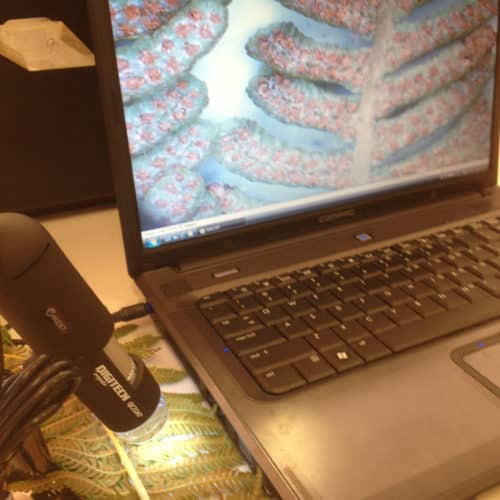
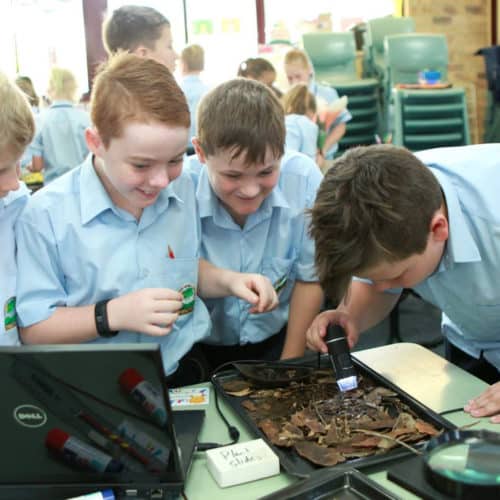
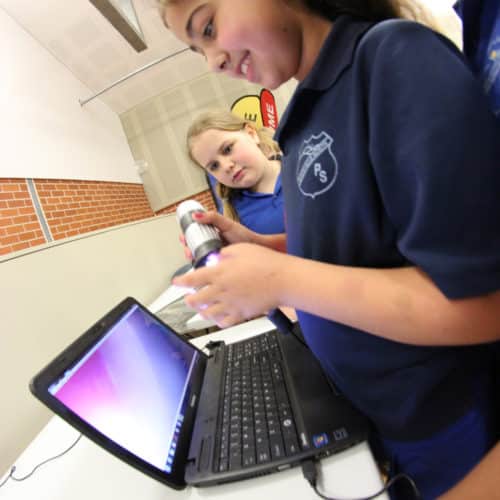
Using high-definition digital microscopes, students hunt for detail. Their mission is to document their specimens with extreme accuracy, using the digital interface to identify structures that are invisible to the naked eye.
3. Beyond the Lens
We conclude by looking at Scanning Electron Microscopy (SEM). We discuss the frontiers of microbiology, exploring the distinct structural differences between bacteria, viruses, and fungi.
Our Commitment to Quality Science Education
A Trusted School Partner for 20 Years
Fizzics Education delivers reliable, syllabus-aligned visits that engage students and meet the practical requirements of the classroom.
Providing schools with access to professional-grade digital microscopes.
Highly rated by teachers for classroom management and curriculum alignment.
Experienced educators trained to facilitate high-level biological inquiry.

Australian Curriculum Mapping
Australian National Curriculum Mapping for all our science incursions
Australian ACARA Content Outcomes:
Science F-10 Version 9.0
Year 3
- compare characteristics of living and non-living things and examine the differences between the life cycles of plants and animals AC9S3U01
Year 3 & 4
- examine how people use data to develop scientific explanations AC9S3H01, AC9S4H01
- consider how people use scientific explanations to meet a need or solve a problem AC9S3H02, AC9S4H02
- pose questions to explore observed patterns and relationships and make predictions based on observations AC9S3I01, AC9S4I01
- compare findings with those of others, consider if investigations were fair, identify questions for further investigation and draw conclusions AC9S3I05, AC9S4I05
Year 5
- examine how particular structural features and behaviours of living things enable their survival in specific habitats AC9S5U01
Year 5 & 6
- investigate how scientific knowledge is used by individuals and communities to identify problems, consider responses and make decisions AC9S5H02, AC9S6H02
- pose investigable questions to identify patterns and test relationships and make reasoned predictions AC9S5I01, AC9S6I01
- compare methods and findings with those of others, recognise possible sources of error, pose questions for further investigation and select evidence to draw reasoned conclusions AC9S5I05, AC9S6I05
Australian National Curriculum Mapping for all our science workshops & shows

NSW K-10 Science Syllabus Mapping
NSW K – 10 Science Syllabus mapping
NSW Science Syllabus Content
A student:
- ST2-4LW-S compares features and characteristics of living and non-living things
- ST2-1WS-S questions, plans and conducts scientific investigations, collects and summarises data and communicates using scientific representations
- ST2-2DP-T selects and uses materials, tools and equipment to develop solutions for a need or opportunity
- ST3-1WS-S plans and conducts scientific investigations to answer testable questions, and collects and summarises data to communicate conclusions
- ST3-2DP-T plans and uses materials, tools and equipment to develop solutions for a need or opportunity
NSW Science and Technology K–6 Syllabus (Implementation from 2027)
For explanatory points & implementation advice, please visit the NESA Science and Technology K–6 Curriculum site.
Stage 2
ST2-DDT-02 designs and uses algorithms, represents data and uses digital systems for a purpose
Stage 3
ST3-SCI-01 uses evidence to explain how scientific knowledge can be used to develop sustainable practices
- Observe behavioural and structural adaptations of plants and animals, and suggest how these may help them survive in their environments
ST3-DDT-02 creates, evaluates and modifies algorithms to code or control digital devices and systems

VIC Science Syllabus Content
VIC Curriculum F–10 Version 2.0
For explanatory points & implementation advice, please visit the VIC Curriculum F-10 site.
- living things have characteristics that distinguish them from non-living things and things that were once living, including fossils. VC2S4U01
- scientific investigations to answer questions or test predictions can be planned and conducted using provided scaffolds, including identifying the attributes of fair tests, and considering the safe use of materials and equipment. VC2S4I02
- light can be produced from many sources; light travels in a straight path, can form shadows, and can be absorbed, transmitted, reflected or refracted by objects. VC2S6U08
- repeatable scientific investigations to answer questions can be planned and conducted, including, as appropriate, deciding the variables to be changed, measured and controlled in fair tests, considering potential risks, planning for the safe and ethical use of equipment and materials, and obtaining permissions for investigations conducted on Country and Place or in protected areas. VC2S6I02
Session Requirements
👥 Capacity & Timing
👨🎓 Attendance: Max 32 students per class.
🏫 Target: Designed for Years 3 to 6.
⏰ Duration: 60 minutes.
🛠️ Set/Pack: 45 mins setup + 45 mins pack down.
📍 Space & Power
🏗️ Room Layout: 7 tables arranged in a perimeter around the room.
🔌 Power: Access to 2 standard electrical power sockets.
🪑 Seating: Chairs are not required for students.
Go Further!
Complete Units of Work to Support Your Teaching
Support your classroom with 270+ syllabus-linked lessons, high-quality videos, and marking rubrics.
Save time and engage students in STEM year-round with high-quality videos, printable experiments, and full marking rubrics.
Extend the Experience
Pair this workshop with a larger stage show for groups of up to 240 students:






