
Bubble Geometry
Find out how to make a cube-shaped bubble whilst learning about geometry! Lots of fun and easy to do at home or in class. Part of >150 free experiments!
Adult supervision for setup

You will need
- Four Pipe cleaners
- Strong Bubble mix
- Deep bucket
- Somewhere you can get wet!
Method
-
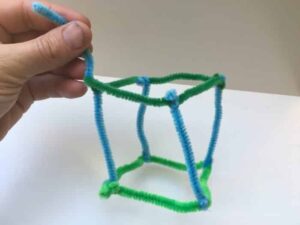
Connect pipe cleaners together to form a cube … i.e. 6 sides.
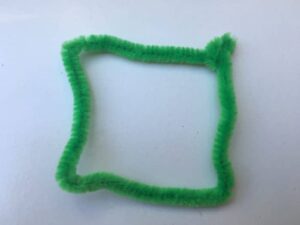
First fold one of the pipe cleaners into a square.
-
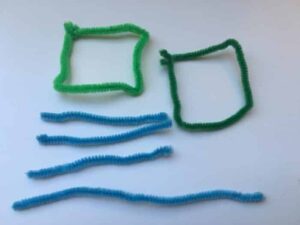
Now fold another of the pipe cleaners into another square and chop one of the other pipe cleaners into 3 parts. Leave one pipe cleaner untouched at this point.
-
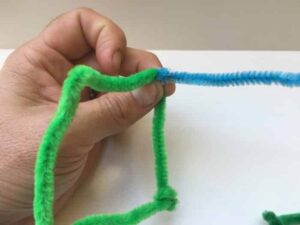
Wind each of the short pipe cleaner pieces onto the corners of the 2 squares made.
-
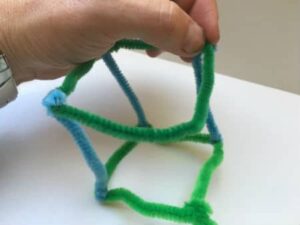
Begin to connect the squares together to form the cube.
-
Finish off the cube with the final pipe cleaner and leave a small amount hanging off the cube to act as a handle. You can straighten up the frame later.
-
Carefully pour the bubble mix down the sides of the bucket to avoid making small bubbles.
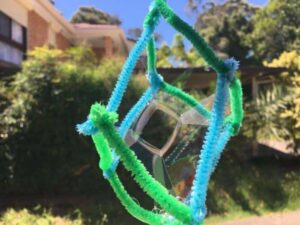
Dip the cube into the bubble mix and carefully withdraw it a couple of times. Can you make a cube-shaped bubble form on the inside of the pipe cleaner frame?
-
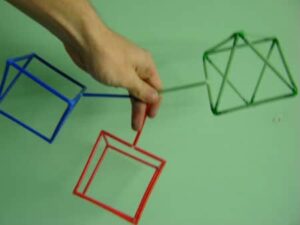
Try making tetrahedron (4 sides), a octahedron (8 sides), and a dodecahedron (12 sides)!
Does the bubble shape match the shape of each frame… why?
-
School science visits since 2004!
– Curriculum-linked & award-winning incursions.
– Over 40 primary & high school programs to choose from.
– Designed by experienced educators.
– Over 2 million students reached.
– Face to face incursions & online programs available.
– Early learning centre visits too!
-

The science behind it
Why Does This Happen?
The Science of Cube-Shaped Bubbles
Bubble films are incredibly stretchy! Scientists call this “stretch” surface tension. Because the water molecules in the bubble mix want to stick together as tightly as possible, they always try to shrink into a sphere shape, which is the shape that has the absolute minimum surface area for the volume of air trapped inside.
Normally, a bubble is a lonely sphere. However, when you dip a cube-shaped frame into the mix, the bubble films must stretch to connect to every single wire edge. When you then blow a bubble into the centre of this frame, the surrounding films pull on it from every direction.
Instead of a sphere, the inner bubble is forced into a minimal surface structure that matches the geometry of the frame. This creates a square-sided bubble in the middle because it is the most efficient way for all those soapy films to meet while still trying to shrink as much as possible!
Variables to test
Find out more on variable testing here.
-
Solution Chemistry
Try different mixtures of bubble mix. Does adding more glycerine or corn syrup make the films stronger and the cube more stable? -
Scale and Volume
How big can you make the cube before the surface tension isn’t strong enough to hold the flat planes of the bubble together? -
Geometric Variety
What happens if you use a triangular pyramid (tetrahedron) frame instead of a cube? Does the inner bubble change shape to match?

Teacher's note
Curriculums change, and so does the way you implement them in your classroom. Please use your own experience and knowledge of your students to use these resources to best effect for student learning.
Still want the curriculum links?
Here are the suggested links:
Australian Curriculum (ACARA) Science:
NSW Science syllabuses:
Victorian Curriculum Science:
Want this experiment — and many more — running in your classroom?
Have us visit your school — every student gets three hands-on experiments in 60–90 minutes with a qualified presenter.








