
Convection spiral
Demonstrate convection with a papr spiral over a heat source. Part of over 150 free science experiments on the Fizzics Ed website.
Adult supervision for setup
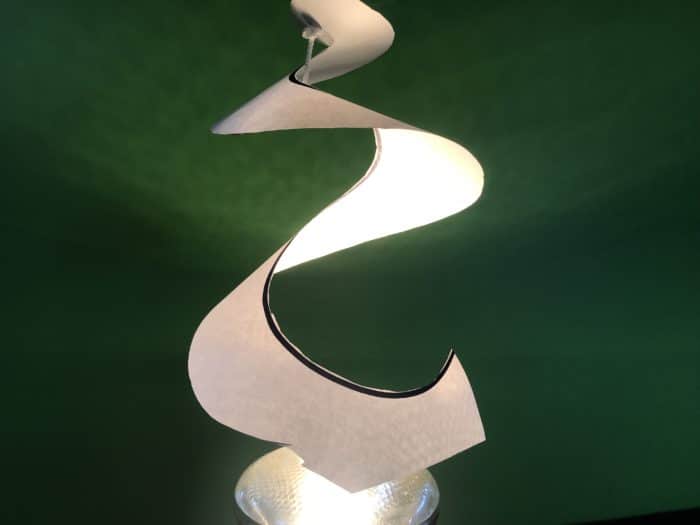
You will need
- Pen, paper or a printer
- Scissors and string
- One desk lamp
- Adult supervision and help
Method
-
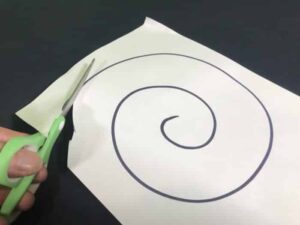
Cut a spiral out of paper as illustrated below. A 6 cm diameter spiral should be sufficient.
-
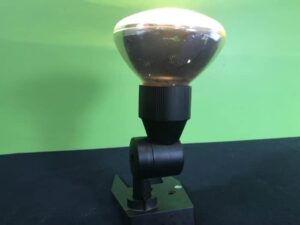
Turn on the desk lamp and shine its light towards the ceiling.
-
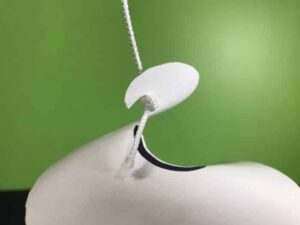
Make a whole in the exact centre of the spiral and thread the string through it.
-
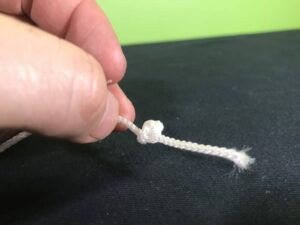
Tie a knot in the end of the string to hold the spiral in place.
-
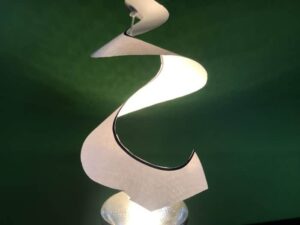
Holding the string, dangle the spiral 10 cm above the desk lamp
BE CAREFUL: Don’t let the paper touch the light!
-
Get the Unit of Work on Heat Energy here!
- What actually is heat?
- How does heat move through different materials?
- How does heat change the properties of materials and more!
Includes cross-curricular teaching ideas, student quizzes, a sample marking rubric, scope & sequences & more
-
School science visits since 2004!
– Curriculum-linked & award-winning incursions.
– Over 40 primary & high school programs to choose from.
– Designed by experienced educators.
– Over 2 million students reached.
– Face to face incursions & online programs available.
– Early learning centre visits too!
-

The science behind it
Why Does This Happen:
The Science of the Paper Convection Spiral
The spinning paper spiral is a simple yet powerful way to visualize convection—the transfer of heat energy through the movement of a fluid (like air or water). This process drives everything from the breeze in your kitchen to massive thunderstorms in our atmosphere.
[Image of a convection current showing warm air rising and cool air sinking]
How Convection Works
When the lamp is turned on, it heats the air molecules directly around the bulb. As these molecules gain thermal energy, they move faster and push farther apart.
- Density Shift: Because the heated air molecules are spread out, the warm air becomes less dense than the cooler air around it.
- The Updraft: Just like a cork popping to the surface of water, the lighter, warm air rises. As it moves upward, it pushes against the surface of the paper spiral, causing it to spin.
- The Cycle: As the warm air rises, cooler air rushes in to take its place. This air is then heated by the lamp, creates its own lift, and the cycle continues. This is a convection current.
Weather and Thunderstorms
In nature, convection is responsible for the formation of clouds and rain. When warm, moist air is forced to rise—often by a cold air front—it creates a strong updraft.
- Condensation: As the air reaches high altitudes, it cools, and the moisture condenses into water droplets, forming cumulus clouds.
- Cumulonimbus: If the updraft is powerful enough, the cloud grows into a massive cumulonimbus (thunderstorm cloud).
- The Anvil: These clouds can reach 12 kilometers high! When they hit the tropopause (a stable layer of the atmosphere), they can’t go any higher, so they spread out into a classic “anvil” shape.
Variables to test
Find out more on variables here.
-
Spiral Geometry
Change the width or length of the spiral. Does a tighter coil catch more of the updraft, or does a longer spiral become too heavy for the rising air to lift? -
Heat Intensity
Change the strength of the light source (e.g., a low-watt bulb vs. a high-heat spotlight). Does a higher temperature increase the speed of the rotation? -
Friction and Torque
Does the type of string make a difference? A stiff string might resist twisting more than a fine thread. How does torsional resistance affect the start of the spin? -
Ambient Temperature
What happens if you run the experiment in a cold room versus a warm room? Convection depends on the temperature gradient (the difference between hot and cold).
To keep your experiment valid, ensure there are no drafts from air conditioners or open windows that might push the spiral and interfere with the convection current!

Teacher's note
Curriculums change, and so does the way you implement them in your classroom. Please use your own experience and knowledge of your students to use these resources to best effect for student learning.
Still want the curriculum links?
Here are the suggested links:
Australian Curriculum (ACARA) Science:
NSW Science syllabuses:
Victorian Curriculum Science:
Want this experiment — and many more — running in your classroom?
Have us visit your school — every student gets three hands-on experiments in 60–90 minutes with a qualified presenter.








