
Shriveling potatoes
Learn about the complicated process osmosis in a fun and easy way. This experiment called shriveling potatoes is a great and simple way for kids to learn!
Adult supervision for setup
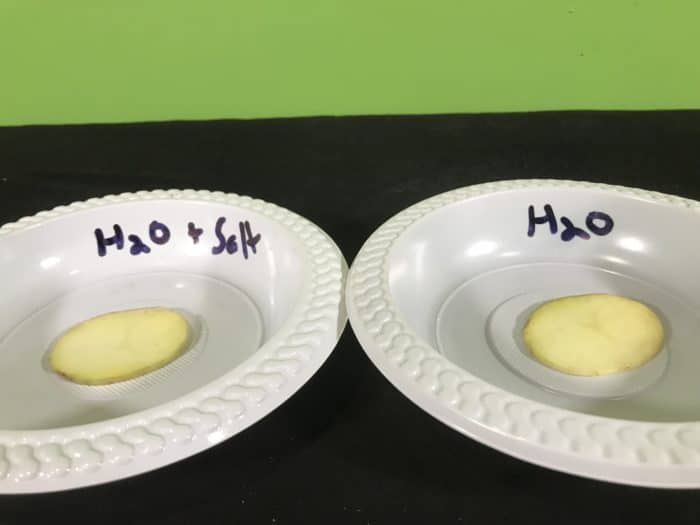
You will need
- 1 x Potato
- 2 x Cups of Tap Water
- 1 x Sharp Knife
- 1 x 500g Container of Table Salt
- 1 x Permanent Marker
- 2 x Small Disposable Plates
- 1 x 30 cm Ruler
Method
-
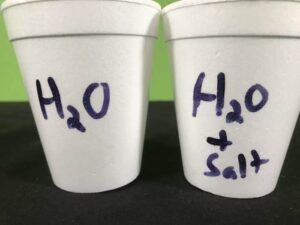
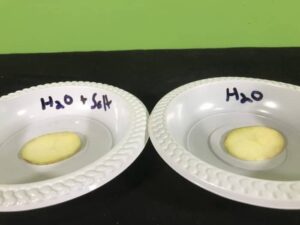
Label 1 cup of water “H2O.” Label the other one “H2O + Salt.”
-
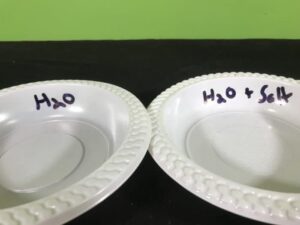
Label the disposable plates the same way.
-
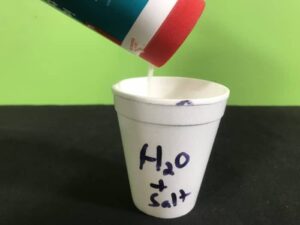
Add salt into the cup labelled “H2O + Salt” until it’s saturated with salt. Saturated means that no more salt can dissolve in the water. You’ll know when this happens because even after stirring it a lot, there will still be salt crystals at the bottom of the cup.
-
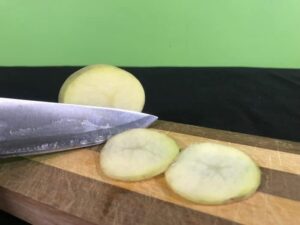
Cut the potato into thin slices. You’ll need two thin potato slices for this science experiment.
-
Place one potato slice on each plate.
-
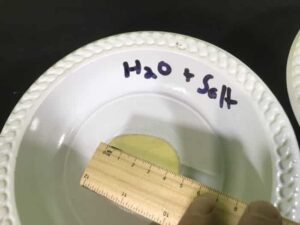
Measure the diameter of each potato slice and write these measurements down.
-
After about half an hour, go back to the potato slices. Do they look any different?

-
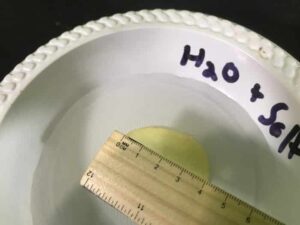
Measure the diameters again. Have they changed? Why?
-
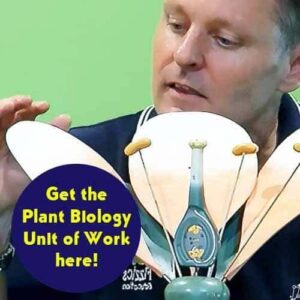
Get the Unit of Work on Plant Biology here!
- Learn about the parts of a flower
- Discover how vascular tissue transports water & sugars around the plant
- Learn about plant pigments and adaptations to the environment
- From photosynthesis to transpiration & more, there’s a heap covered!
Includes cross-curricular teaching ideas, student quizzes, a sample marking rubric, scope & sequences & more
-
School science visits since 2004!
– Curriculum-linked & award-winning incursions.
– Over 40 primary & high school programs to choose from.
– Designed by experienced educators.
– Over 2 million students reached.
– Face to face incursions & online programs available.
– Early learning centre visits too!

-

The science behind it
Why Does This Happen?
You’ll notice that the potato slice that was soaked in the saltwater is smaller than it used to be. How did this happen? Well, the potato is made up of millions of plant cells, each surrounded by membranes that are semi-permeable. This means that molecules can travel into and out of the cells, especially water which is a solvent.
While the potato is alive, the cells can decide which chemicals they want inside and which they want kept outside using special gate mechanisms in the cell membrane. But now that the potato has been removed from the ground, those gate mechanisms do not work as well anymore (if the potato is dead they won’t work at all). Instead, the chemicals surrounding and within the potato cells move in such a way that there’s a balance inside and outside the cells.
In the plate filled with saltwater, the environment external to the cells has a very high concentration of salt; a lot higher than the environment inside the cells. Solvent chemicals including water will naturally move in such a way that the concentrations of the solution are balanced. In this case, the water moves so that the salt is the same concentration inside the cell and outside the cell. The way this is achieved is that water from inside the cells flows out through the membrane into the salty solution in the plate. The water acts as a solvent and dilutes the salty solution, making the salt concentration outside the potato less ‘salty’ and makes the solution inside the cell less dilute and more concentrated or simply more ’salty.’ As the water leaves the cells of the potato, the potato slice shrivels up, and our measurements show this. You might also see the slice in clean water grow larger, as the water flows in the opposite direction; into the cell in an effort to dilute the other chemicals within the potato cells themselves.
What you have just looked at is Osmosis. This is the name for the movement of solvent molecules such as water through a semi-permeable membrane into a region of where there is a high concentration of chemicals other than the solvent (in this case, the salt). The movement of the solvent into the salty solution equalizes the concentrations on both sides of the semi-permeable membrane.
Vocabulary
- Solvent: The material that dissolves a given substance (usually a liquid but can be a gas or solid too).
- Solute: The substance dissolved in the solvent as described above. In this science experiment, it was the salt.
Variables to test
- Would distilled water vs fresh water make a difference?

Teacher's note
Curriculums change, and so does the way you implement them in your classroom. Please use your own experience and knowledge of your students to use these resources to best effect for student learning.
Still want the curriculum links?
Here are the suggested links:
Australian Curriculum (ACARA) Science:
NSW Science syllabuses:
Victorian Curriculum Science:
Want this experiment — and many more — running in your classroom?
Have us visit your school — every student gets three hands-on experiments in 60–90 minutes with a qualified presenter.








