
Soap powered boat
Explore the effects of surface tension with a soap-powered boat! It shoots across the water and is so easy to make. Part of >150 free science experiments…
Adult supervision for setup
You will need
- Cardboard or balsa wood (laminated paper or a thin plastic chopping board works well too)
- Tub of water, scissors and glue
- Detergent or soap
- This image to print out
Method
-
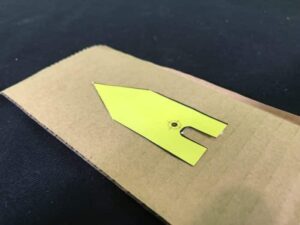
Print, cut out and glue the picture here onto some cardboard, or copy it onto your piece of balsa wood.
We’ve found that thin plastic such as a chopping board works well too!
-
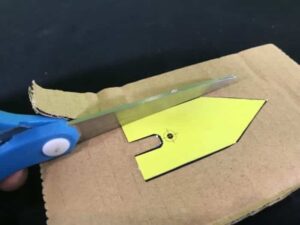
Cut out the boat picture, along the black lines, to make your small boat.
-
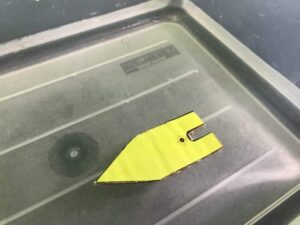
Place the boat into a tub of water.
-
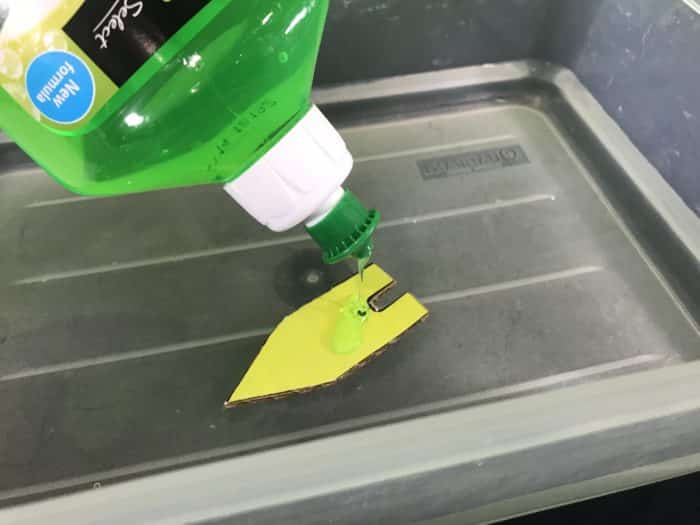
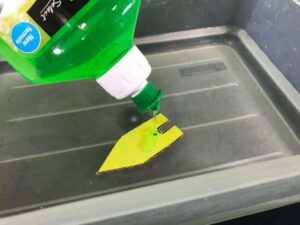
Place a drop of detergent, or soap, onto the ‘target’ of the boat.
Why does the boat travel forwards?
-
Get the Unit of Work on Water Science here!
- Explore the water cycle
- Learn about cohesion, adhesion & capillary action
- From water currents to floatation, join us to explore water science!
Includes cross-curricular teaching ideas, student quizzes, a sample marking rubric, scope & sequences & more
-
School science visits since 2004!
– Curriculum-linked & award-winning incursions.
– Over 40 primary & high school programs to choose from.
– Designed by experienced educators.
– Over 2 million students reached.
– Face to face incursions & online programs available.
– Early learning centre visits too!
-

The science behind it
Why Does This Happen?
The Science of the Soap Powered Boat
The movement of your soap powered boat is a fantastic display of physics and chemistry working together. It can be explained by three key scientific principles: Surface Tension, Newton’s Third Law, and the Marangoni Effect.
All liquids possess surface tension, caused by intermolecular forces pulling the liquid molecules together. This creates a stretchy “skin” on the surface. When you add detergent to the back of the boat, you are adding a surfactant. These molecules wedge themselves between the water molecules, breaking the hydrogen bonds and significantly weakening the surface tension in that specific area.
As the detergent molecules rapidly spread out across the surface, they create a “pushing force” backward into the water. According to Newton’s Third Law of Motion—which states that for every action, there is an equal and opposite reaction—this backward movement of the soap provides the thrust needed to send your boat zooming forward!
Simultaneously, the Marangoni Effect is at play. This describes how a liquid with high surface tension pulls more strongly than a liquid with low surface tension. Because the water in front of the boat still has high surface tension while the water behind has low surface tension (thanks to the soap), a surface tension gradient is created. The “stronger” water at the front effectively pulls the surface—and your boat—forward toward the area of higher tension.
Variables to test
Find out more on variables here.
-
Hydrodynamics & Design
Try different shapes of boats. Does a sleek, pointed “bow” move faster than a wide, flat one? This tests how water resistance (drag) affects the boat’s speed. -
Surfactant Potency
What happens if you use a solid bar of soap instead of liquid detergent? Different soaps have different chemical compositions; does one break surface tension more effectively than the other? -
Water Saturation
Try to run the boat a second time in the same water. You will notice it slows down or stops! This is because the detergent has already lowered the surface tension everywhere. To reset the experiment, you must use fresh water to restore that tension gradient. -
Liquid Temperature
Does the boat move faster in hot water or cold water? Since heat already lowers surface tension slightly, it may change how much of a “pull” the boat receives from the surrounding water.
Remember, for a “fair test,” only change one thing at a time. Whether it’s the boat material or the type of soap, keeping everything else the same ensures your results are valid!

Teacher's note
Curriculums change, and so does the way you implement them in your classroom. Please use your own experience and knowledge of your students to use these resources to best effect for student learning.
Still want the curriculum links?
Here are the suggested links:
Australian Curriculum (ACARA) Science:
NSW Science syllabuses:
Victorian Curriculum Science:
Want this experiment — and many more — running in your classroom?
Have us visit your school — every student gets three hands-on experiments in 60–90 minutes with a qualified presenter.








