
Watermelon pop
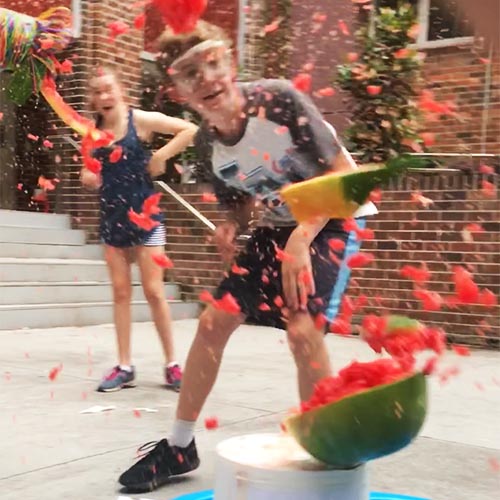
Explode a watermelon using just rubber bands! This science activity is perfect for science fairs or simply some fun with your class. Find out more…
Adult supervision for setup
You will need
- A full-size watermelon
- Rubber bands that fit around the watermelon (e.g., 87 x 6mm)
- Safety glasses
- A platform to raise the watermelon up (optional)
- A hose for easy clean-up
- Hungry people to eat the leftovers!
Method
-
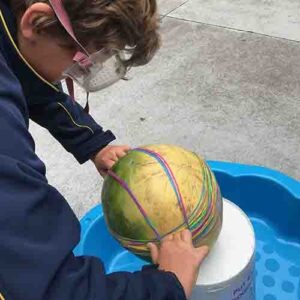
Put your safety glasses on. Stretch a rubber band around your watermelon.
-
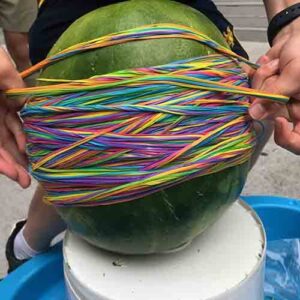
As you add more and more rubber bands you’ll find that they will tend to spread out around the watermelon rather stay in the centre. Try to keep as many of the bands around the middle of the watermelon as possible.
-
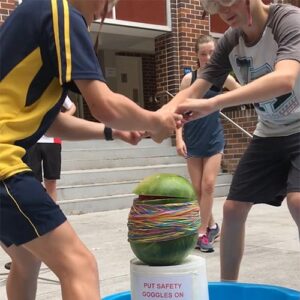
You may find it easier with two people stretching multiple rubber bands over the watermelon to speed up the process. As soon as you see the watermelon begin to split, it’s time to step back!
The photo above was taken at the exact moment the watermelon started to split
-
Once the watermelon has begun to split it will likely implode at any moment. The image above was taken roughly 4 seconds after the first split was seen in the previous step!

-
Get the Unit of Work on Forces here!
- Push, pull
- Friction & spin!
From inertia to centripetal force, this unit covers many concepts about Newton’s Laws!
Includes cross-curricular teaching ideas, student quizzes, a sample marking rubric, scope & sequences & more

-
School science visits since 2004!
– Curriculum-linked & award-winning incursions.
– Over 40 primary & high school programs to choose from.
– Designed by experienced educators.
– Over 2 million students reached.
– Face to face incursions & online programs available.
– Early learning centre visits too!
-

The science behind it
Why does this work?
The Science of the Watermelon Pop
The dramatic explosion of a watermelon under the pressure of rubber bands is a perfect study of stress, strain, and energy transformation. It demonstrates how small amounts of force, when multiplied and concentrated, can eventually overcome the structural integrity of a solid object.
Potential vs. Kinetic Energy
When you stretch a rubber band, you are doing work on it. This work is stored as elastic potential energy within the polymer chains of the rubber. The more bands you add, the more potential energy is “loaded” onto the watermelon.
- Structural Resistance: The watermelon’s rind is quite strong and acts as a load-bearing structure. It resists the inward “squeezing” force (compression) of the rubber bands.
- The Breaking Point: Every material has a yield strength. Eventually, the cumulative force of hundreds of contracting rubber bands exceeds the rind’s ability to hold its shape.
- The Implosion: Once the rind cracks, the watermelon implodes inward. This sudden movement triggers the instantaneous release of all that stored potential energy, converting it into a massive burst of kinetic energy (the explosion of fruit and juice!).
Variables to test
Find out more on variables here.
- Elasticity and Width: Try thin versus thick rubber bands. Do thicker bands provide more tension per band, requiring fewer total bands to reach the breaking point?
- Thermal Effects on Rind: Is there a difference if the watermelon is warm versus cold? Cold temperatures can make organic structures more brittle, while warmth might make them more flexible.
- Surface Area and Volume: What about different sizes or types of watermelon (e.g., seedless vs. seeded, or yellow vs. red)? Does a larger radius distribute the force differently, making it harder to pop?
- Placement Concentration: What happens if you spread the rubber bands across the whole watermelon instead of keeping them in a concentrated line around the middle?
Want more potential to kinetic energy experiments?
Try creating a Cobra weave using popsicle sticks!
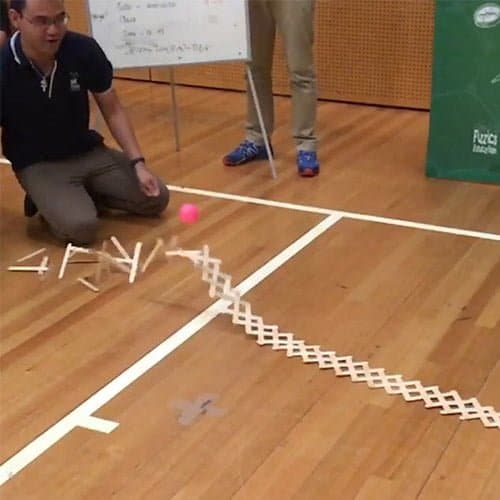
Safety Note: This experiment can be dangerous! Always wear safety goggles and stay a safe distance back once the watermelon starts to deform. To keep your results valid, try to use rubber bands of the same brand and size for each trial!

Teacher's note
Curriculums change, and so does the way you implement them in your classroom. Please use your own experience and knowledge of your students to use these resources to best effect for student learning.
Still want the curriculum links?
Here are the suggested links:
Australian Curriculum (ACARA) Science:
NSW Science syllabuses:
Victorian Curriculum Science:
Want this experiment — and many more — running in your classroom?
Have us visit your school — every student gets three hands-on experiments in 60–90 minutes with a qualified presenter.








