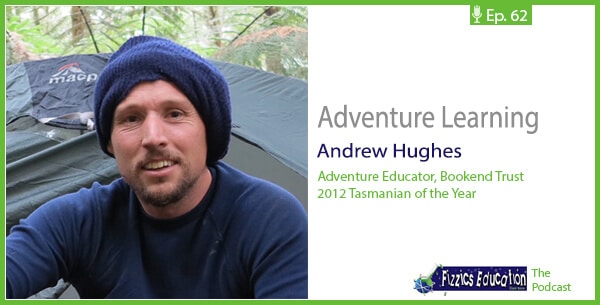
Ever wanted to go on an adventure? Well, Andrew Hughes from the Bookend Trust does this for a living and through Expedition Class he inspires student young and old to learn more about our environment & our heritage. From hiking the wilds of Tasmania to sea kayaking around Papua New Guinea, Andrew takes adventure learning for students to another level!
What happens when a teacher trades the whiteboard for a sea kayak and a tandem bicycle? In this episode, we venture into the world of “Adventure Learning” with Andrew Hughes. We discuss his childlike outlook on challenges and how his extraordinary expeditions across the globe are used to bring environmental science and community connection to life for thousands of students following his journey online.
About Andrew Hughes
Andrew Hughes is a renowned adventure educator with a unique professional background in both Science and Primary Education. As the mastermind behind Expedition Class, Andrew has spent the last 10 years professionally planning expeditions and sharing the wonders of the natural world via digital platforms. His work with the Bookend Trust earned him the title of 2012 Tasmanian Australian of the Year and the Bryce Courtenay Power of One Australian Hero award. Whether he is paddling solo through remote waters or embarking on his latest Swag Family project—an Australia-wide tandem bicycle adventure with his wife and young children—Andrew’s mission is to make the world a classroom without walls.
Awards: 2012 Tasmanian Australian of the Year, Bryce Courtenay Power of One Hero.
The Bookend Trust & Expedition Class
The Bookend Trust is a not-for-profit science and environmental education organisation based in Tasmania. It focuses on promoting positive stories and connecting the public with what scientists are doing in the wider world.
Key Initiatives:
Expedition Class: A digital learning platform that connects students in classrooms with Andrew’s real-world adventures through video, written reports, and spontaneous interviews.
Citizen Science (Where? Where? Wedgie!): A project that enlists the public and students to make field observations of Wedge-tailed Eagles to track population trends for this endangered species.
16 Legs: A documentary and educational package focusing on ancient cave spiders and unexplored cave systems in Tasmania, featuring Dr Neil Doran and Neil Gaiman.
Antarctic Experience: Led by David Dick-Fossey, this programme takes students through CSIRO labs and on flights over Antarctica to witness Mount Erebus and connect with Casey Station.
Top Episode Learnings: Science in the Wild
The Power of Spontaneous Learning:
Andrew explains that while concrete resources are provided, the best learning occurs when teachers and students respond to the unpredictable, “live” events of an expedition as they unfold.
Authentic Citizen Science:
We discuss how projects like Where? Where? Wedgie! move students from passive consumers of science to active contributors, helping to build longitudinal datasets for endangered species.
Embracing the Unknown:
Andrew highlights that for adventure learning to work, there must be an element of the unknown. By watching an explorer navigate real risks, students develop resilience and a deeper understanding of scientific field work.
Education Tip: The “Virtual Expedition” Log.
Follow Andrew’s lead by having your students “follow” a real explorer or scientist currently in the field. Ask them to keep a Scientist’s Log where they predict the challenges the explorer will face and use scientific data (like local climate charts or topographic maps) to justify their predictions. This turns a passive reading task into an Active Inquiry into the realities of field science.
[00:00:15]Ben Newsome: Just welcome again to another Fizzics Ed Podcast. Big week this week! We’re speaking with Andrew Hughes, who was named the 2012 Tasmanian Australian of the Year and the Bryce Courtenay Power of One Australian Hero for his work with the Bookend Trust. This is a not-for-profit science and environmental education organisation that’s all about promoting a better understanding of the natural world, which really helps us understand how we can act for our own positive wellbeing in the future.
[00:00:50]Ben Newsome: Now, Andrew is very much busy about developing ways to engage students in learning from beyond the classroom. He really does believe there is room for a world for teachers to do some extraordinary but calculated risks, all in the name of education. That’s exactly what he’s been doing with the Expedition Class. We’re going to hear about his work, not just in the outdoors by himself, but bringing kids involved with this. Today, you’ll definitely hear exactly how he’s going about this.
[00:01:28]Ben Newsome: So, without further ado, let’s just sit back, relax, imagine that we’re out in Cradle Mountain or somewhere beautiful in Tasmania and listening to one of Australia’s leading inspiring educational leaders when it comes to adventure learning. This is the Fizzics Ed Podcast.
[00:02:11]Andrew Hughes: I make up a job description called adventure learning teacher. Sometimes I just go for adventurer, but essentially I work for the Bookend Trust and we’re a little organisation down in Tassie, but we’ve got a fairly broad footprint I suppose, because we offer online learning and different things in the environmental and science outreach space. Amongst all that, I go on adventures and I put them in classrooms and teachers drag out of that lots of great learning opportunities for students.
[00:02:40]Ben Newsome: So here’s the thing. I know as a kid every kid wants to be a fire person at some point and they want to do certain things, but one of the things that often comes up is I want to go adventure and go on travels and things. But you’re getting to do this! How on earth did you fall into this?
[00:02:58]Andrew Hughes: It reminds me, I was driving the other day home thinking about this conversation I’d have with you. I thought I don’t have a lot to offer here other than that I started exactly as you said as a young kid loving going on adventures in my neighbourhood and just kept doing that and I just haven’t stopped. The way you fall into it is you just keep doing it persistently and consistently, and you never let anyone tell you that it’s a bad idea even if it is a bad idea, you just keep doing it.
[00:03:30]Andrew Hughes: So I’ve literally just continued being a child with a very childlike outlook on life and done that for the last 10 years professionally and the last 40 years as a human being. So that’s how it’s happened.
[00:03:40]Ben Newsome: Isn’t that really where the magic happens, I must admit. I feel like this is going to get philosophical, but isn’t that really the point where you are often when you just having fun is where the real moments are really happening and there’s a genuine connection with your project, for whatever your project might be? But I mean, if you just happen to be playing, all the hoo-ha and bureaucracy and all that stuff seems to melt away while you just having fun. So straight up, you’re living the dream! Good on ya.
[00:04:08]Andrew Hughes: Well, I totally agree with you. I guess I come from a science background generally from the university level, but I also just come from loving the outdoors—bushwalking, kayaking and all that sort of stuff. I knew from dot really, as soon as I experienced that, climbed a mountain, walked a track, paddled across a body of water, I knew that so much good personal learning but also learning about the world around us comes from actually physically engaging with it.
[00:04:40]Andrew Hughes: What I do is an extension of all that and I speak for the entire Bookend team. What we do is share what the world around us has to offer by actually being out in it and experiencing it, and I think that is, you’re right, the powerful way to learn.
[00:04:51]Ben Newsome: And that Bookend Trust really is quite a powerhouse. I know you said you’re just a small little team out of Tasmania, but geez, you are doing some big things. Maybe just paint a picture, I guess, of exactly how the Bookend Trust sort of got going and what it does. I must admit, I didn’t realise just how much you guys actually do. Now I know a lot more. Where does this all come from and all that sort of thing? Paint us a picture.
[00:05:21]Andrew Hughes: Well, it goes back 10 years and Dr Neil Doran is the director of the Bookend Trust. It was his big idea. He left public service as a zoologist with the Department of Primary Industries and Water down here in Tassie. He, with his past supervisor Dr Alistair Richardson from the University of Tasmania, wanted to do something that had a positive impact on young people and, to be honest, the community as far as how they engage with science in the public sphere.
[00:05:55]Andrew Hughes: So the Bookend Trust was really set up to try to promote positive stories and put people in touch with what scientists are up to in the wider world. In the early days, and they started that without me being involved at all, then right in the early days, Neil must have been listening to the radio and I was off paddling up the east coast of Australia or whatever I was up to at the time. He said, “What I think you’re doing is really close to what we want to be part of as well,” which is reaching all audiences, including primary schools, in this space of positive, quality educational opportunities.
[00:06:40]Andrew Hughes: So I joined up way back in 2008 and we’ve been building education and public outreach projects that really don’t dwell on the doom and gloom and they really just celebrate the world we have around us by, like I say, doing those things that are hands-on. Which includes online learning but also actually taking people out into field settings and on scientific expeditions where they can experience some of the wonder of life I suppose. That’s what’s generated the heat and interest in it ever since.
[00:07:04]Ben Newsome: And it’s certainly not just around Tasmania. Mind you, I must say around Cradle Mountain and beyond there are some beautiful places, but you’ve taken students to Fiji and even over to Antarctica. I mean, you’re not messing around!
[00:07:18]Andrew Hughes: No, and what I think is just wonderful and we share a very special part of the world down here in Tasmania and we love it and we promote the heck out of it wherever we can. But it’s not the be-all and end-all, and we know that kids come from all across the country, all across the world. Tassie is really fascinating to them, but our Tassie kids are also fascinated by the rest of the world around them. So we mix it all up.
[00:07:45]Andrew Hughes: We’ve taken kids over to Fiji, we’ve had exchanges with kids from Thailand that have come over to Tassie and taken our Tassie kids over to Thailand. We’ve got a wonderful project that David Dick-Fossey runs with us called the Antarctic Experience. He takes, in conjunction with the research institutions down here, he takes students from around Australia through the CSIRO labs, the Australian Antarctic Division labs where they hook up through video conference with Casey Station.
[00:08:20]Andrew Hughes: Then they jump on a plane and fly over Antarctica and get to eyeball, you know, the ice, Mount Erebus and all those wonderful things down south. So the range of programmes from a small team does sort of defy logic at times and I must admit we feel it at times too. We’re stretched to the limit, but we really love what we do, so it’s all for a good cause I suppose you’d say, Ben.
[00:08:36]Ben Newsome: Well, it is and I must say, I mean, it’s not just about public education, you’re 100% involved in citizen science as well. I mean with the Wedgie project and a few other things, Coastwatchers and things, that’s unreal! Tell us a bit more about those.
[00:08:51]Andrew Hughes: Wedgie one is very close at the moment because we’ve just come off the National Science Week event. So when I crossed to you last Friday to the National Museum, I raced back down to the wharf at Hobart where they have this big festival of bright ideas they call it. My part in that was to stand behind a stall and talk to kids and adults about the “Where? Where? Wedgie!” project.
[00:09:15]Andrew Hughes: And this year’s online adventure learning project, but also citizen science project, where we’re inviting students and adults and importantly adults to go out and help us make quality field observations of Wedge-tailed Eagles on a particular weekend and then feed that back into a citizen science model where we could start to try to get our heads around the population of Wedge-tailed Eagles. Starting now but going hopefully for many years into the future where we can track that population trend for this endangered species that we don’t know as much about as possibly people think we do.
[00:09:47]Ben Newsome: Now, one of those things about the Bookend Trust is you really do have a lot of things happening and yourself, I mean, you’re genuinely right in the thick of it. You’re packing up the family and travelling around Australia really soon with the Swag Family! This is yet another thing. I mean, I must say there’d be people listening in when they hear this, imagine going on this adventure, it’d be unreal. Andrew, tell us about it.
[00:10:11]Andrew Hughes: This is where work crosses over with just life and I guess that’s true of many of the projects that we’ve been involved in. But this one’s particularly close to home because I’m packing up—I’ve got two little kids, my wife and I, Nicola, have two little kids who are two and four at the moment. They’ll be three and five before we leave but we’re popping them on the back of tandem bicycles and we’re going to ride as far as we can around Australia.
[00:10:43]Andrew Hughes: This is under the direction of some really inspiring and amazing people to learn about the places where people live around Australia and the landscape of Australia from people that know a lot more than we do. So we become the eyes and the ears for students in classrooms through our Swag Family website that we’re building to sort of relay this big Australian story into classrooms from people that know it the best.
[00:11:05]Andrew Hughes: And it’s going to take us, yeah, we think 10-11 months. That’s how long we’ve given ourselves and we’re going to produce lots of great stuff for schools and the general community just to engage with a side of Australia that they might not get to see, and we’ll be doing it from the back of tandem bicycles, which is sort of ridiculous, but it’s adventurous and it’s going to be good fun.
[00:11:25]Ben Newsome: And the beauty about this particular trip is that, I know when I pack up for the holidays, I know pretty much where I’m going, where I’m going to be staying, not to the point of what I’m going to eat because I don’t plan that deeply. But I’ve got a rough idea of my itinerary, but you’re doing this differently.
[00:11:42]Andrew Hughes: Yeah, you’re right and this is the part that actually really excites us because we’re travelling, we know we’re starting. We’re starting in Tasmania, we’ll probably start at one of our public schools because we’ve got a lot of support down here in Tassie for these education projects. So we’ll ride out of the school sometime in the middle of February when school gets back next year.
[00:12:05]Andrew Hughes: And then we’ll head to the north-east of Tassie where one of our project partners, a wonderful Tasmanian Aboriginal elder called Aunty Patsy Cameron, has agreed to let us basically rock up on her doorstep on our tandem bikes and say, “Aunty Patsy, we’re here, where should we go next?” And from there, Aunty Patsy will recommend or suggest one of her friends or contacts or colleagues from somewhere else in hopefully south-eastern Australia, because we don’t want to go too far to start with.
[00:12:35]Andrew Hughes: And then we’ll ride off to visit that person and then be connected to another person down the road, and we’ll be passed around, if you like, the community for the next 10 months after that where we’ll be guided largely by the people we meet as to where we should go and what we should be learning.
[00:12:53]Ben Newsome: Which is exciting because, I mean, obviously people will be able to follow your journey as you go along, but I mean, there is another output that I guess people can engage with even if they can’t follow you on that journey in the first place. And the fact that, I mean, that output, what is the cumulative thing that you’re going to actually have by the end of that trip?
[00:13:10]Andrew Hughes: What you could expect, if you’re in a classroom for example, if you’re a teacher going, “Oh what, how does that relate to me in my school?”, is that what we do is we package up and before and during, we have lessons and units of work that will relate to what we’re doing in a general sense.
[00:13:30]Andrew Hughes: And then as we’re going, what we find is teachers use the video content, the photographic content, the written reports, the interviews we do with people. They actually find that they spark conversations and directions in the learning in the classroom that we can’t anticipate before we start and teachers can’t anticipate before they actually find that content in their classroom.
[00:13:53]Andrew Hughes: So we do have very concrete resources for teachers before we go, but then we find actually most of the really great stuff comes from spontaneous learning, if you like, from the engagement with the adventures as we go. So it sounds like a lot of fun, and it is. It is also a lot of hard work because we put these resources together very carefully so that teachers can get a lot out of them.
[00:14:18]Ben Newsome: And I suspect a lot of training prior too, because you have to be fit!
[00:14:22]Andrew Hughes: You’d be wrong about that one, Ben. It’s funny you say that. This year, the “Where? Where? Wedgie!” project this year, I for the first time in 10 years, I drove a car around with a scientist called James Pay. And James is this very enthusiastic eagle researcher who’s been tracking eagles and the only way we could really go and investigate his project and the birds that he’s been tracking was to drive around.
[00:14:48]Andrew Hughes: So normally where I get one month of very solid exercise a year, this year I’ve had none. And I’m planning on going away very unfit, and my wife would probably say the same. She’s a bit fitter than I am. And then as we go we train and we’re riding, we’re doing it and we get a bit fitter as we go. So if you’re sitting there thinking, “Oh, I couldn’t possibly do something like that,” just think of a really lazy office worker sitting in front of a computer for many hours a day at the moment and then jumping on a bike and then heading off, because that’s pretty much what we’re doing. We’re not extraordinarily fit or, yeah, we’re not that person. We’re very average commuters if you like.
[00:15:24]Ben Newsome: There’s probably easily a mathematics component here and straight up in terms of your resting heart rate as it changes through time or the kilojoules intake…
[00:15:38]Andrew Hughes: That would be interesting. I think we might have to, yeah, we could hook ourselves up to some little computers and see how that goes. In fact, that’s a very good idea and that’s why it’s good talking to people about this stuff because most people have good ideas about the project. Good on ya, Ben!
[00:15:53]Ben Newsome: Well, I don’t know, I mean, go for it! The thing is there’s so much you can do. In fact, I suppose it comes down to that about internet connectivity but there’s an app, Google Science Journal, which is kind of cool. It uses all the different measuring devices that are in your various phones and you could actually even look at the acceleration and deceleration as you go up and down the mountains and also produce a bucketload of data for people to analyse. In fact, actually, it’d be interesting actually. I wonder if because you’re dealing, you deal with primary students all the way up to secondary and beyond, so I mean there could be this output of data that people could, they could just look at the raw numbers and try and work out what were the contours they were riding on at this point? Because technically you probably could do it. It’d be a bit hard to crunch the numbers though. But it’s a lot of fun!
[00:16:40]Andrew Hughes: Yeah, no, and that’s, I mean, that’s the sort of stuff. So you’re thinking as a teacher now and you’re just going, “Oh, here’s what they’re going to be putting out there, what could I do with that in my classroom?” That’s exactly what good teachers do too. They just get the content, the raw content if you like, or the data that we put out there for teachers and students to consume and then they make stuff up that I couldn’t think of on my own. And that’s how adventure learning actually works. You’ve got to the nub of it right there.
[00:17:04]Ben Newsome: I must say though, I’ve got young kids. Having a three and a five-year-old, or soon to be a four and six, I mean, that’s going to be interesting managing emotions! I can imagine.
[00:17:15]Andrew Hughes: Yeah, well, this is, yeah, and like I say to any class I visit, adventure has to have a huge element of the unknown for it to be an adventure. I mean, we could write a book about this adventure without doing it and you know how it’s going to go because you get to write it from your imagination. But when you actually go on adventure, you don’t know how things are going to pan out.
[00:17:42]Andrew Hughes: And students really clock onto this idea of, “Oh, this could end any number of different ways and we will have to be part of it to see how it unfolds.” And one of the big unknowns that we’ve got on this trip, which is legitimate and it worries me and it certainly worries my wife, is how our kids go. And we don’t want to be putting them in positions or situations that could do long-term harm or impact them negatively.
[00:18:01]Andrew Hughes: So it’s a big part of our planning at the moment is just to think about and try and plan for how our kids might respond to the project and where we have to rip up the plan, if you like, and come up with a new one. So that will be part of the fun of watching it and being part of it is to see what we have to do to modify it to make it successful.
[00:18:22]Ben Newsome: Absolutely. And as parents, you definitely will look after your kids. In fact, it actually reminds me of, I cannot, I’m really terrible with names and things, but there was a Canadian family, I swear on Netflix, who was doing a similar thing. They were trying to get to Asia but they weren’t using traditional transport and they had packed up their kids as well. They were a bit older, I think they were like nine and 12 or something like that. And, you know, I think they were catching freighters and all sorts of things to get across. It is, and you’re right, by definition adventure is the unknown, otherwise you’re really just doing a tour itinerary. And I can imagine this is going to grab the kids’ imaginations, yours and the people watching in.
[00:19:03]Andrew Hughes: Well, and the reason we’re still here 10 years later from when this all started, that’s Bookend, Expedition Class, the whole adventure learning thing that we do—and it’s not everything we do, but it’s a big part of what we do as an organisation—is because kids respond to it. They’re, another phrase I use with classes is kids are the best adventurers. And when I said I’m just a big kid really, and that’s true in the sense that my outlook on life and how to approach challenges is very childlike and adventurous-like, which is just we’ll see what happens. We’ll chuck a few things together, we’ll make a plan and then off we go and then we’ll report back what happens and modify it as needs be.
[00:19:44]Andrew Hughes: So taking risks, going on adventures is a very childlike thing to do and that’s why kids respond to it and that’s why we get such a good reaction from classrooms and students that participate in it.
[00:19:57]Ben Newsome: Out of all your adventures, you’ve been sea kayaking through to hiking up all sorts of places. What’s one that sticks out as a memory that you just look back and go, “Wow, I did that.” What would it be?
[00:20:11]Andrew Hughes: That’s a good question. Well, there was one where… and I can test this because when I go to schools and talk to kids there’s always a couple of stories that I end up falling back to for some reason. They just come to top of mind. And one story or adventure that I relate a lot is going to a nearly deserted island in Papua New Guinea.
[00:20:38]Andrew Hughes: And it was nearly deserted. It had one very old but very extremely fit man called Dagama living on this island called Delama Island off the south-east coast of Papua New Guinea. And I got permission from Dagama and his extended family, the traditional owners, to stay on his island for a month, and I took over with me a couple of bags full of gear, my survival kit if you like.
[00:20:59]Andrew Hughes: I stayed on the island to survive and document that for students as a science of survival project called the Cruso Project. And I have fond but also distressing memories of that month on the island because I was truly hungry and I was truly struggling at times for motivation for why I was there. So it was a fascinating personal experience to be the real-life Robinson Crusoe, which I think is what a lot of people dream about doing in some form or another when they read those kids’ adventure books. So I got to live that sort of dream and that’s a memorable one.
[00:21:37]Ben Newsome: I bet! Actually just thinking about books themselves, I mean, geez, you’d have to have a few books in you. I was literally saying you yourself, like you’ve got enough stories that you could stitch together into books.
[00:21:59]Andrew Hughes: I don’t do that, Ben, but I was thinking on the island because it’s a sore point because I took the SAS Survival Guide which only had a small chapter on the tropics, which was useful but not great, and Robinson Crusoe which is very hard to read because it was written hundreds of years ago. So yes, you’re right, there’s stories out there. Everyone’s got stories, but yes mine have just come from some pretty silly ideas along the way.
[00:22:23]Ben Newsome: Well, with the adventure learning you’ve got your highs and you’ve got the lows. At any point you’ve thought, “Wow, I’ve kind of got myself into a bit of a situation?” When has it ever gone pear-shaped, so to speak?
[00:22:37]Andrew Hughes: The true adventure test, I suppose, is when things do go wrong. It happens to a lesser or greater extent on all trips and it could just be something that’s disappointing or didn’t quite go as you planned, but it could also be life-threatening. On one trip around Papua New Guinea in a sea kayak back in, I think it must have been 2008 or 2009, I faced a leg infection that had run out of control and I was completely useless and completely unprepared for it and in hindsight it was a ridiculous situation to be in.
[00:23:15]Andrew Hughes: But I was in a remote part of Papua New Guinea with a severe leg infection and had to get an emergency evacuation out to a hospital, have it operated on and a stage of recovery before I could continue. And that was all playing out in front of, admittedly at that time, a smaller audience than these days, but the students were actually going along for the ride of, “Oh, Andrew’s just posted that he doesn’t know what’s going on with his leg,” and then there’s a couple of days’ delay and Andrew’s just posted that he’s in hospital. So this was real adventure learning in a sense and I wouldn’t want to repeat that one, but occasionally, that being the worst case, it can go wrong.
[00:23:53]Ben Newsome: Understandably! I mean, you’re in a tropical environment, even just a small nick in the skin can become infected and wow, that’s pretty full on actually. Oh dear!
[00:24:05]Andrew Hughes: It was! It was just a… it’s another story and I’ve got to be careful when I say this in front of students, especially in primary school, because it was literally just a little coral cut or an insect bite on my knee that over a course of six days incapacitated me and stopped me walking and swelled up and got into the skin and almost into the blood and knocked me off.
[00:24:29]Andrew Hughes: As I relate that story to kids about bacteria and Staph or Strep getting in and running riot in there and then my knee sort of exploding and blood pouring down my leg, I’ve occasionally had a few little kids when I haven’t prepared them properly go a bit white and look like they’re about to pass out. So yes, you’ve got to tailor your message to the audience, that’s for sure.
[00:24:49]Ben Newsome: Yeah, make it less vivid! Oh no, it’s wonderful. Undoubtedly there’d be people listening in who will want to get involved in this type of work and whatnot. What would you suggest be your first steps? Whether you’re speaking maybe a high school audience or maybe an undergraduate class, people who are thinking, “Hey, I love environmental sciences and whatnot, but they really want to get out in the outdoors and get into adventure learning as such.” What would they need to do in their first steps to get involved?
[00:25:22]Andrew Hughes: It’s a good question. I guess you’ve got to cobble your own passions and interests into this right from the beginning. It only became a job after I’d done it for enough years that everyone around me believed that it was worthwhile. So it wasn’t like something you could apply for, it’s something that developed out of just wanting to keep on doing this same thing of going on adventures and sharing them with students in this very novel online format.
[00:25:58]Andrew Hughes: So the training is going on your own adventures to start with that are just for yourself and your own personal skills and development. For me, the biggest challenge I ever faced with these projects is the public side of it, and that’s talking to kids in classrooms and working out how to communicate with students of different ages effectively. So I did a teaching degree largely just to be confident and comfortable and to get skills that would help me communicate with kids.
[00:26:33]Andrew Hughes: And it’s not an easy thing to do and it’s something I’m still not all that great at, but it’s something that develops over time. So for me, personal adventures that led on to working out how to communicate them to a younger and different audience and then getting the right people on board for things like technical stuff that you’re not ever going to have access in your own brain to, people that can design websites, people that can promote and market and do the things that you can’t do it all yourself. So recognising where you’ve got gaps in your own skill set and getting really good people to fill those gaps, they’re sort of the keys to it, I think.
[00:27:04]Ben Newsome: I bet! And right, it’s always about the support infrastructure around you and no person can do everything by themselves. We are not human Swiss Army knives! We need people to help out.
[00:27:16]Andrew Hughes: That’s right. And that’s where the Bookend Trust and Neil came along at the right time with their own passions and areas of expertise that really together the Bookend has grown as a series of individuals that have formed an organisation that all do our own separate things within the organisation, but we all come together when it counts to support each other and make it bigger than any one person, which is really important.
[00:27:42]Ben Newsome: Absolutely. And I’ve had the pleasure of meeting up and chatting with Neil Doran before. He’s a Churchill Fellow and just released 16 Legs, which we’ll talk about a bit more after, which is a really interesting cave documentary in regarding the breeding cycles of these spiders and really ancient caves down in Tassie. I’m going to ask you straight up, were you able to be involved in that project with Neil?
[00:28:07]Andrew Hughes: I was, and certainly not to the degree Neil was. 16 Legs is just a huge story. You’ll have to get Neil on another time to run you through the whole thing. But my particular part of it or Expedition Class part of it was to do an expedition project called Cave Search. So as part of the 16 Legs documentary, we had a month out in the south-west of Tassie using LiDAR imagery that we got from Forestry Tasmania to identify spots that might have caves in them that have been unexplored until now.
[00:28:43]Andrew Hughes: And I spent a month traipsing around the bush down there with a couple of other guys, including some cave teams from the Southern Cavers and other groups. And we went and found caves for a month and talked to kids about how that all went. And then we brought students down and we did a thing called Cave Art where we had students making art out of their cave experiences and then sharing that in a big public exhibition.
[00:29:08]Andrew Hughes: And that all formed part of this 16 Legs package, which is very much about a nature documentary but also about the ways that we could engage students in an educational sense hanging off the side of it. So I had a bit part in the 16 Legs story, but overall it’s been a wonderful film to be associated with and it’s doing great stuff out there still.
[00:29:26]Ben Newsome: Yeah, definitely go check that out. I was lucky enough to see one of the Sydney premieres and narrated by Neil Gaiman as well. It’s really just a well-shot as well as the story itself. It’s beautifully shot.
[00:29:40]Andrew Hughes: I don’t know if you caught the story, Ben, but Joe Shemesh, who’s the cinematographer for much of it, and his off-sider Doug Thost, they spent literally months down caves with cameras that they didn’t know would work in these environments, trained on spiders that don’t move very much and trying to capture their life cycle and the story of the cave spiders but all the other cave animals was a very major challenge. And the success of the film all rests on this perseverance of Neil and the team to get these extraordinary stories of an underground creature that lives in the dark and doesn’t move much.
[00:30:21]Ben Newsome: It’s brilliant. So you guys are very involved in lots of stuff. It’s kind of like often when we usually finish chats with, “Hey, where would you go to find out more information?”, I kind of feel we need like a big list with bullet points of different things that you guys are getting involved with. All right, so first up, how would they get to find out more information about your current project that’s coming up with the Swag Family?
[00:30:44]Andrew Hughes: swagfamily.com.au is where we’re building the full educational website at the moment. At the moment, there’s a holding page where you can sign up to a newsletter so we can keep people up to date. So that’s the trip around Australia looking at cultural connections but individual connections and learning about the country from tandem bicycles. So that’s a really good one for teachers or anyone next year that loves an adventure story.
[00:31:15]Andrew Hughes: The bookendtrust.com website has a sort of container for and branches off into many of the things we’ve talked about: the projects for Antarctica and Fiji Power and 16 Legs. So that’s probably the best spot to go. And we continue to innovate and create new projects all the time, so it’s worth just hooking up with the Facebook page Bookend Trust and we put most of our information through there as well.
[00:31:37]Ben Newsome: Awesome. And as usual, we’ll pop that in the show notes so you can go check that out for sure. Look, Andrew, thanks very much for squeezing a bit of time in for chatting about this and you must be looking forward to kicking off with this.
[00:31:51]Andrew Hughes: The hardest part of every project, well certainly the adventure learning stuff that we do, is the months before. And when you actually leave and you depart and you’re underway and you’ve got your bag and it’s got this much gear in it and that’s all you’ve got pretty much for the rest of the expedition, everything’s simple because you can only choose between these different things and this different way to do it.
[00:32:15]Andrew Hughes: But leading up to it, this is the hard part that we’re in at the moment, which is trying to design the project from the curriculum, from all of the people that we need to have involved and talk to and everything else. So I’m very much looking forward to departure with Nick and the kids and the fun starts when we drive down the driveway and say goodbye to this life of work, I suppose, that we’re in at the moment.
[00:32:38]Ben Newsome: Yeah, but it’ll be so much richer for it for sure. And definitely, if you’re listening in and you’ve got a class that you think could get something out of it, try it out! Jump on swagfamily.com and go check out exactly what’s going on with Andrew and the family and think about how you might be able to use this trek to enrich your own students’ lives.
[00:33:03]Ben Newsome: Potentially maybe some of the kids watching or doing projects off this might actually start thinking about adventure learning themselves, which I think would be a great outcome. But also learning about the environment and Aboriginal culture and everything else is a stunning outcome as well. Thank you very much, Andrew, for your time. And look, we might catch another time, perhaps you might be on the bike in the desert somewhere, but who knows? It’s going to be great.
[00:33:25]Andrew Hughes: I’ll do that, Ben. Hook up with us when we’re out there because when you’re speaking from the field, the conversations are so much more interesting and entertaining as well. So do that next year, anytime you like. Been great talking to you and really appreciate the opportunity to let people know about what we’re up to down here.
[00:33:43]Ben Newsome: No worries, mate. Enjoy your afternoon.
[00:34:06]Ben Newsome: Well, there you go, just been hearing from Andrew Hughes who really does communicate and share our wonders of our Australian bushland and beyond by getting involved in adventures that, well, people can tune in on online. And it’s really worth getting your classroom—or if you’re not in a classroom, getting other classes—to get involved with his expeditions.
[00:34:35]Ben Newsome: And I tell you what, Swag Family with his wife Nicola and those two children are going to have a blast going around Australia. It makes me wonder just exactly where they’re going to get to. It’s going to be very, very interesting. And I still recommend you also again jump on the Bookend Trust. Jump on their website, find out what they’re doing and see how their work can link with what you’re doing with your learners. And well worth it and good on ya, Andrew. You’re certainly an inspiring leader and I must say for someone middle-aged such as me, perhaps I need to get out away from the office a little bit and get outdoors just a little bit more.
[00:35:05]Ben Newsome: But anyway, I hope you’ve enjoyed this chat. I certainly did. You’ve been listening to me, Ben Newsome from Fizzics Education, and you’ve been listening to the Fizzics Ed Podcast. I will catch you next one.
[00:35:39]Announcer: This podcast is part of the Australian Educators Online Network. AEON.net.au.
Frequently Asked Questions
What is the primary goal of the “Swag Family” project?
The Swag Family project is a 10 to 11-month tandem bicycle journey around Australia. Andrew, his wife Nicola, and their two young children (aged two and four) aim to learn about the Australian landscape and cultural connections directly from the people who know it best, relaying these stories back to classrooms through a dedicated digital platform.
How does the Bookend Trust utilise citizen science?
One of their major initiatives is the “Where? Where? Wedgie!” project. This programme invites students and adults to make high-quality field observations of Wedge-tailed Eagles. This data helps scientists track population trends for this endangered species, providing insights into habitats and conservation needs that were previously unknown.
What was the most challenging experience Andrew faced in the field?
Andrew recounted a severe leg infection he contracted while sea kayaking in Papua New Guinea. The infection, which started from a simple coral cut or insect bite, required an emergency evacuation to a hospital for surgery. This experience was shared live with students, highlighting the real-world risks and the “science of survival” inherent in scientific expeditions.
What is the “16 Legs” project mentioned in the interview?
“16 Legs” is a major documentary project led by Dr Neil Doran of the Bookend Trust, narrated by Neil Gaiman. It focuses on the breeding cycles of ancient cave spiders in Tasmania. Andrew contributed through “Cave Search,” using LiDAR imagery to locate unexplored caves and engaging students through “Cave Art” based on their own subterranean experiences.
How does Andrew Hughes prepare for the physical demands of his trips?
Surprisingly, Andrew often begins his trips without being “extraordinarily fit.” He describes himself as an average office worker who uses the first few weeks of a journey to train and build fitness on the road. He believes this childlike approach—just “seeing what happens”—makes adventure and science more relatable to students.
Discussion points summarised from the Adventure Learning with the Bookend Trust with AI assistance, verified and edited by Ben Newsome CF
Extra thought ideas to consider
The “Live” Element in Learning
Andrew mentions that adventure learning works because students don’t know the ending. Consider how introducing “live” or unpredictable elements into standard science lessons—where the teacher doesn’t necessarily know the final result—can increase student investment, curiosity, and critical thinking.
Humanising the Scientist
By sharing his medical emergency in Papua New Guinea and his lack of “peak fitness” before a trip, Andrew humanises the role of an explorer. Educators can use these stories to show the “behind-the-scenes” struggles of scientific work to encourage students who may be discouraged by perfectionism.
Connecting Cultural and Environmental Knowledge
The Swag Family trip relies on local connections, like Tasmanian Aboriginal elder Aunty Patsy Cameron, to guide their route. This highlights the importance of integrating Indigenous knowledge and local storytelling with environmental science to provide a holistic understanding of the landscape.
Recognised by
22 years, award-winning work, 1 purpose
Recognition from business, education and industry bodies across Australia.
Australian Small Business Champion
Multiple years
CILC Pinnacle Award and Hall of Fame inductee
Center for Interactive Learning and Collaboration
Western Sydney Awards for Business Excellence
Winner
Top 100 Coolest Company
Listed
Local Business Awards
Winner
We value your privacy
We use cookies to improve your experience. Essential cookies are always active. You can choose which optional cookies to allow.We use cookies. Optional ones stay off unless you allow them.Privacy policy