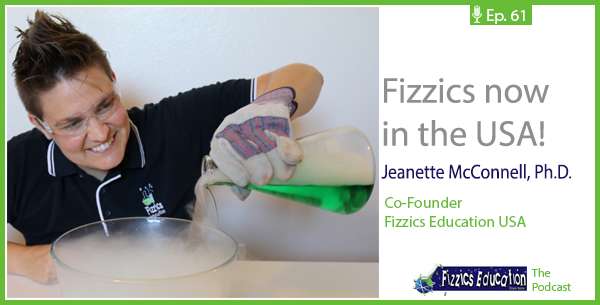
Fizzics Education is now on the ground in San Diego! Hear from co-founder Jeanette McConnell of Fizzics Education USA about her work in science outreach and her thoughts on what makes hands-on experiments memorable.
Science is a universal language, but how do you translate a high-energy Australian STEM model for a North American audience? In this episode, we talk with Dr Jeanette McConnell about her journey from the chemistry lab to leading the charge for Fizzics USA in San Diego. We explore the philosophy that science should never be boring and why hands-on inquiry is the most effective way to engage students, from kindergarten through to high school.
About Dr Jeanette McConnell
A self-professed “science nerd” with a PhD in Chemistry, Dr Jeanette McConnell traded the research bench for the front lines of science communication. During her doctoral studies in Australia focusing on anti-cancer drugs, she discovered that her true calling was science outreach rather than academia. Jeanette has extensive experience running programmes across primary, middle, and high school levels, advocating for experiential education. As the leader of the Fizzics Education San Diego expansion, Jeanette is bringing high-impact, hands-on STEM workshops and science parties to communities across Southern California.
Expertise: Chemistry, Science Outreach, Friction & Movement, and Instructional Design.
Fizzics Education San Diego (Fizzics USA)
This episode marks the launch of Fizzics Education establishing a presence in San Diego, California. This expansion brings the award-winning Australian approach to STEM engagement directly to the US market.
The San Diego Mission:
Physical Learning: Moving beyond virtual excursions to provide in-person, high-impact science shows and workshops.
Accessible Science: Using everyday materials like skateboards and tablecloths to teach complex physics concepts like inertia and friction.
Community Impact: Sparking curiosity in Southern California through school programmes and science parties that encourage children to see themselves as future scientists.
Top Episode Learnings: Science Without Borders
The “Sliding Doors” Moment:
Jeanette’s transition from cancer research to science outreach highlights how a single positive experience in communication can change a career trajectory. For researchers, exploring outreach can reveal skills in public speaking and engagement that laboratory work may not.
Concept Over Spectacle:
Whether using a Ruben’s Tube to visualise sound waves or liquid nitrogen to demonstrate pressure, the experiment must always serve the scientific concept. Spectacular demonstrations are only truly effective when they are grounded in a clear educational narrative.
The Power of Simplicity:
Meaningful learning doesn’t always require complex equipment. Simple demonstrations where students can replicate the results themselves—like the tablecloth pull—often have the most lasting impact on a child’s scientific identity.
Education Tip: The Finesse of Friction.
When teaching concepts like friction and inertia, use relatable, physical demos. As Jeanette suggests, having students sit on skateboards and attempt to pull one another with a rope provides a visceral lesson in contact and mass. It takes a bit of finesse to get the “tablecloth pull” right, but the look of understanding on a student’s face when they grasp the science of inertia is worth the practice!
[00:00:32]Ben Newsome: From simple science experiments done in the classroom and in the home, through to over-the-top science experiments done on stage and beyond, Jeanette McConnell has done it all. She’s an educator out of Southern California and I tell you what, she’s one of the closest people to Fizzics Education, and you’ll hear why.
[00:01:05]Ben Newsome: Yes, welcome again to another Fizzics Ed Podcast. It’s a big week this week and I must say I really feel that every podcast episode on this thing has been big, but this is particularly close to heart because this week we are announcing for sure that we are coming to the US. It’s real! We have people on the ground in Southern California and today you get to hear from the person who’s leading them, Jeanette McConnell.
[00:01:30]Ben Newsome: Jeanette McConnell used to work at Fizzics Education here in Australia. However, with a bit of knocking some heads together and making ideas happen, we have opened in San Diego finally. Now, this is not just a simple infomercial. Jeanette is a fully-fledged educator with a lot of experience in running programmes right from primary, middle school and high school. I tell you what, I’m really looking forward to doing this stuff out on the ground. It’s really going to be a lot of fun and we get to hear from the main person who’s heading this up in San Diego.
[00:02:00]Ben Newsome: So, without further ado, I hope you get a bit out of this just to hear about where Jeanette’s come from, her background and where we’re going. Hey, I got to have a bit of a chat with her and a bit of a catch-up at the same time. So let’s get into this interview. I hope you enjoy it.
[00:02:18]Ben Newsome: Jeanette McConnell, welcome to the Fizzics Ed Podcast.
[00:02:21]Dr Jeanette McConnell: Hey Ben, so excited to be here!
[00:02:23]Ben Newsome: Absolutely. Now, full disclosure, I kind of know you. Jeanette, introduce yourself.
[00:02:32]Dr Jeanette McConnell: Yes, so I’m Jeanette and I used to work for Ben at Fizzics Education Australia.
[00:02:40]Ben Newsome: I mean, it’s kind of one of the most awkward ways to say, “I used to work for you.” But now what I love is this particular session. Normally in all the other podcasts, we get to talk with people outside of Fizzics doing all sorts of different stuff. However, Jeanette and I are working together on an interesting project which is a bit not about Australia. So Jeanette, tell us what are we cooking up here?
[00:03:04]Dr Jeanette McConnell: Yes, so now Ben and I have joined forces and we are starting Fizzics in the United States.
[00:03:11]Ben Newsome: Yay! It’s super-duper exciting. It’s one of these things that’s been coming in the making for quite a while and Jeanette has been incredibly patient for that thing. But let’s hear more about what it is, but also yourself. Jeanette, for a start, you’re a self-proclaimed science nerd. Where have you come from before you got yourself into education?
[00:03:38]Dr Jeanette McConnell: That’s a great question. So I actually started as a scientist in school, I loved doing science and I took it all the way. I went all the way to do my graduate studies. Actually I did those in Australia, where I earned my PhD studying anti-cancer drugs. As soon as I was finishing that degree, I realised that I really wasn’t enjoying myself as much as I thought I would be, and I had the opportunity to do some science outreach through the university and it was a game-changer.
[00:04:14]Dr Jeanette McConnell: I completely fell in love with teaching people about science, bringing it to their level and making it accessible. I was like, “Well, this is what I have to do with my life now.” I had to switch gears, and so that’s what I did and I found Fizzics in Australia. It was just an incredible timing. It was like I knew what I wanted and I found Fizzics and it was a perfect match.
[00:04:41]Ben Newsome: I often wonder about the sliding doors moments that happen with educators because there’s so many different people that talk exactly about this thing; that they had this thing in the back of their head that they maybe want to do this one day and then one thing leads to another and all of a sudden you’re on a new train.
[00:04:56]Dr Jeanette McConnell: The right train!
[00:04:58]Ben Newsome: The right train. I hope that’s a right train considering what you do. So yes, Jeanette used to work with us and unfortunately because of visa reasons had to zip on back to the States. Wind it forward, we are now doing things in San Diego, which is cool.
[00:05:14]Dr Jeanette McConnell: Yeah, it’s very exciting.
[00:05:16]Ben Newsome: Very, very cool. What we’re doing with this particular thing is just trying to get our head around what is it that we’re doing in the States? Because we’ve been going over there for a few years via distance learning, but having people on the ground is a whole ‘nother level. So Jeanette, what’s coming up?
[00:05:34]Dr Jeanette McConnell: Yes, so we are ready to take Fizzics to San Diego. That’s where we’re starting, in Southern California basically, and bring them all of the wonderful things that we see in Fizzics Australia. This hands-on science that is accessible to students and makes these large concepts really easy and understandable for them physically. You were doing it before virtually, but we all know that there is huge value in the physicality of learning.
[00:06:12]Ben Newsome: Science outreach is so much fun and I know that going out, I mean I do it all the time. In fact, full disclosure, I’m sitting in amongst a whole bunch of experiments around hot and cold to run some distance learning out to some schools in New South Wales. It’s part of the DNA of a science educator to get out to the kids in person whenever you can. I mean, you’ve done a lot of this outreach in lots of different capacities. I’m just kind of interested, what’s your experiences been like in the classroom itself?
[00:06:44]Dr Jeanette McConnell: Yes, so I think that was part of why I fell in love with doing science outreach; was seeing and understanding the impact that you can have on students. When I worked in Australia for Fizzics, I remember I was doing a Forces, Friction and Movement programme, which is one of my favourites. A couple of the experiments include the tablecloth pull, where you teach students about inertia, as well as the sitting on skateboards.
[00:07:14]Ben Newsome: The magic trick that’s not magic!
[00:07:16]Dr Jeanette McConnell: Yes, right! And they are blown away. Their faces are incredible. When they can do it themselves as well, they pull that tablecloth out from underneath the bottle and it doesn’t fall over and they’re like, “What?”
[00:07:25]Ben Newsome: What’s really cool, if you want to try this guys, if you’re listening in on that thing, I love it. You’ve all seen it; you get the tablecloth, you pull it underneath the dinnerware and everyone goes, “Wow.” If you really want to up it up just a little bit more, get like a bowl of tinned spaghetti or something messy. As long as you’ve got enough mass in it, the thing will not move because of this thing called inertia. That’s the whole point of the experiment, right? But I agree, I love the idea of bringing that context of what’s seen in almost like a sideshow alley into a science classroom. It totally changes people’s perception of how the world works.
[00:08:04]Dr Jeanette McConnell: Showing the students the science in their everyday lives. The science that’s all around them that they might not have realised was science before.
[00:08:12]Ben Newsome: Good fun. I must say though, how was it, I know I’m just focusing in on this because I tend to focus in on things, but when you first did that trick, so to speak, how did you go?
[00:08:29]Dr Jeanette McConnell: Like, did I mess it up?
[00:08:31]Ben Newsome: Yeah, just out of interest. Everyone’s got to have their first go, right?
[00:08:35]Dr Jeanette McConnell: Hopefully never in front of the students! But yes, definitely when I was practising beforehand. Because there is a bit of having to pull in a certain direction for the forces to work correctly, and that did take a bit of finesse. But I have seen kindergarteners do it, so I knew that I would be able to get there.
[00:08:56]Ben Newsome: And that’s one of the toughest things as science teachers and outreach people. We might have to learn an experiment which, you never really know what you’re signing yourself up into when you’re first entering the teaching landscape. Suddenly you now have to, for example, pull a tablecloth from underneath some dishes and things. What’s been the experiment that challenged you? It’s one thing to pull a tablecloth from underneath a plastic bottle with some water in it, but there are certain other ones that I know that we do which are certainly more visual but potentially from the outside eye thinking perhaps there’s maybe more risky.
[00:09:44]Dr Jeanette McConnell: Yes, the one that comes to my mind is the liquid nitrogen explosion, where you trap some liquid nitrogen inside of a plastic bottle. Pressure builds up and it’s enough to burst that plastic bottle and it creates quite a big, loud explosion. Especially for me as a chemist, I had used liquid nitrogen tons of times but in the science lab, in the chemistry lab. So for me it was this really surreal experience to take it outside of something that was inaccessible to most people and put it in a place that I was like, “Is this okay?” It was a bit of a stressful situation at first.
[00:10:28]Ben Newsome: I must say that experiment, and by the way, heads up for anyone who might have access to liquid nitrogen, this is not, don’t do it first time by yourself with people who have not done it before. There’s a ridiculous amount of training in this because if you actually look on the back of like the material safety data sheets and all the various different versions, it kind of says, “Thou shalt not trap a substance that expands rapidly as it changes from a liquid to a gas.”
[00:11:00]Ben Newsome: There are a number of safety precautions including doing it in multiple galvanised bins which are reinforced, you have water in the base to absorb some of the energy, you put a whole bunch of light ping pong ball type things on top to absorb some of that energy. Yes, it shows it visual when the thing explodes, but the issue is that it really does ride the line. I must say that particular experiment, we avoided it for multiple years. We knew about it, but we didn’t do it as professional science outreach people for a long time because we thought, “You know what, we need to make sure there’s a narrative around this which makes it fair and people understand what we’re doing, but also insurers had to understand it and all the risks involved.”
[00:11:36]Ben Newsome: Funnily enough, once you actually do it and know how to mitigate said risks, it’s okay. But I tell you what, that particular experiment made me nervous when first doing it because I wasn’t quite sure even though I’d been trained around it myself and seen how to do it. Am I going to have ten fingers at the end of this or not? I don’t blame you for wondering about that one.
[00:12:02]Dr Jeanette McConnell: Yes, but I mean as soon as you learn all of the ways you’re supposed to do things and the safety procedures, then it’s fine. Then it’s just a really impactful demonstration of pressure.
[00:12:16]Ben Newsome: Absolutely. You see it in mega-state science festivals and TV shows. I’m pretty sure it got done on Ellen with Steve Spangler. Quite spectacular to millions of viewers. So again, I’m just going to stress again, this is not for your first day of science teaching please, and potentially not even if you’re five years in. Make sure you’re with someone that’s been doing this for a long time and can go through all the risks and things. There’s a lot of control mechanisms. But gee, you must have loved doing that experiment for the first time in front of kids.
[00:12:46]Dr Jeanette McConnell: It was an incredible experience because I was just as excited as they were!
[00:12:52]Ben Newsome: Actually it reminds me, sorry I’m talking a bit too much over you Jeanette, but I do get excited about these sort of things where you go “Wow” for the first time. I remember doing there’s this experiment called the Rubens’ tube, which I know you’ve done. So for those people who haven’t heard about it, a big long gas tube is about two or three metres long and a whole bunch of holes in it and it’s running LPG gas through it and it’s lit up. You play sound waves through it and it’s so cool. I do distinctly remember running that for the first time in front of schools and someone took a photo which is actually on our site because I just had this big goofy grin on myself going, “Oh my god, it’s working and the kids are loving it!” That was going through my head the whole time I was playing with sound waves. It was cool.
[00:13:36]Dr Jeanette McConnell: Yes, it’s interesting because that’s one of the things I really love about Fizzics; is that we can take these extreme or not extreme examples of science and really connect them to the concepts. It’s not, we’re not just doing some fire waves for no reason. It’s always, like you said, you took a lot of time to learn and figure out what you wanted to do with the liquid nitrogen explosion first, because there’s no point in just doing this spectacle. It’s always got to come back to this concept that we’re trying to teach.
[00:14:14]Ben Newsome: Absolutely. And actually I like that you mentioned there it doesn’t have to be over-the-top crazy fire and ice type experiments. It can be incredibly simple. I remember actually my first year university physics lecturer saying, “We’re going to learn motion and here is the box.” So out came the cardboard box. He said, “We’re going to learn about motion using this box for the next eight weeks.” That’s exactly what happened. We used a cardboard box; we pushed it, we put it on a rope and swung it around, we did everything to this box. It doesn’t have to be crazy all the time. I mean, just thinking back to all the various experiments that you definitely do with kids of all different ages, what are some of the ones that are simplistic and yet generate the same sorts of learning outcomes and responses from kids?
[00:15:05]Dr Jeanette McConnell: Yes, that’s a good question. Definitely that one we mentioned earlier with the tablecloth pull. And then also another one of my favourites is the skateboard sort of pull experiment where I would sit on a skateboard and a student would sit on a skateboard. And then we each hold one end of a rope and I ask them to pull me towards them. It’s never going to work because I weigh probably three or four times as much as they do. So they always end up getting pulled towards me and they don’t understand. At first when you do this, they have no idea why that has happened. They’re just confused. They try again and they try again and it keeps happening. Eventually you talk them through friction and what’s going on, and then they understand. You can see it change in their face. You can see them fully grasp this concept and it’s because of some skateboards.
[00:16:03]Ben Newsome: Yes, absolutely. I love that experiment. I was first exposed to that when I was working with the CSIRO, the Commonwealth Scientific and Industrial Research Organisation, when they had an education outreach team that did a fantastic job around this sort of stuff. That double skateboard demo with a rope really gets to the heart of the matter when people have to understand how friction truly works.
[00:16:35]Ben Newsome: Because I know it’s a standard misconception is that friction is rubbing. Friction’s really about contact, really, when you really come down to it. And just how much pressure is between those two surfaces that are in contact and how much surface area is actually touching. The other parts in there are, well you think about what’s actually touching. Does it have to be solids? Could it be a liquid and a liquid or a gas and a gas? I like doing this type of outreach where we get to the heart of the matter in a very short amount of time because, let’s be honest, we haven’t got the kids day-to-day, week-to-week. We’ve only got an hour or two, and sometimes a day. But trying to get to the heart of each subject matter is challenging, but it can be fun too.
[00:17:09]Dr Jeanette McConnell: And I really think that those simple demonstrations where they understand all of the materials that you’re using are sometimes more impactful. From many of those forces, friction and movement workshops that I did, one time I was leaving and some students were running through the playground and they were yelling, “I want to be a scientist!” at me. All we had done were very simple things during the day, but they could now see themselves as a scientist because they understood it. They got it.
[00:17:42]Ben Newsome: Absolutely. I had this weird surreal experience and I get really weirded out at it. It’s like, “Wow.” I remember this child bailed me up in a school hallway with his science book and said, “Can you sign it?” I went, “Oh my gosh, I’m just a teacher, mate,” but, “Yeah, no problem, I’ll sign it for you,” because obviously this kid had gone, whatever triggered in this child’s brain, “I need this person’s signature.” They’re like, “Wow, what an impact” for just being there for an hour. I got celebrity status.
[00:18:12]Dr Jeanette McConnell: Oh, I don’t know!
[00:18:16]Ben Newsome: But I always wonder about the cumulative impact of these type of outreach things. We may not be able to see that student until the next year when they’re in the next year doing different parts of science. But I wonder over the years the impact of these enrichment opportunities that kids get because they’re not everyday experiences. And hey, if you get to see that science can be done with magic tricks, so to speak, I mean that’s certainly better than reading through a textbook.
[00:18:50]Dr Jeanette McConnell: Oh yes, a million times better!
[00:18:55]Ben Newsome: Absolutely. Mind you, you can do science with a textbook too. Make sure you do this with old textbooks so you don’t get in trouble if you’re listening, but you can totally fold two textbook pages together. You can fold them together like a deck of cards so you’re holding the two spines in your hands and the pages are facing each other. If you get like a 400-page textbook, or better, a telephone book if you can get one still because hey, the internet’s there now, you can get these pages all put together really tightly in such a way that you can get two kids to try and pull these things apart and it ain’t going to happen because surface area is there and friction is a real issue. I digress, but there are so many things we can do.
[00:19:35]Ben Newsome: So, righto, so we have gone ahead and set up in Southern California to do stuff. So what sort of things are we going to be doing?
[00:19:47]Dr Jeanette McConnell: Well, we are going to be doing all sorts of science! We are going to do in-schools, like we’ve been talking about on this chat today, things around forces and chemistry, magnetism, energy. All of those things we have and are ready to share with the school communities here. But also, science parties. We’re excited to bring those to Southern California as well.
[00:20:19]Ben Newsome: So your job is to leave a whole bunch of slime and bubble residue in people’s homes all across Southern California.
[00:20:27]Dr Jeanette McConnell: Exactly! I’m so excited to do it. I’m so excited to bring all of the slime and get it all over people’s children.
[00:20:36]Ben Newsome: And flow-on effects all through their walls and everywhere and we’re going to stain everything and we’re going to create a whole bunch of havoc and mayhem. No, we’ll be good, we don’t have to do that to that level. But I tell you what, it is fun and engaging. One of the things I really love doing lately is all about creating impact that doesn’t involve us. So one of the things I’ve been really excited to be involved with is teacher professional learning events. So coming in and spending a day doing a rapid accelerator around, “Here are things that we’ve seen for many, many years in hundreds and hundreds of schools,” and doing that type of stuff in Australia certainly is fun, but being able to now do that into another country is really exciting from my end and certainly something to look forward to. You know what it means, I guess I might get an excuse to maybe come over and play.
[00:21:28]Dr Jeanette McConnell: Yeah! And it’s really exciting to be able to bring something so valuable to where I’m from, to bring this incredible programme, and I’m just really excited to be able to share it with my community. That’s what I’m all about.
[00:21:44]Ben Newsome: So thinking about, so you were an early career researcher and you kind of had this sliding doors moment right at the very start of this chat that you decided to go into science education. I’m just kind of wondering, what sort of advice, because I know we have researchers listening in to this as well, for people who might be thinking about stepping out of the lab, so to speak?
[00:22:04]Dr Jeanette McConnell: Yeah, so it’s a tough place to be because the lab and academia often place so much value and prestige on staying at the bench and doing this lab work. So my advice is to give yourself permission to explore other areas. Even if you like bench work, maybe you’ll like something else more. I think really the biggest piece of advice is to just allow yourself to look around and see what else you can do. What other skills do you have that are really great?
[00:22:38]Dr Jeanette McConnell: I discovered that I was really good at talking about science and I didn’t know that before I allowed myself to explore these other parts of science. And the other thing that I think it took me a while to learn is that you can still do impactful and meaningful work without having to be the person holding the pipette. And so those are the two things: give yourself permission to explore and realise that it’s not just working at the bench that is meaningful and can be impactful to society.
[00:23:15]Ben Newsome: Absolutely, and I must echo those thoughts as well. But I must also say that you don’t have to suddenly do a massive career change and jump out into an education field. I mean just doing the occasional bit of outreach, like you could go to a festival, maybe speak about the research that you’ve been doing. Maybe do the occasional, if you’re able to within your facilities, have people visit your site and learn from you. There’s actually a place called Nepris (N-E-P-R-I-S) that allows you to speak from your computer to schools via Skype about the work that you do. And that’s incredibly impactful for kids that may not have a chance to come to your facility but to still connect with a researcher doing stuff.
[00:23:55]Ben Newsome: So there’s lots of different ways you can get involved. You don’t have to go into formal or informal education as we happen to be in. You can still make a difference as a researcher, without a doubt. But at the same point, if you want to get involved in this type of thing, I suppose you just tap Jeanette on the shoulder, right, if you want to do this?
[00:24:14]Dr Jeanette McConnell: Yes!
[00:24:16]Ben Newsome: So actually that brings up the point, Jeanette, how do we find out about what’s going on with Fizzics USA?
[00:24:22]Dr Jeanette McConnell: Yeah, so we have a website, it’s fizzicseducation.com and you can also email us at [email protected]. Those are the two best ways to get a hold of us and to learn what we do.
[00:24:38]Ben Newsome: Absolutely. And there’s already a bunch of resources being built out on that site. It’s one of those things, it’s early days, but highly exciting and I must say it’s going to be a lot of fun to see where this goes. But also, it’s not about us, it’s more about getting to the students themselves that may not have had a chance at this point to do this type of thing. So it is, it’s going to be a fun journey. And hey Jeanette, thank you very much for popping on this.
[00:25:04]Dr Jeanette McConnell: Oh thank you Ben, I’m so excited. I just can’t wait to see what impact we can have on, let’s just start with Southern California.
[00:25:15]Ben Newsome: Yeah, why not? Why not? All right, well have a fantastic afternoon. I’ll have a great morning down here because I’m talking from Sydney, you’re talking from, you’re in San Diego itself, right?
[00:25:25]Dr Jeanette McConnell: Yes, San Diego.
[00:25:27]Ben Newsome: Probably not too bad weather. Right now we’re coming to extremely cold stuff. We’ve got staff in Canberra, Brisbane, Sydney, Melbourne. The people in Canberra had in Celsius minus seven the other week. So I don’t know what that is in Fahrenheit, I probably should do a quick conversion, but they were talking about how they had to put horse rugs onto their water pumps because the pipes were freezing. Now we don’t know anything about cold like people up in Upstate New York or Minnesota or something, but we’re learning about cold right now. And as Australians, we do heat. So maybe I’m very happy and aligned with you because you’re in San Diego.
[00:26:06]Dr Jeanette McConnell: Yeah, you should try to get them to make some of those frozen bubbles!
[00:26:09]Ben Newsome: Oh, good point. Yes, right, just blow bubbles and put them on the lawn and just see how long they take to freeze. Oh, that’d be interesting. Actually, isn’t there the experiment, I swear, okay, everyone jump onto YouTube. If you’re a child listening, make sure you’re there with your parents or teachers so you’re looked after. But go look up, check this out, you’ll see people in the dead of winter where it’s really cold in really cold places like Alaska and Russia and that sort of thing, where carefully people have a pan of hot water, like properly hot water, and they step outside of their house and they throw it into the incredibly crisp, almost frigid air, and it just goes “pow!”
[00:26:52]Ben Newsome: This steam just, you see it condense incredibly quickly. Go check out on YouTube, I don’t know what your search parameters would be, but that’s amazing, just don’t get yourself burned if you do it. Side note, but hey, if you’ve been listening long enough to hear, you know that’s exactly what I tend to do in this podcast. But look, much appreciated Jeanette, I should leave you be this afternoon, but looking forward to seeing what we do in Southern California and going from there.
[00:27:18]Dr Jeanette McConnell: Cool. Thank you so much, Ben.
[00:27:37]Ben Newsome: Well there we go, we were speaking with Jeanette McConnell who’s heading up the San Diego side of Fizzics Education USA. And I tell you what, it is going to be a blast doing programmes as we move into the new school year. Jeanette is super pumped, I can tell you that, about doing some programmes right from the early years from preschool all the way into high school. And there’s going to be a lot of rich programming that we’ve been doing for years here at Fizzics, only we get to do it on the grounds in Orange County and San Diego, the whole area. It’s going to be a blast, and of course, travelling beyond that because that’s exactly what we do here, I must say.
[00:28:13]Ben Newsome: So, I hope you reach out to fizzicseducation.com and say good day to Jeanette. Say Ben said hi. But until you do that, I hope you have a fantastic week, have a fantastic month, and I’ll catch you very, very soon. You’ve been listening to me, Ben Newsome, Fizzics Education, and you’ve been listening to the Fizzics Ed Podcast. I’ll catch you next week.
[00:28:59]Announcer: This podcast is part of the Australian Educators Online Network. AEON.net.au.
Frequently Asked Questions
How did Dr Jeanette McConnell transition from laboratory research to science education?
Jeanette began her career as a research scientist, earning a PhD in Australia where she studied anti-cancer drugs. During the final stages of her degree, she realised she was not enjoying the laboratory environment as much as expected. An opportunity to participate in science outreach through her university proved to be a “game-changer,” sparking a passion for making science accessible and engaging for students, which led her to join the Fizzics Education team.
Why does Jeanette believe that simple science demonstrations are often more effective?
She argues that when students understand the everyday materials used in an experiment—such as skateboards, ropes, or tablecloths—the science becomes more relatable. These simple demonstrations allow children to see themselves as scientists because the concepts (like friction or inertia) are clearly visible and understandable, rather than being hidden behind complex laboratory equipment.
What advice is offered to researchers interested in science outreach?
Jeanette encourages researchers to give themselves permission to explore fields outside of academia and lab work. She highlights that impactful work for society does not always require “holding the pipette” at a bench. Researchers can start small by speaking at festivals, hosting site visits, or using platforms like Nepris to connect with schools via Skype to share their work and inspire the next generation.
Discussion points summarised from the Fizzics Ed Podcast with AI assistance, verified and edited by Ben Newsome CF
Extra thought ideas to consider
The Cumulative Impact of Outreach
Consider how a single one-hour science show can act as a “sliding doors” moment for a child. While the educator may only be present briefly, the psychological impact of being “bailed up” by a student for an autograph suggests that these encounters can fundamentally shift a child’s self-perception and their future relationship with STEM subjects.
Spectacle vs. Substance in Science Communication
Discuss the balance between high-visual “spectacle” experiments (like the Rubens’ tube or liquid nitrogen) and everyday physics. How can educators ensure that the “wow factor” of fire and explosions always serves the underlying scientific concept, preventing the demonstration from being perceived as a mere magic trick?
The Value of Physicality in a Digital Age
While distance learning and virtual excursions have global reach, this conversation highlights the “huge value in the physicality of learning.” Explore why physical presence and the ability for students to finesse an experiment themselves—such as the tablecloth pull—remains a vital component of science education despite advancements in digital delivery.
Recognised by
22 years, award-winning work, 1 purpose
Recognition from business, education and industry bodies across Australia.
Australian Small Business Champion
Multiple years
CILC Pinnacle Award and Hall of Fame inductee
Center for Interactive Learning and Collaboration
Western Sydney Awards for Business Excellence
Winner
Top 100 Coolest Company
Listed
Local Business Awards
Winner
We value your privacy
We use cookies to improve your experience. Essential cookies are always active. You can choose which optional cookies to allow.We use cookies. Optional ones stay off unless you allow them.Privacy policy