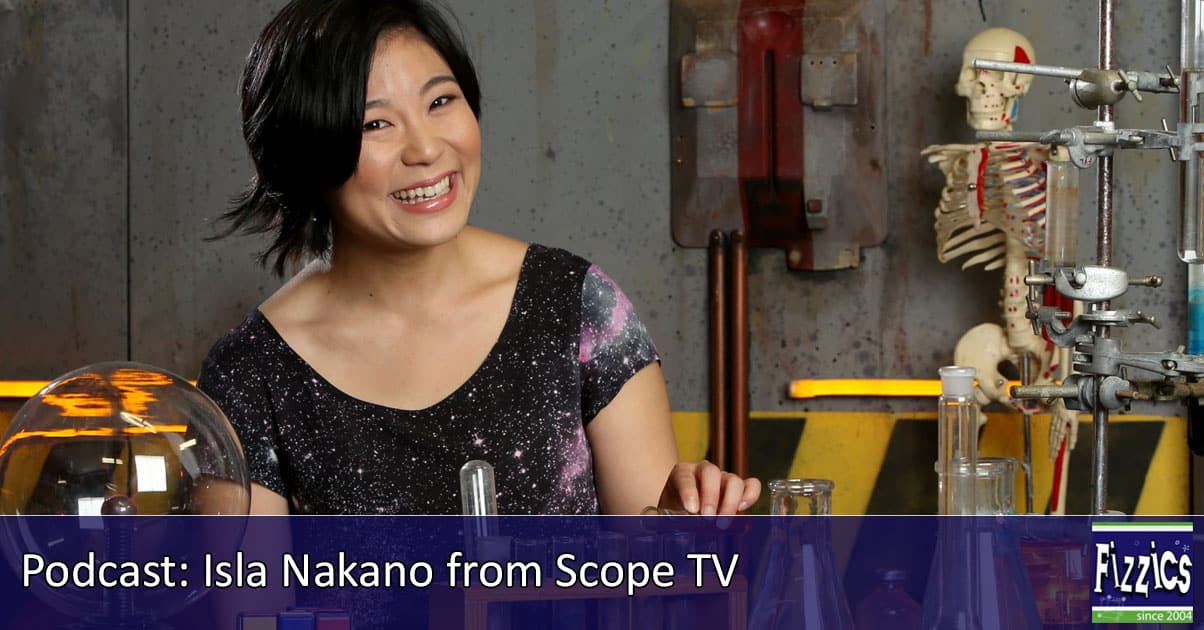
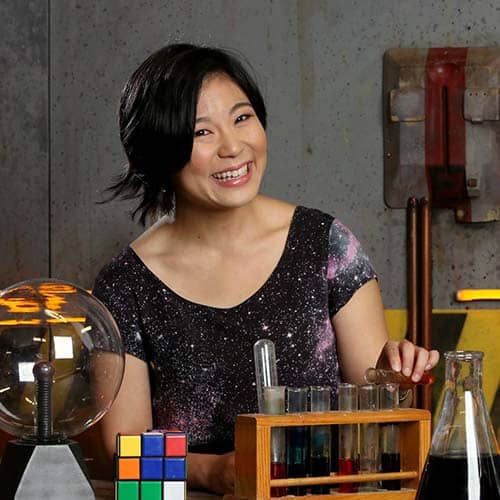
We hang out with Isla Nakano as she chats about her role as the host of Scope, a national kids science show that goes across Australia on Network Ten. Isla is passionate about getting kids into science and we get to hear about her pathway into being a science presenter on TV and what it takes to pull segments together for a national audience.
Isla Nakano is a prominent science communicator and the former host of the beloved national children’s science programme, Scope, on Network 10. Her journey into the spotlight began at The University of Sydney, where she completed a Bachelor of Science before dedicating herself to the art of scientific storytelling. To refine her craft, Isla earned a Master of Science Communication while traversing the vast landscapes of remote and regional Australia with the renowned Questacon Science Circus, delivering high-energy live shows to diverse school communities.
Isla’s extensive experience with Questacon – The National Science and Technology Centre saw her facilitating immersive STEM, design, and innovation workshops for various age groups. Her leadership skills were further cemented when she moved into a coordination role for the Science Circus, where she actively trained and mentored postgraduate students, helping to shape the next generation of Australian science communicators.
As the face of Scope, Isla was responsible for researching, writing, and presenting segments that ignite curiosity in children aged 8 to 12. She collaborated closely with researchers across Australia to translate complex scientific data into engaging, accessible narratives. Beyond the screen, Isla is a tireless advocate for increasing the representation of women and girls in STEM fields and is deeply committed to fostering greater cultural and gender diversity within the Australian television industry.
Top 3 Learnings from this Episode
The Impact of Visible Role Models: Isla emphasises that diversity in science media is crucial for encouraging children from all backgrounds to see themselves in STEM careers.
Authenticity Over Perfection: Success in science communication comes from finding your own voice and being genuine, rather than trying to fit a preconceived mould of a “presenter.”
Saying “Yes” to Experience: Building a career in communication requires a broad portfolio of experiences—from performing in regional towns to writing scripts—which collectively build the necessary resilience and skill.
Connect with Isla and explore more science:
Catch episodes of Scope on 10 Play to see science in action.
[00:04:36]Isla Nakano: I suppose that’s kind of the role of myself as a science communicator, I’m sure that you kind of resonate with that as well, Ben. But yeah, trying to get kids interested firstly. That spark of interest and then getting them to take the next steps into learning more and being more interested. And I think, yeah, I think that’s what I really like about the programme that it’s about, from a network perspective, it’s about entertainment over fact. And for me, you know, I love science and I love talking about it, so it is really easy for me to prepare science. Well, not easy, I guess, but I’m passionate and I love what I do. Making science a little bit cooky, a little bit quirky, something that’s a little bit different to kind of reading about science in a textbook or watching a really dry science documentary.
[00:05:22]Ben Newsome: I totally agree. And speaking of a spark of interest, what got you into the whole science thing? I mean, everyone’s got a story about how they get into this, but you specifically getting into science—you’re a scientist first and now you’re a science communicator. What got you all into this sort of thing?
[00:05:38]Isla Nakano: It’s an interesting question. You’re right, so many people have different stories, but for me, I was born in Japan and my family’s in Japan. My parents and I migrated to Melbourne actually, initially, when I was two years old. My parents have a very strong tie to their family back in Japan, so I’d actually travel to Japan every summer holidays that I had during my schooling years. I’d travel on a big jumbo jet plane and that’s kind of what got me into science actually. I was fascinated by how this massive metal box with 800 people could take off so easily and land so gracefully. I spent a lot of time at the airport. So to this day, I’m a massive, massive plane nerd, I love them.
[00:06:23]Isla Nakano: But yeah, I think that’s where my initial spark of science started, starting to ask questions. And I think that is the most important thing about science, right? It’s about asking questions, wanting to know more and trying to find the information that you want.
[00:06:43]Ben Newsome: One of the fun things about this is that when you even look at how things work, even if you actually understand how it works, it’s one thing to understand it, it’s one thing to actually see it happening. I still think that when you look at a plane, really, that’s quite a couple hundred tonnes of stuff in the air and it holds up. Knowing that there are four principles of flight is a good thing, but seeing it’s another thing. And that’s a lot of the fun, is actually showing people examples of a thing in the real world, in practice, and it makes such a difference.
[00:07:10]Isla Nakano: Yeah, totally, definitely. And I think that’s where I got into science communication. I did follow the science pathway, I studied science at university, but I really liked breaking down the research that I was doing or the science of flight right down to friends who are really disinterested in science. I’d talk to them and I guess my enthusiasm was just oozing out of me that a lot of people who were listening to me, whether it were my parents or my friends at school, they really said, maybe science is interesting. There are obviously people who aren’t old and in lab coats and have really disgusting hair. It is just about everyday things. And I really liked talking about it.
[00:07:45]Ben Newsome: Absolutely. And hello to all you old men with disgusting hair too, welcome to the podcast. No, absolutely, it is a wide range of people and we all do lots of different things. I’ve got to ask, what sort of research were you doing?
[00:07:55]Isla Nakano: I have a background in medicinal chemistry and pharmacology. So I love chemistry, I love drugs and medicines and how they interact with the body. I had a part-time job at a pharmacy during university. And similarly there, the thing that I loved doing there the most was catching any old people especially who had a lot of time and just being like, let me tell you how the drug that you’re taking works in your body, and chatting to them about it. And yeah, I think I’ve always liked that.
[00:08:28]Ben Newsome: I really like that. No, it’s really cool because we actually—we do a bit of work with the National Indigenous Science Education Programme. They’re out of Macquarie University, and they do this really cool thing where they work with indigenous elders from all over, mainly northern New South Wales. But they find all these weird alkaloids in plants. And they only know about these plants being kind of cool because they talk with the indigenous elders and they find out what were you doing with these plants and how were they used in different ways. And they go, hang on, maybe we should check this thing out. And there is a lot of stuff to be discovered when it comes to medicinal purposes in so many different ways. Do you miss research?
[00:09:18]Isla Nakano: I do, totally, I miss it so much. I do have the pleasure of going into a lot of research labs now, interviewing scientists and STEM enthusiasts. But yeah, I really do miss it. But the great thing is that being a science communicator, you do get to dabble in a lot of different sciences and I think that’s something I really enjoy.
[00:09:43]Ben Newsome: Absolutely. So now you did formerly train in science communication in ANU, right in the heart of Australia, I suppose, Canberra. What was that like going through the Science Circus?
[00:09:57]Isla Nakano: It was—I mean it sounds really clichéd, but it was a very life-changing experience. The Science Circus travels all around Australia, especially into regional and remote areas of Australia, doing science shows. And for me, I grew up mainly in Sydney, and I guess I had a very privileged background in that my parents were supportive. They sent me to the local government school, but my school had really great teachers who were really supportive and encouraging of all of their students. Then I went to university.
[00:10:41]Isla Nakano: And I think going into other areas and tapping into different people and their communities, it made me realise how different people are. I mean, it sounds really obvious, but there is quite a big divide that I think we can acknowledge. That there is a lot of, you know, regional and remote schools are under-resourced, teachers are so under stress and they just don’t get the support that they should and do get that their peers in metropolitan areas do get. And I think to me that’s when I realised, yeah, that science communication and education in general is really important and not everyone gets what I got.
[00:11:19]Isla Nakano: So in that sense, it was a really kind of life-changing experience. I really saw different aspects of people’s lives. But sort of more from a personal perspective, it did make me realise how much I really like talking to people, how much I like travelling, seeing different parts of the country, meeting lots of different people and seeing different communities.
[00:11:43]Ben Newsome: Which parts of the country did you get to go to?
[00:11:45]Isla Nakano: Oh, I’ve actually been to every state and territory except for Tasmania for work. Some of my highlights are going to indigenous remote communities in Central Australia. That was such a special experience. Mainly, oh I don’t know, I’ve been to lots of places. I really liked going to the south-western corner of Western Australia, sort of the Esperance area up through to Kalgoorlie, some really, really beautiful and different landscapes up there. Touring through—it’s always nice going to a wine region like the Clare Valley in South Australia.
[00:12:24]Ben Newsome: Yeah, well, pure for research reasons, I guess.
[00:12:28]Isla Nakano: Oh, of course, yeah. Obviously for work.
[00:12:30]Ben Newsome: Yeah, I got that. So that’s really cool. So fast-forward now, you’re now with Scope and which is a, you know, a fantastic programme which, you know, impacts kids all over the place. What’s it like working at Scope?
[00:12:42]Isla Nakano: Oh, every day’s really different. It’s so much fun and working with really, really creative people is fun too. My whole team, none of them are—have a science background. In fact, no one sort of in the children’s department at the moment have much of a science background. And so it’s a really great tester actually, to write a script and say, hey, does this make sense? Do you understand what I’m trying to get across?
[00:13:21]Isla Nakano: So it’s, yeah, it’s a great test and it’s really fun working with a lot of diverse people as well. I mean, the kids’ department at Channel Ten are such creative, passionate people and it’s always fun being surrounded by people who love doing what they do.
[00:13:42]Ben Newsome: So it’s kind of hard to sort of compare and contrast because you’ve only got a week before the whole lockdown thing happened. So it’s kind of like, what was it like before? It’s like, was there a before? But I guess you’d have a chance to have a chat with your team to find out, you know, what are the challenges, what has it been like? How has it—what’s it like working with a production crew when you can’t go out on site so much anymore? Or have you been going out on site? I genuinely just don’t know. How have you been sort of managing the last seven months?
[00:14:07]Isla Nakano: I think a lot of it has been—well, for starters, we’ve been doing a lot of in-house skits and sketches and things where we used to go out and, yeah, interact with scientists and members of the public and things like that. So we’ve definitely become really creative. We’ve become great at set design, creating, you know, a lab here and someone’s bedroom in the corner of an office and things like that. Being really resourceful.
[00:14:47]Isla Nakano: And yeah, I think doing a lot of this kind of thing, Skype, and it’s kind of opened a lot of doors. Up until now, Scope’s really focused on interviewing local scientists, people who are in Brisbane or in the Brisbane area. But now because, you know, regardless of whether they are in Brisbane or—this was the case maybe three months ago now, but yeah, whether they were in Brisbane, whether they were in Melbourne, whether they were in London, you know, the format’s the same. It’s all—we did a lot of Skype interviews, so it meant we got to interview some really cool people that we probably never would have thought to reach out to. That’s been a really great opportunity.
[00:15:13]Ben Newsome: And it’s really broad. I mean, I love how IT just brings people together. Yes, we’re all staring at this screen, this little camera up there, we’re all doing that. But we get to connect. I mean, that’s eventually what communication is about—making connections with audiences—and certainly, certainly is a lot of fun. I guess a question like—you’ve done a lot of work with lots of audiences in lots of ways. I mean, in some ways I’m feeling like I’m putting you on the spot so I’ll let you give you some time to think, but there are all these different audiences. There are large audiences, there are small audiences, there are older audiences and there are really little baby kids in preschool. What do you like working with the most? I suppose, who do you like working with the most?
[00:15:43]Isla Nakano: Oh, it’s a good question. At the moment, working for TV, it’s a really different experience, I suppose. Up until now, as you said, I’ve been able to see my audience, whether they were really old or really young or teachers or kids or whoever it was. You could see it and you knew who you were up against. With TV, it’s really hard to know, and it’s hard to know who to pitch to. But I think having the experience beforehand has been really good.
[00:15:58]Isla Nakano: I love—one of the things I used to do at Questacon, the National Science and Technology Centre, is that I would go around to these communities, regional and remote, and work with students kind of almost one-on-one to do like a STEM and innovation design workshop and get them to build something in a 90-minute period. And my favourite students were the ones who were actually quite disengaged and didn’t want to engage in the activity, they thought they were a little bit too cool for school. And I think one of the huge benefits of being someone who flies in and flies out and isn’t a teacher is that, you know, well firstly you get such a small amount of time and to me it’s such a big challenge and it’s really fun saying, you know, I’ve got 90 minutes to try and get this kid on side. And yeah, that’s I think that’s really fun because it’s so rewarding when you do get them on side.
[00:16:40]Isla Nakano: And to be fair, you won’t—I probably only succeeded one every three students. I don’t have a huge success rate. But it’s so rewarding and I just respect teachers so much who have to deal with it every day and they don’t have the benefit of just being able to leave at the end of the, you know, at the end of a lesson. They’ve got to see these students over and over again and building that rapport, I think, I’ve just oh, just amazing. It’s amazing the stuff that teachers do out there. But yeah, I love trying to get on their—to yeah, to try and communicate with people who I don’t necessarily not necessarily understand initially. I suppose I was the kid who was, I was, you know, the typical nerd at school.
[00:17:46]Ben Newsome: You’re in a safe space. It’s okay.
[00:17:48]Isla Nakano: In a safe space. No, I was totally the teacher’s kid—teacher’s pet. And I had, you know, like when there were the kids in the back who were talking when the teacher was talking, I was like, oh my goodness, be quiet! I don’t know why you’re doing this. And to be able to engage with students like that I think is yeah, it’s really special. I love I love working one-on-one with students like that.
[00:18:10]Ben Newsome: Absolutely. We actually, oh gosh, 70 episodes ago, I don’t know, Dr Simon Crook, who does a lot of professional development work with a whole bunch of schools around Australia, especially high schools, he did say this quote. He said, “You can engage me or you can enrage me.” And I went, you know what, I’ve taken that one to heart because it’s totally the case. I was the kid that you wouldn’t have liked. I was in the back of the room messing around a little bit, probably a little bit too much. Probably to this day I probably mess around a bit too much, let’s be honest.
[00:18:38]Ben Newsome: But it came down to engagement. I mean, when I was hyper-focused on people that could engage me and not so much on others, and I suppose in a lot of ways I have to take some of that on board. I probably should have listened a bit more. However, making lessons engaging is an important thing. I suppose with science communication, when you’re visiting different places with a particular experiment or activity, a STEM build or whatever it is, it’s almost like a scientific method. You actually get to do a test, check, iterate, go again. You get to play around with it. And so even just sometimes the nuances, it could be phrasing, it could be a way you pitch it, it could even be, honestly, your body position sometimes. Who knows? Whatever it is that grabs the kids’ attention, do that thing.
[00:19:21]Ben Newsome: But you don’t know until you try these things. And I suppose, this would be the same thing I suppose with… yes, you’re in a TV environment now where the audience is in front of you, but at the same point, you still need to work with your team with feedback. In a lot of ways, it must be a very interesting and dynamic environment. I mean, how do you get the feedback that “Oh, I’m pitching too high or pitching too low”? I’m guessing it’s a bit of a team sort of thing.
[00:19:44]Isla Nakano: Yeah, totally. I think for me, the biggest feedback is as much as I hate doing it, is watching yourself back. And you can get a lot of feedback from that. I’ve certainly had heaps of failures. I’ve watched especially the earlier ones, I’ve watched it and just been like, it’s so cringey because you’re either pitching way too high or pitching way too low. And yeah, I think trying to get feedback from, I think as I said, we have a group of very passionate and very supportive people at my work. And a lot of them do have kids who are in our kind of target age range and we sort of experiment with them.
[00:20:23]Isla Nakano: But yeah, I think trying to get self-feedback is probably the biggest thing. For people in TV, they’ll say ratings and all that kind of thing is a big way that they get feedback, which isn’t necessarily, as scientists, it’s not—that doesn’t really mean anything really. But yeah, I think thinking about the content, testing it out on lots of different people, I think is the best way to get that feedback.
[00:20:56]Ben Newsome: Well, absolutely right. And when you are presenting… I actually remember presenting, I was at a Rotary function trying to explain what we do. And the guy said, “Just understand that everyone in the room here has done Toastmasters.” I went, I’ve never done it. He said, “They’ll pick up on every ‘um’ and every ‘ah’ and every struggle. And they’ll love you for it and tell you all about it afterwards.” I went, “Oh, thanks very much. That’s a fantastic pep talk before I talk to all these people.” But it does, I think in a lot of these sort of things, it is just getting up there and doing it. I mean, I think anyone listening who’s in education, just think back to your first lesson. Of course it was struggle street. Maybe you weren’t, maybe you were perfect, I don’t know.
[00:21:37]Ben Newsome: But as a whole, I mean, most of us just genuinely… and it’s not just about what we’re explaining, your timing could be way out. I mean, I’m just thinking about your 90-minute builds. You might have this really cool idea that they’re going to build this thing, and the reality is the kids can’t hold a pair of scissors. The fine motor skills and all that sort of thing does make a difference. And also, that true connection. I mean, you could be trying to describe a perfectly good idea in the right cultural context you think, but the kids’ got no idea what you’re talking about because they’ve never lived it or breathed it. I mean, try explaining an ocean wave and how waves work for a kid in the middle of the country. Some of them have never seen the sea. So it does make a bit of a difference.
[00:22:18]Ben Newsome: Cool. So, right back to the very start, we talked about how you love those planes. But then again, you got into looking at medicines and whatnot. What made you go, “You know what, I want to study medicines”? Because there’s a lot of people who are students who are listening to this, trying to work out which STEM career they’re going to go into. I mean, what made you go, “You know what, I’m going to check that out because that’s interesting”?
[00:22:41]Isla Nakano: It’s an interesting question. I—you’re right, so many people have different kind of stories. To me, to be honest, when I left year 12, I didn’t explicitly know that I wanted to do science communication because I didn’t know that it was a thing that existed. And I said, I think I can—this is the benefit of hindsight now that I look back. I didn’t know this at the time. But at the time, I reckon I really liked, I loved science and I loved people. And to me, the only kind of jobs that put those two things together was either being a teacher or being a doctor. And I thought, “You know what, I’m going to pursue one of those two things.”
[00:23:22]Isla Nakano: And I loved, yeah, I really liked things that were around me. And to me, that was, you know, medicine’s something that is part of everyone’s lives. It’s a big part of a lot of people’s lives. And to me, there was a pharmacy just down the road from me, and I guess getting a job there was a big part of why I studied pharmacology and medicinal chemistry. But yeah, I actually was gunning for becoming a doctor. And it was sort of later when I was doing my honours, actually, that I realised that science communication was a field that paid. I mean, not well, but it still paid enough.
[00:24:02]Ben Newsome: And you get to play, let’s be honest. Yeah, exactly. And it is, you don’t realise, even now, I’m still like scratching my head thinking like I get paid to do this kind of thing. And yeah, it is like talking to lots of different people and opening up those networks that I discovered this amazing field that, yeah, that I never knew existed that I guess I’ve always wanted to do. Oh, absolutely. So I mean, anyone who’s ever hung out in a—any sort of a head teacher’s office, like a science teacher’s office, or if you’ve been lucky enough to hang out in the back rooms of a museum, people have genuinely very serious conversations about slime. In fact, actually, an hour or so just before this, we’ve just built with the help of some students at Macquarie, a tensegrity structure.
[00:24:53]Ben Newsome: …where it’s basically this thing where it looks like it’s going to collapse because it just looks like it’s sitting on string. And that doesn’t make sense because string should collapse. It’s all about tension and compression and how the forces work. And then we’re putting bowling balls on this thing and then we’re trying to work out how we’re going to describe this thing and we’re trying to work out how we’re not going to have it fall and break ourselves in front of 300 people. And that’s a real conversation and it’s a serious conversation. It’s actually work. And yet we’re actually just playing around. It’s a lot of fun. Absolutely. So I guess knowing all this, with just imagine that you had a whole bunch of science communicators in front of you, the next crop of the people who will communicate the science. What would be sort of the advice you’d like to give them?
[00:25:08]Isla Nakano: For me, anyway, it was all about making networks and pursuing things that you really enjoyed. I didn’t know that National Science Week was a thing that existed until I was in second year of university. And when I discovered it I was like, oh that’s really cool, I’m going to go to some events. And I went to a couple of events, and one of them was an event run by Ruben Meerman and he’s the Surfing Scientist, he’s quite well-known. And he spoke so well and I thought, that’s really cool. And I went to speak to him at the end of the session and he said, I actually went through a programme called the Questacon Science Circus and you should check it out too. So he really led me into that path and then from there spoke to a lot of people and they said, oh why don’t you try volunteering at the Australian Museum in Sydney? And I did that, and from there, these networks and this whole new world opened. So I think, having a community is really important in these kind of situations, trying to find the community that you belong to and trying to find people who are your people. So talking to people, reaching out.
[00:25:53]Isla Nakano: And there are a few times actually that I have emailed people just off the cuff, I’ve seen their email on Google, or I’ve Instagram DM’d people, just because I’m like, you’re really cool, I want to be friends with you and I want to know more about how you got where you are. And most of the time people are really gracious and they actually really like talking about themselves. Who doesn’t? It’s flattering when someone says to you—and even being asked to be on this podcast is super flattering, why wouldn’t you want to share your story? And I think a lot of people are in the same boat. So it never hurts to reach out to people you admire and you think are really cool, who are your role models, and ask them directly how they got into where they are and see if you can get yourself like an internship or a day just hanging out with them, shadowing them.
[00:27:18]Isla Nakano: Asking for help, I think is another really big one. Don’t be afraid to ask people for help and to do things. Science communicators, I think a lot of us—I am certainly not great at all of the sciences at all. There’s one science that I’m like, yep, I can nail it, I’m really good at it. There are other areas like physics, for example, it’s not my thing, I just don’t get it, I find it really difficult. And I think that’s okay sometimes, it’s hard to speak with authority almost as a science communicator and say, oh I can talk about physics because I’m a scientist and I’m a science communicator. And that’s totally okay and to acknowledge that we can’t be great at everything and to ask and reach out for help is another big thing.
[00:27:41]Ben Newsome: Yeah, I like that and actually it’s something we can definitely do in our classrooms too, because the reality is that there might be certain things, just say you’re not into IT. Tell you what, the kids are! And they’ll happily take it on board and they’ll happily show you. In fact, my daughter told me how to mess around with—I didn’t know how she was changing the Google to changing Chrome. I said, so how’d you do that? She goes, oh you just change this little attribute on the code, I just inspected the element. I went, oh do you now? She’s in year 5. And how’d you learn that? I just watched a friend do it. Aha. So that was literally yesterday.
[00:28:26]Ben Newsome: So it’s kind of fun how the people in front of you can contribute to your knowledge. It’s 100% the case and it’s definitely how it works. And I do like the idea of you saying, I mean, yeah you’ve got to reach out. I kind of like the idea of the door won’t open unless you put your hand on the handle and turn it a little bit. It just doesn’t really work any other way, really. So yeah, no that’s really cool. And Isla, thank you for rocking up on this podcast too. I know you’re flat out, undoubtedly with quite a tight and busy schedule, a production schedule so to speak. We don’t have a production schedule so much, we just as long as we turn up to the workshops and shows on time, everyone’s happy. Tends to work.
[00:28:58]Ben Newsome: But look, thank you again. And look, Isla, how do we—is there anything that we could visit about your world or anything else that we should go visit while we’ve got you on the podcast?
[00:29:11]Isla Nakano: Yeah, like you said, I’m passionate about the job that I do right now, Scope TV. We have an excellent array of videos on our YouTube channel. We post some fun stuff on our Instagram as well as, and I post a lot of things myself, well not a lot actually, I’m trying to get into social media. In fact, one of my first social media stories was created with the help of a year 11 student who was very good at doing the stickers and the gifs and whatever else. So I’m trying to get into that. But I’m also working on a programme called Totally Wild, also on Network Ten. It is a show about animals and action and adventure and things like that, but I am the resident scientist on the show and doing lots of little science segments, so it’d be great if you can check that out as well.
[00:29:58]Ben Newsome: Absolutely. And I’ve got to say I grew up on Totally Wild. Definitely, definitely did. That’s definitely my age group. That just timestamps me very neatly, I believe. But anyway, no. But look, thank you very much. And definitely as usual, we put these links in the show notes so people can go check that out. And definitely Isla, thank you very much for visiting the podcast and well done with not only just finding your dream job but honestly just inspiring audiences, it’s really cool.
[00:30:24]Isla Nakano: Oh, thanks for the time, Ben. It’s been lots of fun.
[00:30:44]Ben Newsome: Well there we go, we just heard from Isla Nakano who you can really tell loves her science and more importantly, loves inspiring others and trust me, they’ve done an amazing job through Scope. Network Ten has done a really good job when it comes again to getting kids into science. I mean, we see hundreds of thousands of kids a year and they often say “Hey, we watch Scope in the afternoons” and you know that Isla’s making an amazing impact with kids all over the place. It’s really, really cool. So if you want to go check out what Isla’s been doing on Instagram, look up isla_nakano (I S L A underscore N A K A N O).
[00:31:29]Ben Newsome: Or you can also check out scopetvau on their Instagram and see what they’ve been doing with their filming, what they’ve been doing with upcoming episodes in various different segments and all that sort of thing. So much appreciated. Thanks again for hanging out on the Fizzics Ed Podcast. And I hope you have a fantastic 2020. And if you’re listening past 2020, I hope you’re having a great year, whatever year you’re listening to this, and I will catch you another time.
[00:32:11]Announcer: This podcast is part of the Australian Educators Online Network. a e o n dot n e t dot a u.
Frequently Asked Questions
How did Isla Nakano transition from a Bachelor of Science to a television host?
Isla’s journey involved a combination of formal education and hands-on experience. After completing her Bachelor of Science at The University of Sydney, she pursued a Master of Science Communication. During this time, she joined the Questacon Science Circus, travelling across regional Australia to perform live science shows, which helped her develop the performance and communication skills necessary for her role on Scope TV.
What does a typical production day look like for the host of Scope?
A typical day involves a mix of research, scriptwriting, and location filming. Isla works closely with the production team to identify fascinating scientific stories across Australia. She then translates complex research into engaging scripts tailored for an audience of 8 to 12-year-olds and travels to various sites—from laboratories to field locations—to interview experts and demonstrate scientific principles.
Why is diversity and representation such a major focus for Isla?
Isla believes that “you cannot be what you cannot see.” By being a person of colour and a woman hosting a national science programme, she aims to provide a visible role model for children from diverse backgrounds. She advocates for greater cultural and gender diversity in the media to ensure all children feel that a career in STEM is accessible and welcoming to them.
What advice does Isla give to those wanting to enter the science communication field?
Her primary advice is to say “yes” to as many opportunities as possible and to seek out diverse experiences. Whether it is writing a blog, performing in a science circus, or volunteering for local events, these experiences build a broad skill set. She also emphasises the importance of being authentic and finding your unique voice rather than trying to replicate others.
How does Scope TV manage to explain complex scientific topics to children?
The programme focuses on storytelling and finding the “human” element within the data. By collaborating with actual researchers and scientists, Isla and the Scope team break down intricate concepts into relatable narratives, often using analogies and visual demonstrations that resonate with the curiosity of young viewers without oversimplifying the core science.
Discussion points summarised from the Isla Nakano from Scope TV with AI assistance, verified and edited by Ben Newsome CF
Extra thought ideas to consider
The Role of Storytelling in Scientific Literacy
Consider how narrative structures can make abstract scientific data more memorable and impactful. By framing a discovery as a journey or a mystery, communicators can bridge the gap between technical expertise and public understanding, fostering a more scientifically literate society.
Representation as a Catalyst for Innovation
Reflect on how increasing diversity in STEM and science media isn’t just about equity, but also about improving the quality of science itself. Different cultural and gender perspectives bring unique questions and problem-solving approaches to the laboratory, potentially leading to breakthroughs that a more homogenous group might overlook.
The Evolution of Science Communication in the Digital Age
With the rise of social media and short-form video content, how can traditional science programmes like Scope adapt to keep younger audiences engaged? Discuss the balance between entertainment value and scientific rigour in a landscape where information is consumed rapidly and through various digital platforms.
Recognised by
22 years, award-winning work, 1 purpose
Recognition from business, education and industry bodies across Australia.
Australian Small Business Champion
Multiple years
CILC Pinnacle Award and Hall of Fame inductee
Center for Interactive Learning and Collaboration
Western Sydney Awards for Business Excellence
Winner
Top 100 Coolest Company
Listed
Local Business Awards
Winner
We value your privacy
We use cookies to improve your experience. Essential cookies are always active. You can choose which optional cookies to allow.We use cookies. Optional ones stay off unless you allow them.Privacy policy