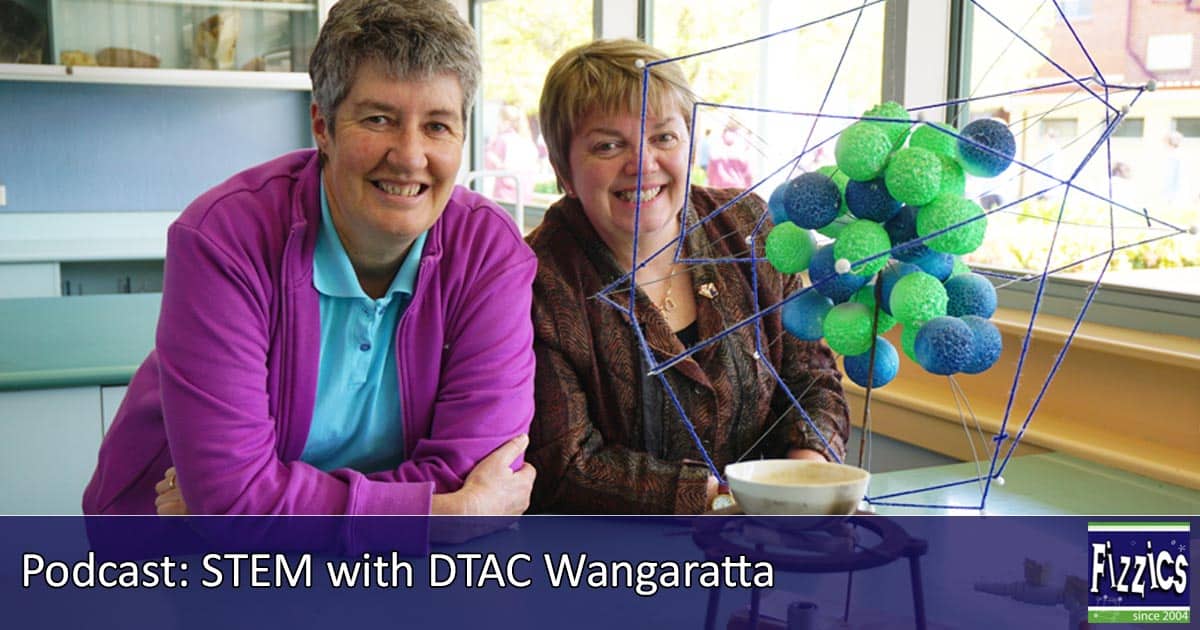
Be inspired as we chat with Maree Timms, founder of Digital Technologies Advisory Committee Wangaratta. DTAC Wangaratta helps students across the region & beyond connect with STEM in a variety of ways!
The Digital Technologies Advisory Committee (DTAC) is a collective of dedicated organisations and individuals working tirelessly to address digital inclusion in regional Victoria. Established as a strategic collaboration between the NE Tracks LLEN (Local Learning and Employment Network), GOTAFE, and Charles Sturt University, DTAC has become a powerhouse for regional innovation.
The impact has been measurable and significant. When DTAC commenced in 2016, the local Digital Inclusion score sat at 43.8. The most recent reporting shows a leap to 50.8—an impressive 7% increase. To put this in perspective, Melbourne’s score moved by just 1.1% in the same period, highlighting the effectiveness of these grassroots regional initiatives.
Top 3 Learnings
Facilitation over Expertise: You don’t need to be a coding expert to lead a robotics team; success comes from coordinating resources and fostering student teamwork.
The Power of the ‘LLEN’: Connecting schools with industry through Local Learning and Employment Networks is vital for providing students with real-world STEM pathways.
Grassroots Digital Inclusion: Significant gains in regional digital literacy are best achieved through local collaboration and community-driven professional development.
Key Initiatives & Successes
Professional Development: DTAC organises its own teacher workshops and facilitates regional collaborations with DLTV, STAV, MAV, and OzGrav at Swinburne.
Girls in STEM: A major priority for the committee, including high-profile workshops where Ford engineers travel to Wangaratta to mentor local students.
Space and Robotics: Through a partnership with the [Organization] Foundation, students participate in prestigious programmes like the Kibo Challenge and the Seeds in Space programme.
“The formation of DTAC has to sit high up there with creating change and innovation in our community. We would never have thought we would have achieved all this. There have been so many wonderful outcomes.” — Maree Timms
Maree Timms is an extraordinary educator whose career has taken her from Monash University to remote Arnhem Land and back to her hometown of Wangaratta. With a teaching journey beginning in 1986, Maree has spent decades fostering curiosity in diverse and multicultural settings, including ten years at Gunbalanya Community School.
Career Highlights
Opening National Science Week at Parliament House in 1994 with the “Taminmin Magic Science Show” in front of Dr Karl Kruszelnicki.
Leading Indigenous students from Gunbalanya to the Paralympic Games and winning NT Film of the Year for a community Claymation project.
Representing Australia at the VEX World Robotics Championships in 2018, 2019, and 2020.
Winning the inaugural Kibo Challenge 2020, allowing students to code NASA’s Astrobee robot on the International Space Station (ISS).
Maree describes her role as a facilitator and coordinator: “I still don’t know how to code… or build robots—but I have taken teams to the highest level. I gather good allies that have the skills I don’t have and complement mine… I coordinate, facilitate, and ‘hammer’ them on the communication, teamwork, and organisation skills that lead them to success.”
[00:00:00]Announcer: You’re listening to the Fizzics Ed Podcast. For hundreds of ideas, free experiments and more, go to fizzicseducation.com.au. And now, here’s your host, Ben Newsome.
[00:00:20]Ben Newsome: Welcome once again for another Fizzics Ed Podcast. I hope you’re having a fantastic day or evening or wherever you are. And I must say today is quite the inspiring chat. We’re hanging out with Maree Timms, who some people might have come across because she is heavily involved with the Digital Technology Advisory Committee of Wangaratta. And I must say she does an amazing job with getting kids really involved—seriously—in STEM. I mean, seriously, she’s set up a digital resource library, she does events and workshops, and she helps connect and collaborate with a bunch of people, not just in Wangaratta, but all over the place. And she is a truly highly passionate teacher out at Galen Catholic College, as you will find out. And so that’s what this chat is all about. It’s all about setting up really, your own ed-preneur space within your district. And I must say, she’s done an amazing job considering just the initial steps that she did to be able to support her local kids and just how far it has gone. So I hope you enjoy this chat with Maree Timms. I certainly did. And let’s listen into it.
[00:01:21]Announcer: This is the Fizzics Ed Podcast, for all about science, EdTech and more. To see 100 fun free experiments you can do with your class, go to fizzicseducation.com.au—that’s physics spelled F-I-Z-Z-I-C-S—and click “100 Free Experiments.”
[00:01:36]Ben Newsome: Maree, welcome to the Fizzics Ed Podcast.
[00:01:39]Maree Timms: Oh, thank you, Ben, for having me. It’s a pleasure.
[00:01:43]Ben Newsome: Look, I am completely stoked, honestly, I really am, to have a small time window with you to have a bit of a chat about what you’ve been getting up to, because we’ve been sort of hanging out on Twitter for a while, but I really haven’t had a chance to genuinely chat really directly about what you do. And my gosh, you do a bit! So Maree, can you please let people know what you get up to and how this has all sort of come about?
[00:02:07]Maree Timms: Yeah, well, first of all, I’m passionate about STEM and I’m a science and maths teacher, but there’s so many opportunities out there. And we’ve by sort of accident—well, not quite accident, but we’ve ended up creating a team of people, a collaboration that’s taken this region off the planet. I could say that! By saying “off the planet,” we’ve had our students in October last year, actually control a robot—the NASA Astrobee robot—on the International Space Station. So that was pretty cool, I can tell you.
[00:02:55]Ben Newsome: That’s quite a few steps away from just trying to help some local kids get right back into learning, and then you’re doing that. All right, so that’s quite a series of leaps. [Organization], so to speak. So how did that come about? I mean, all right, we’ll get there. Initially, what kicked all this off?
[00:03:16]Maree Timms: My colleague and I were sitting there chatting, another science colleague, about how we were really worried about the number of students not taking STEM subjects. So we started to chat about it, and then we realized—and it was during National Science Week in 2015. And so we thought—and we’d just been told the theme was Robots, Drones, and Droids. And we just thought, “What a great Science Week theme!” 2016 Science Week. So we decided let’s really ramp it up and we decided to do a STEM expo. And that was a careers expo, get as many people in, start sort of contacting people. And then I thought, “Well, wouldn’t it be great to get the local council on board?” So, you know, that’s—I thought, “Yep, if we want a big event, let’s get all of Wangaratta on board.” So I went to the council quite, I guess, naively, and they said—and they went, “Oh, no, we’ve tried that. Doesn’t work. Doesn’t work.” And I was like, “Oh.” So I was a little bit disappointed. And as I was walking out, someone ran over to me and said, “Excuse me, excuse me, I overheard. Here’s this fella. Contact him.” And she gave me a card, and it was Danny O’Donoghue from the local Learning Employment Network, which is a government organization that works with schools and that to try and keep kids in education. And so I rang him up and he’s just like, “Okay, let’s organize a meeting.” So I sat down and chatted to him and he’s just sitting there and he’s going—and I explained the STEM expo, what we wanted to do. And he’s just looked at me and his eyes were like—the grin was just getting bigger and bigger and bigger. And then all of a sudden he just goes, “Stop!” And I’ve gone—and I’ve stopped and thought, “What’s happening here?” And his eyes had lit up, biggest grin ever, and then he’s gone, “You are handing me my job on a platter.” He said, “I’ve been to all these schools in the area. I’ve knocked on principals’ doors, I’ve rang them.” He goes, “This is my dream. This is what I want.” And so he said it’s unbelievable that he had tried to get into schools, ask principals, ask people, “Is there a teacher that would work with me on this?” And so he got me in contact with his offsider, which was Anne Shaw, and then connected me with the Charles Sturt Uni and Goulburn Ovens TAFE. And so me and my colleague, Anne Shaw, and Anne Geddes all met, and it was like a melding of minds, like-minded. And yeah, so—and then my cousin worked at the local TAFE. And so we got him on board as well. So we ended up with a collaboration to create the STEM expo. And it was absolutely amazing. We had 400 students from the region come to it, and we had a community session in the evening, 200 community members came through. So that’s in a regional area, to have that many people—and like, they were busloads of schools coming in. So we had Mansfield come, which is about two hours away.
[00:07:12]Ben Newsome: So they really wanted to go.
[00:07:14]Maree Timms: Yeah, that’s awesome. So I think the timing was there, the theme was there. And like, one old fellow who’s a retired engineer, and he came to the expo—and this is like one of the things that keeps him on my mind—was this old fellow coming in and he’s going, “I’m a retired engineer. I’ve heard about 3D printers. You’ve got 3D printers here. I want to see what a 3D printer looks like and what it does.” And he sat with the TAFE people who had the 3D printer, and he sat with them, I reckon, for at least an hour just chatting and watching it print. So, yeah, it really I think it opened up our community and it was the seed for a lot of things after that. Obviously the robot theme, we ended up trying to get some robots up here and we talked to Travis Burroughs, who is in charge of Vex Robotics in Melbourne. And he said he couldn’t come, but he’d do a professional development on the following weekend. So we thought, “Oh, why not?” So, not knowing too much about robots and programming, I asked him can I invite more than just teachers, can I invite my gang? So we had the Northeast LLEN crew, we had the TAFE crew, we had Charles Sturt Uni, we had schools, we had parents, we had kids. So we had about 20 to 30 people come to this, and there was only three actual teachers amongst the 30 people. And Travis brought robots and we were building robots, he was teaching them how to program it, you know, very simply. And everyone loved it. And then two weeks later, Travis said—rang me up and asked would we host the Australian National Championships.
[00:09:31]Ben Newsome: And the snowball continues.
[00:09:34]Maree Timms: And the snowball just continued. It was just, yeah, it was like one thing, one thing, one thing. And it just blew us away of how it sort of went and just the next thing after the next thing. So—
[00:09:53]Ben Newsome: What’s amazing about this is just how many times I’ve heard similar stories where it just takes one person and suddenly it all starts to blossom. It’s so really cool hearing this. And I mean, part of this is tenacity, resilience, and handling the “no,” because you’re going to get them. You’re totally going to get them.
[00:10:12]Maree Timms: Oh, absolutely. But what’s really amazed me is there’s people out in the community that want to connect to schools that don’t know how. There’s people who have got skills in the community who are willing to share, but don’t know how. And if I feel like I’m acting as a bridge, and it’s just by reaching out that once with that idea, I guess has given me a whole different mindset of, “Hey, you know, doesn’t matter if people say no, but there’s another opportunity around the corner.” And just reaching out. I mean, our robotics team, we asked if we could go and visit a local engineering firm that had one robot, and that one robot just picks up an iron girder, moves it to another spot and welds it. So, you know, one of those big industrial—so we went there, was absolutely fantastic. The kids loved it. And we walked out with a 3D printer under our arm.
[00:11:34]Ben Newsome: You should go to more remote places like that! Go to more places.
[00:11:38]Maree Timms: So it was like, he’s going, “Oh, it was a 3D printer that was at Aldi and they’d bought it to just see if it was—if 3D printing would work for them and if they would go up-scale to buy bigger, more industrial-type 3D printers. So they just had this one and then he’s gone, “Oh, we don’t use this anymore. We decided that 3D printing is not really for us. So off you go, take it with you.”
[00:12:06]Ben Newsome: It was going to go in the dump anyway, so take it! That’s great.
[00:12:10]Maree Timms: Yeah! And that’s what I mean, there’s little things that people would love to connect and they just don’t know how. And now with STEM, there’s so many amazing programs out there. I don’t know if anyone out there’s listening, if you see—go to Dr. Amanda Caples, the lead scientist of Victoria. Her and Jaala Pulford, the minister, has pulled together for Victoria a “Girls in STEM” map. And it’s fabulous. You click on the links and it just takes you to all these opportunities for STEM engagement and especially for girls. So really cool sort of thing. They’ve got another one that Dr. Amanda did, Dr. Amanda Caples did, a few years back, a couple of years ago, with just the STEM map, which is the same sort of thing. So keep an eye out for those if you’re interested.
[00:13:14]Ben Newsome: Absolutely. And as usual, we’ll put these things in the show notes for sure, because it’s very, very useful. And by the way, if you’re listening in a completely different state, province, country, wherever you are, if there isn’t one, guess what? You can make one! You can do these sort of things.
[00:13:27]Maree Timms: That’s exactly right.
[00:13:28]Ben Newsome: Yeah. Now that’s the thing. I actually love what happened at local council and in some ways it reminds me what actually happens with networking and collaboration. Quite often people want to go to the source, and I get that. We want to go to the source to be able to get the thing that we want to make happen. But sometimes that person’s either too busy or something’s on their plate or in a lot of ways, like your person found out, sometimes the gatekeepers will just stop you having those chats in the first place. But you never know who people know. You never know. And that business card that started that off was really, really cool.
[00:14:05]Maree Timms: No, it is. It’s, yeah, it was one little thing can lead to so many opportunities. I mean, by Travis asking us to host the Australian Nationals, I mean, we were the three teachers, we ended up working—and this is where the collaboration was. To host the national championships, we were allowed to get put three teams in, or you know, the three schools that went to that PD, the three teachers were allowed to put the teams in, but we didn’t have robots. We didn’t know anything about it. We had six weeks to do it. The kits would have had to have come from New Zealand. And it was like, “Oh, what are we going to do?” And the kits cost money. But because we had that collaboration with Northeast LLEN, they helped us fund them. So they—like the Wodonga team ended up getting funded by the Wodonga LLEN, and we got funded partially with—and Barinya, the other school in Wangaratta, got fully funded. So that collaboration allowed us to have funding to buy the kits and because they were at the PD. And three years—like we had that national championship, so we learned a lot. The second year we asked to host it again, so we got to do it again. And in that one, we got the excellence award and got to represent Australia and go over to the world championships. I mean, and I can’t program! I can’t build robots! But the kids did, through forums and learning, teaching themselves. So that’s another thing, you don’t have to know it. You just have to facilitate.
[00:16:07]Ben Newsome: Absolutely so. And the next event can usually produce the next event that produces the next event that produces the suddenly you’re now working with NASA on the moon! Which is amazing and cool, and it really goes to show that—you said this was back in 2015, so it’s not that long ago, really. Not really. And I mean, I mean, often people think that the next year you’ve got insurmountable challenges, it’s going to be hard, we can’t achieve all things. But three years from now, that’s actually quite a long time when you think about that. Now, you’ve effectively doubled that time as 2021. There is a spectacular amount of stuff you can do in six years. It really, really is. It’s just about taking the first step.
[00:16:50]Maree Timms: I know! And we keep pinching ourselves. Like our D-TAC group, we’ve called ourselves D-TAC, the Digital Technologies Advisory Committee. We went for a—I think it was once again about October 2016 because after the STEM expo, we were so proud of ourselves and that, and there was a funding grant coming up for STEM education and creating opportunities for kids. So we went for it, it was a federal government grant, I think $50,000. So—and instead of writing a collaboration between Galen Catholic College, Northeast LLEN, Charles Sturt University, Goulburn Ovens TAFE, we needed a shorter name, so we formed D-TAC, the Digital Technologies Advisory Committee. And we didn’t get it. We put a lot of time and effort into it, but we didn’t get the grant. But it didn’t stop us. And we just—we just kept going. And D-TAC has got its own web page, which we get—our one of our collaborations with Education Advantage, they support us. They’ve leased us iPads—well, sorry, I’m jumping ahead. So D-TAC has started a digital lending—a digital resource library. So we have Spheros, we have Vex Robotics kits, we have a Google Expeditions kit, we have all sorts of digital toys that—and STEM activities that local schools can borrow. And we’ve built that up through a lot of in-kind support, but a lot of support through our partners. Charles Sturt University will put in money at the end of the year if they get a few spare dollars, they will say, “Okay, well, what does D-TAC lending library need?” And so we’ll find some new toys and new gadgets to add into it. We do holiday robotics and coding holiday camps and—or holiday programs, and then the money that is raised from that goes towards buying new equipment. So it’s—yeah, it started off as a tiny weeny idea to something that we’ve—it’s just grown into an amazing little venture, I guess.
[00:19:38]Ben Newsome: It well is! I was about to say you remind me directly of what I’ve been talking about, being on Clubhouse, which is basically ed-preneurship. So it really is a case of so what if someone won’t support me? I’ll support myself and I’ll find the opportunities. And that’s exactly what you can do. I mean, and I love the fact that even if you didn’t get a grant, you just went ahead anyway. It reminds me of what we did with—a nonprofit that was finalized only last year, but we’ve been running effectively this for 10 years, Virtual Excursions Australia, to support museums and zoos and aquariums all over the country and around the place. And that was always there as a support mechanism. We finally last year said, “We really need to formalize this.” It took us 10 years, maybe we’re slow learners. But the idea was that it didn’t matter. We just wanted to get stuff done. And that’s exactly what you’ve been doing. It’s really cool.
[00:20:25]Maree Timms: No, we’ve had, yeah, it’s been an amazing ride. It really has. It’s like—I often describe it as a roller coaster, except we haven’t had the downs. It’s just—it’s just kept going up and up and up. Ah, so fantastic. And I really do love what you’re doing. And I also do know that very, very soon you like, actually still have a teaching job, so things sort of go slowly, but fast. But we get things done. And we realized it should have been the D-TAG, the Digital Technologies Action Group. But D-TAG doesn’t sound as good as D-TAC.
[00:21:13]Ben Newsome: No, it’s okay! You could have a slogan, “We take action,” something like that. But I’ll tell you what, though, I mean, one of the things that’s crossing my mind, which could be crossing other people’s minds too, is time. Isn’t that a beast? How are you handling doing your main role as well as D-TAC and everything else that comes around with it? How do you handle that?
[00:21:33]Maree Timms: That’s where the teamwork and collaboration—we’ve all got our different skills, but we all support. And if I can’t do something, I know I can hand it off to someone else or someone else. Our local community realized that we are going above and beyond. So if they want to borrow something and we can’t get it to them straight away or, you know, we can’t coordinate it, there’s no—there’s no issues. They know it will happen. If they’re having trouble with something, we try, you know, with the equipment, we try to troubleshoot it as quickly as we can. But if we can’t, there is no issues. They realize what we’re doing. We do put in a fair bit of extra time, but it’s because we love it. It doesn’t feel extra or a burden. I think that’s part of it as well.
[00:22:33]Ben Newsome: It’s a passion project. It’s a hobby. It’s something fun.
[00:22:36]Maree Timms: It is! It is. It’s like—it is a passion project and it is like a hobby. And the amount of hours of in-kind stuff that we do is quite phenomenal. But it’s, yeah, the teamwork is amazing. The collaboration is amazing.
[00:22:53]Ben Newsome: Well, it’s funny, you know, because I know this is an audio medium, but above Maree’s head just behind her is the words “collaboration” and “leadership.” I don’t know where she actually is, and so there’s also “friendship” I believe below—yep, it is, it is friendship, I thought so. And that is very much the case. And I do love people that work, in, you know, generally do something for their passions. Really, really cool. And I mean, and the thing is, like, the time becomes irrelevant at that point. I mean, okay, even in my case, I’m 17 years into Fizzics now. It’s just been time, but I haven’t really—it’s just been having fun. Lots of it. Hey, I’d love if possible, imagine if you had some people in front of you, just say there was like, you know, a quick PD session for an hour at some conference or whatever it is, and you got people who want to set up a version of D-TAC somewhere and they’re wondering about their very first step. What would you suggest?
[00:23:47]Maree Timms: Contact your local Learning Employment Network. It’s a government agency. They have been—they’re all over the place. But reach out. Just keep asking people, anyone who’s sort of outside education. If you’ve got a university nearby, contact the university. We have a very small Charles Sturt Uni outreach which has only got one person now, used to have two people. But you know, contacting a university. If you’re lucky enough to have a university nearby, contact them. Universities are so keen to connect with schools. They’ve got the expertise. Anyone out there—oh, the other one, the STEM Superstars.
[00:24:40]Ben Newsome: Oh yeah, Superstars of STEM, yeah.
[00:24:43]Maree Timms: You know, contact them! There’s some brilliant people out there and they want to connect. So just search for people who interest you and connect with them and say, “How can you help?” You know, and just start that conversation and you’ll be surprised at how well it will go.
[00:25:05]Ben Newsome: I tell you what, what a simple action step. I mean, honestly, right, I challenge everyone here. Literally just write, “Hi, I’m dot-dot-dot. I work here. I was wondering how can I help? Be in touch. Please reach out.” And then you put up your email. Done! It’ll take you less than 30 seconds. Double dare you. Right? There you go.
[00:25:25]Maree Timms: Exactly. And you never know what comes out of it. My double dare was, “I’m going to go to the Wangaratta Council,” and look what’s happened! Someone gave me a card.
[00:25:36]Ben Newsome: And the thing is, like, it’s not just about what you do, it’s eventually about the kids, the learners themselves. Because I mean, without these initiatives, well, nothing happens. It’s stagnant. And that’s a real shame. And so it’s just a matter of just making those first steps. And I get the time thing, I totally get it. But like you said, it doesn’t have to just be on your shoulders. There are many shoulders in this world.
[00:25:56]Maree Timms: Oh, absolutely. And I mean, I think part of my mindset is I’m scared of what the future is going to be like for our students when we’re still sitting in an education bubble that’s based on 19th-century curriculum and things like that. I mean, the world is going and education has not got there. We’re still—I’ve been in the game 30 years and I’m still teaching some of—like technology has changed and technology’s come into the schools. But if you really drill back down, some of the stuff I’m teaching in science is still the same sort of stuff that I’m teaching now, 30 years later. And the world is changing. And so if it’s not happening sort of in our classrooms as such because of curriculum, because of all of this, how else can we get that change, I guess?
[00:27:04]Ben Newsome: Absolutely. And just facilitating, you know, whether if you’re short on equipment, there’s some way out of it. If you’re short on time, there’s some way out of it. There’s usually a “some way.” The worst thing is to say, “Nope, it ain’t going to happen,” because guess what? You’re right. It ain’t going to happen if you say that. That’s for sure.
[00:27:20]Maree Timms: Oh! And find your allies. I mean, Brett Webber is my colleague here and he has got—he’s got the coding skills, he’s got the—so, you know, I managed to get kids to the world championships—we didn’t get to go in 2020 because of COVID—but three years in a row representing Australia for Vex Robotics. And I still can’t code a robot! But my colleague can. My colleague has got the skills to help with that. And you know, there’s people within your school, there’s people outside who would come in. When we joined up for the Kibo challenge, which is the NASA—the NASA one, and that’s through [Organization] Foundation—
[00:28:10]Ben Newsome: I know Jackie, I know Jackie, yep.
[00:28:12]Maree Timms: Yep! So that’s a fantastic opportunity. And we were—we entered it to just learn, and we didn’t really—we were at the point where we thought, “No, this is—this is too hard,” and we were about to sort of give up, and we were having that conversation. And then one of the teachers said, “Oh, what are you talking about? My husband—” and we looked at her and we said—she goes, “He invented the internet.” And it was like, “But he’s a medical GP.” “Yeah, in a past life he worked for IBM in IBM and was a software engineer.” And it was like, “What?” And so then he came in and helped us and he mentored the kids. And yeah, we represented Australia in space!
[00:29:06]Ben Newsome: Which is exactly the point which we were talking about before. You never know who people know or what they’ve done in past lives. Very, very true. Hey, Maree, I know you do have to zip soon. So what I want to do though is find out and make sure that people can get in touch with you and find out more about what you’ve been up to. So how would they do that?
[00:29:23]Maree Timms: Well, I’m a big Twitter fan, so on Twitter, so @MareeTimms and that’s M-A-R-E-E-T-I-M-M-S and it’s Timmsy. D-TAC, our D-TAC group, if you’re interested in having a look at our web page, it’s still in progress, but that’s www.dtac.zone. So, and my email, [email protected]. So, yep, please feel free to connect. Really happy to chat to people about my journey, but yeah, it’s been a fabulous one. And all I can say is reach out to anyone who you think that might interest you.
[00:30:23]Ben Newsome: No, absolutely. I love it! Love it. Thank you so much for hanging out just for a brief moment of time. I think we’re going to hang out anyway on Twitter and whatnot regardless. But really well done and love how those first steps with, you know, the local employment agency and suddenly you’re doing what you’re doing now. And I got this funny feeling that you’re going to be doing a lot more.
[00:30:44]Maree Timms: Oh, yeah, who knows? But um, yeah, it’s just been an amazing ride.
[00:30:50]Ben Newsome: Oh fantastic. Well, thank you so much and hope to catch you another time.
[00:30:54]Maree Timms: No worries. Thank you so much, Ben. It’s been a pleasure.
[00:30:57]Ben Newsome: We hope you’ve been enjoying the Fizzics Ed Podcast. We love making science make sense. Why don’t you book us for a science show or workshop in your school? If you’re outside of Australia, you can connect with us via a virtual excursion. See our website for more.
[00:31:14]Ben Newsome: Well, there we go. You just heard from Maree Timms, who you can really tell loves getting STEM into her community and beyond through D-TAC Wangaratta. So definitely reach out to her, especially on Twitter, she hangs out there a lot. So go to Twitter and look up for her handle, which is @MareeTimms, so M-A-R-E-E-T-I-M-M-S. Also head over to her D-TAC Wangaratta page, which is www.dtac.zone. And as usual, there are more links in the show notes themselves. I’ll put them in because there’s a whole bunch of stuff. Everything from STEM maps from Dr. Amanda Caples through the Superstars of STEM organization, Vex Robotics, there’s all sorts of stuff in those links and as usual, we put it on the Fizz Education website as well. So look, I hope you’re having a fantastic day, evening, afternoon, morning, night, whatever it is, wherever you are. And you’ve been listening to me, Ben Newsome. I hope you enjoy these podcasts. We are as usual got more of these coming up and look, I’ll catch you another time.
[00:32:12]Announcer: You’ve been listening to another Fizzics Ed Podcast. We’re excited about science. Subscribe on iTunes to download the next episode as soon as it’s released. And don’t forget, for hundreds of ideas, free experiments, our new Be Amazing book and more, go to fizzicseducation.com.au. That’s physics spelled F-I-Z-Z-I-C-S.
[00:32:39]Ben Newsome: This podcast is part of the Australian Educators Online Network. aeon.net.au.
Frequently Asked Questions
What is the Digital Technologies Advisory Committee (DTAC) and how does it help regional areas?
DTAC is a collaborative collective in Wangaratta that brings together schools, industry, and higher education. It helps regional areas by pooling resources to provide professional development for teachers and high-tech opportunities for students, effectively bridging the digital divide between regional and metropolitan centres.
How did Wangaratta achieve a significant 7% increase in its Digital Inclusion score?
The increase from 43.8 to 50.8 was achieved through targeted grassroots initiatives, such as local teacher workshops, ‘Girls in STEM’ programmes, and industry mentorships. This collaborative approach allowed the community to improve digital literacy and access far faster than the state average.
Do teachers need to be coding or robotics experts to lead successful student teams?
No. Maree Timms demonstrates that an educator’s most valuable role is often as a facilitator and coordinator. By connecting students with industry experts and focusing on teamwork, communication, and organisation, teachers can lead teams to international success without being technical specialists themselves.
What is the Kibo Challenge and how can students participate?
The Kibo Challenge is an international competition where students write code to control NASA’s Astrobee robot on the International Space Station (ISS). Participation in Australia is often facilitated through the [Organization] Foundation, which provides the platform for regional students to engage with space science.
Why are Local Learning and Employment Networks (LLENs) important for STEM education?
LLENs act as the ‘glue’ between education and industry. They help schools find industry partners, coordinate large-scale events, and secure the necessary support to run complex programmes like robotics competitions or engineering workshops that might be difficult for a single school to manage alone.
Extra thought ideas to consider
The Power of Regional Collaboration
DTAC serves as a model for how regional communities can take charge of their own digital futures. When local government, education, and industry work together, they can create bespoke solutions that address specific regional challenges more effectively than top-down state-wide mandates.
Soft Skills as a Foundation for Technical Success
While coding and engineering are the visible outputs of programmes like VEX Robotics, the underlying success is built on ‘soft skills’ such as resilience, collaboration, and project management. Educators should consider how these transferable skills are the real long-term benefits of STEM engagement.
Bridging the Industry-Education Gap
Bringing engineers and industry professionals into the classroom—such as the Ford engineers visiting Wangaratta—provides students with ‘visible’ career paths. This mentorship is often the catalyst that turns a casual interest in technology into a lifelong career pursuit.
Recognised by
22 years, award-winning work, 1 purpose
Recognition from business, education and industry bodies across Australia.
Australian Small Business Champion
Multiple years
CILC Pinnacle Award and Hall of Fame inductee
Center for Interactive Learning and Collaboration
Western Sydney Awards for Business Excellence
Winner
Top 100 Coolest Company
Listed
Local Business Awards
Winner
We value your privacy
We use cookies to improve your experience. Essential cookies are always active. You can choose which optional cookies to allow.We use cookies. Optional ones stay off unless you allow them.Privacy policy