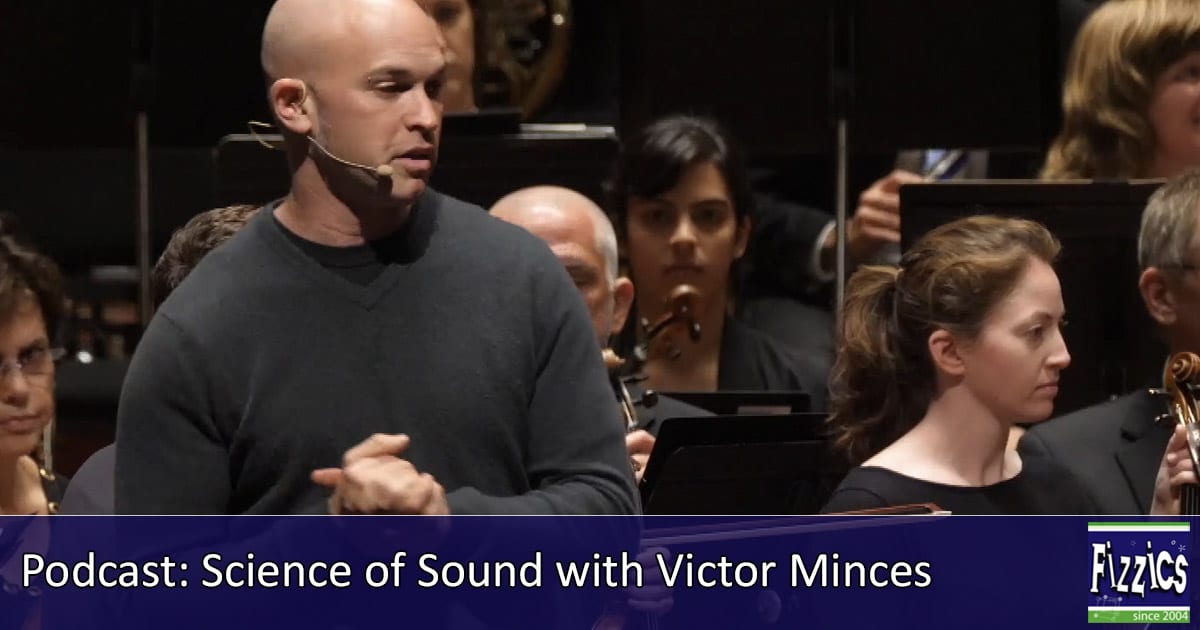
Meet Victor Minces, a researcher at the University of California, San Diego, who has applied his background in physics, neuroscience and the cognitive science of music to create Listening to Waves, a project sponsored by the National Science Foundation. It’s all about inspiring students to develop a deeper appreciation of both science and sound!
Victor Minces exploring the physics of sound with a student.
Based at the University of California, San Diego (UCSD), Listening to Waves is a pioneering initiative investigating the profound relationship between musical performance, brain function, and broader aspects of human cognition. The group is deeply committed to educating students on the multi-faceted science of sound, exploring its physical properties, perceptual nuances, and neural impacts.
The programme originally emerged from research conducted at the Temporal Dynamics of Learning Centre (TDLC), a National Science Foundation (NSF) sponsored conglomerate of laboratories. Their core mission is to bridge the existing gap between the rigorous scientific study of learning and the practical educational system. Today, the initiative is further bolstered by an NSF grant for Innovative Technologies for Students and Teachers (ITEST).
To date, Listening to Waves has reached more than 3,000 students across San Diego County. This impact includes successful collaborations with the High Tech High School System, the Boys and Girls Club of San Diego, the Museum School, and the Sweetwater School District, proving that the science of music is a powerful tool for universal engagement.
🚀 Top 3 Learnings
Sound as a Physical Bridge: Music provides a tangible way to explore wave physics, making abstract concepts like frequency and amplitude visible through digital tools and physical vibrations.
Cognitive Impact: Engaging with musical science influences neural pathways, bridging the gap between artistic performance and the neuroscience of how we learn and process information.
Inclusive STEM Entry: Instrument building serves as a universal hook, lowering barriers for students who may not traditionally see themselves as “science people” by using creative expression as a starting point.
🔬 The Setup
The programme utilises a unique blend of instrument building and digital analysis to make abstract wave physics tangible. By creating “science-fied” musical instruments from simple materials, students can literally see and feel the vibrations they are studying while using specialised software to quantify their findings.
📐 Physical Space
A dedicated acoustic environment or a classroom with low ambient noise is ideal for these activities to ensure clear sound analysis. Students require desk space for laptop-based sound exploration tools alongside room to experiment with physical string and percussion setups to observe how frequency and amplitude change with physical adjustments.
[00:00:15]Ben Newsome: Welcome to another FizzEd podcast. I hope you’re having a fantastic day, evening, or wherever you are. Today is an interesting chat all about the science of sound. We’re hanging out with Victor Minces, who’s from the Department of Cognitive Science at the University of California. What he really loves and is passionate about is getting kids into understanding how sound truly works. He’s set up this really amazing site, listeningtowaves.com, a project sponsored by the National Science Foundation, which is there to help inspire students to develop a truly deep appreciation of both science and sound. Chatting with Victor was fantastic. It was recorded a little while ago, and it is well worth your time. You’re going to find out why during the chat. If you love your sound, if you love your science, and if you want to know how he got involved in connecting science with an orchestra—seriously, he did that too—it is well worth checking this out. I hope you enjoy the chat.
[00:01:00]Announcer: This is the Fizzics Ed podcast, for all about science, EdTech and more. To see 100 fun free experiments you can do with your class, go to fizzicseducation.com.au. That’s Fizzics spelled F-I-double Z-I-C-S and click 100 free experiments.
[00:01:17]Victor Minces: Thank you very much. I’m glad to be here.
[00:01:21]Ben Newsome: I’m really happy you’ve reached out because you do some interesting stuff. I figure rather than me introducing you, you would be the best person to describe what you do and how you do it. Victor, tell us a bit about what you do and what you’ve created.
[00:01:41]Victor Minces: I do many things. It’s sometimes hard to know where to start, but what I’m liking the most these days is my education programme. When I finished high school, I started studying fine arts because I really loved art, and then I got really interested in physics because I felt it was giving me a strong mental challenge that I needed at those times. Then I went to neuroscience, using physics to understand neuroscience. Then I started working on the cognitive science of music because I love music and also because I thought it was a good way to help society understand the role of music in education. Through that, I started informally teaching students in the school that I was working at about the science of music. The students loved it so much that I felt it was the most important thing I had done in my career. I turned that into my main objective, my day-to-day activity. I was very lucky to get funding from the National Science Foundation, so now I do this every day. The goal of my programme is to create a sense of wonder in kids when they understand the science of sound. Sound is everywhere, and we perceive it but we don’t think about it, we don’t know what it is. When you start understanding it, which happened to me when I was studying physics, when I started seeing sound as a wave, it really blew my mind because I could see waves all over the place. Instead of just hearing a sound, I would hear a sound and that would make me think, how is that object vibrating? That also opens the door to create vibrating things. That might be creating electronic music using a lot of signal processing if you understand how to play with signals, but also create musical instruments. If you understand how things vibrate, you can set them up in a way that they vibrate just the way you want and you can make some crazy musical instruments, which is another thing that I like doing, both by myself and with the students.
[00:03:01]Ben Newsome: I must say, it sounds like you’ve clearly fallen into a place where you really just get to play now, which is fantastic.
[00:03:11]Victor Minces: I’m very fortunate. Yes.
[00:03:13]Ben Newsome: That’s awesome. I was actually just thinking—we run a programme here at work called Science of Sound, funnily enough.
[00:03:19]Victor Minces: Oh wow.
[00:03:21]Ben Newsome: Getting into it, it just got me thinking, as people are listening to this, if you run it through your speakers, we could play different sounds. If you go onto the free app called Virtual Oscilloscope, you can watch the waveforms do their things, and it can be lots of fun.
[00:03:36]Victor Minces: Exactly. I do two things in my work. One is, I started going to schools and doing a lot with physical objects. I found that was great for the few students that I could reach. But if I wanted to make a big difference, I needed to reach many students through the web. For that, we created three web applications, which are really beautiful. One of them is an oscilloscope.
[00:04:13]Ben Newsome: Oh wow.
[00:04:16]Victor Minces: It is a little different than other oscilloscopes in that on the one hand, it’s easy to use and change scales and do a bunch of things that oscilloscopes do. But also we changed it so people could playfully interact with the sound that they visualise. You can not only visualise the sound, but you’re actually recording the sound and you can play it back, create loops, stretch it, compress it, reverse it, and add some other effects. It’s an oscilloscope, but it gives you a chance to play.
[00:05:07]Ben Newsome: That’s awesome. It’s a pity in a lot of ways that this is an audio medium. Seeing as we’re doing sound, an audio medium makes sense for what we’re doing. We could always check it out and definitely go onto your site and see all those tools. That would be really handy, because we often run that for younger kids and look at frequency and amplitude and what they’re actually hearing. When you think about it, at a simplistic level there’s not too much going on with sound, but if you dig a little deeper, it gets a little complex, especially when waves start to interact and interfere and do all the things that they do, especially when you go into high school. I’m hearing that you teach the gamut; you’ve got a whole range of kids that you’ll be teaching using the tools. What are some of the challenges that students have when they’re trying to get their head around how sound truly works?
[00:07:15]Victor Minces: I think the best challenge the students have is the same challenge that teachers have, which is that what needs to be taught is these standards. The standards are a bit wrong and they don’t focus on something that is everyday. For example, one of the standards is wavelength, which everyone has trouble with. The reason people have trouble is because you cannot really see it. There are so many other things related to sound that are equally important, maybe more important than that, which you can really perceive. I try to focus on those things, although I have some contents for teachers that include information about wavelengths. If people could just focus on the stuff that is fun and meaningful, I think it would be much easier for everyone.
[00:08:29]Ben Newsome: I must say, seeing you mentioned fun, probably the two fun things we love to do. One thing that works a treat is called a Chladni plate. I never say it quite right. C-H-L-A-D-N-I. You’re nodding away, yes. That is really cool with a violin bow and then showing videos of cornflour slime, Oobleck, bouncing around on different frequencies and it looks awesome. What are some of the fun things that you use for the kids?
[00:08:58]Victor Minces: I really recommend these web applications. I think they’re fun themselves. Beyond the oscilloscope—and they are free, so anybody with a computer can use them. Beyond the oscilloscope, I have a spectrogram tool. The spectrogram tool allows you to decompose the frequencies of the sound, because any sound is actually a chord.
[00:09:28]Ben Newsome: Yep.
[00:09:31]Victor Minces: Any sound is made of many frequencies, not just one single frequency. A spectrogram allows you to see what are the frequencies that compose every sound. Like in the case of the oscilloscope, we modified the spectrogram so people could also interact playfully with it. If you have a touchscreen, especially a computer, in the phones it doesn’t work as good yet because the screen is too small, but it really turns your computer into a harp. You can choose a musical scale, you can actually create a musical scale, and then you slide your fingers through your computer and you will hear the music. I like to set it to a blues scale and I put the Rolling Stones in the background, and I play and I feel like I’m Stevie Ray Vaughan with five hands. Because each of your fingers is playing a different note and it just feels so good.
[00:10:37]Ben Newsome: That’s really cool. And really good for kids to visualise, too. That’s what spectrographs do. It’s really awesome. One of the things that I noted was that you work with young underrepresented students, and that’s really cool. Could you tell us a bit about how you’ve been doing that and the outcomes of that work?
[00:10:54]Victor Minces: When I started this, I was not specifically thinking of working with underrepresented students. I actually just wanted to do something fun for me, which was a bit selfish. But I’m lucky that the National Science Foundation puts a lot of stress on reaching those populations. In order to get a grant, I had to do research and create a network to reach these populations. Through doing that, I realised that it is actually the most important thing to do, and now I wouldn’t even think of doing it with kids that already have a school with lots of resources and parents with lots of time and a college education to help them out. I do enjoy working with underrepresented populations. The results I got were great. For a little bit of background, I don’t know how things are in Australia, but in the US it is typical that underrepresented populations not only don’t have access to lots of resources—for example, schools don’t have much money for buying materials for hands-on experiments—but there’s also this idea that they might have low self-efficacy, which means that they cannot see themselves as scientists or engineers because there’s this idea that a scientist is a rich white person.
[00:12:57]Ben Newsome: Yes. I think I’ve mentioned this on the podcast before. I double dare everyone, if you’ve got a kid nearby, get them to draw a scientist. I absolutely guarantee it’ll be an old white man with crazy hair. Although, I can’t guarantee it anymore because there has been a shift. Some young girls are now drawing a female scientist, which I really shouldn’t say “female scientist,” you should just say “a scientist” because they’re a scientist regardless of their gender. The kids now will draw girls or boys or whoever they feel is a scientist. But that is very much true about who they think. Honestly, it still does pervade. I ran that activity only yesterday with some grade seven students and they were all boys, and guess what? I didn’t see a single girl drawn. They were all white. Yet the group I was with, most of those kids were of a variety of different backgrounds. It was very clear that that still pervades for sure.
[00:13:58]Victor Minces: When I interact with the kids—first of all, I am Latino. I am from Argentina and I speak Spanish. I’ve been working mostly in schools that are 95% Mexican. It’s right across the border; you can almost walk to Mexico in the schools that I work at. I think I myself provide a role model of somebody that is a scientist and is Latino. But also in the activities that we do in these schools, they are very hands-on, and I do things that invite the students to investigate. Investigate is not just a cold thing. What I do is I present a really amazing, surprising sound experience. I can give you some examples later, or you can watch some videos on my website. They go, “Whoa!” When they go like that, their eyes turn big and then they want to figure out how that works. For example, one that I really like is actually hard to describe verbally because it’s so experiential. Basically, if you grab a metal pipe and you hold it on the top and you hit it with a mallet, it doesn’t do any cool sound, it just goes “clank.” But if you hold it at 22.5% of the length, you’re grabbing a node, a vibrational node, which are these magic points. Then if you hit the pipe, it will make a super long, beautiful sound.
[00:15:59]Ben Newsome: Oh, that reminds me! We use a screaming rod demonstration, aluminium rods, and we put rosin all over our fingers. We hold the rod and we rub it, so we hold it exactly at the node, otherwise it’s not going to work. Just light and don’t touch the end so the end can actually vibrate, and you can build up a superposition and it gets louder and louder and screams. Then you can try and go up an octave. It’s a lot of fun, I like that idea.
[00:16:30]Victor Minces: Yeah, that one is fun too. After I do that, I give the pipes to the kids and I’m like, “Okay, you figure out how to do it.” I don’t tell them how to do it. The kids get obsessed trying to figure it out. I do activities that sort of—for me doing science is not reading science textbooks, it’s more feeling that sensation of “I want to find out how this works.” I do a bunch of things in the schools. I don’t know which one is more important; I think it’s the holistic approach. It does change the perception that students have about science and about themselves as scientists. It increases their self-efficacy, and they love the science experience according to the surveys.
[00:17:36]Ben Newsome: That’s fantastic. You’re right, it’s never going to be one visit, three visits, ten visits. Education lasts for years for good reason. In fact, education shouldn’t stop. It’s not just one angle. Here is my wave demonstrator and now you know waves, and you walk away. No, they’re never going to know it that way. You’ve got to do it lots of different ways. Considering you work with underrepresented students and schools, and we do know about the resourcing problem because it’s very real. People listening in all over the world, from a variety of different socioeconomic backgrounds, because not everyone teaches at a high-end school. If people were listening to this and they want to get hands-on with something that doesn’t cost a fortune because they personally have to fund it—what are the sorts of things that you’d suggest if they were going to investigate sound but not cost the earth? Obviously what’s on your site, but what else?
[00:18:48]Victor Minces: The web applications also have lesson plans that were made with the San Diego County Office of Education curriculum developing experts. They can spend a lot of time playing with the web applications and learn a lot about sound. Other than that, if it’s about doing things with physical objects, I think it would be good to do activities that stimulate kids to listen more. For example, some homework: when you go around your life in the next week, try to see if you can find sounds that have a clear musical note. What objects were those? Maybe you can bring them over and think, how is this object vibrating? Anything that is creating musical instruments, I think is super fun for the kids and invites them to think how objects vibrate and how sound is created, why do we perceive sound like that?
[00:20:00]Ben Newsome: I like that, especially these days with maker space, making a thing is great for kids and challenging them. Saying, “Here’s the fancy instrument, it might be a guitar or a flute. Here’s a pile of materials that make no sense, see if you can make this stuff get close to making a note.” Kids can make their own guitar, they can do these sorts of things and have a lot of fun. You don’t even need materials. If you’re listening to this, pull out a headphone if you have one in your ear. Stick your finger up in the air, tap your elbow. Nothing happens, right? Now put your finger in your ear. Now the sound changes because the sound transfers differently because it’s travelling through different mediums. We don’t need expensive stuff to start the beginnings of it. You can even talk to kids that might have a bath and say, “Tap the side of the bath. Now put your head under the water and tap. You will hear a difference.” We’re hearing a transfer of sound difference, and that brings up a conversation about what matter is made of.
[00:21:05]Victor Minces: Totally. There are super simple things. Most people didn’t do this, but you can grab your throat and say “Ah!” and you’ll feel the vibration in your fingers, which invites kids to think, “What is making your fingers vibrate?” Then you can have people yelling in a piece of paper, grabbing it with their fingers. When you yell “Ah!” without touching the piece of paper, you still feel the vibration in your fingers.
[00:21:55]Ben Newsome: I like that. While you’re holding the paper in front of your face doing that, it reminds me of being at a concert and you’ve got the speakers turned right up and you can feel the thump, you can feel the compression wave coming at you. It reminds me there are opportunities to have misconceptions for sound because we often think of it as a simple wave going up, down, up, down. There’s a heap of different forms of waves and trying to get your kids’ heads around how it all works can be challenging. I wonder from a visualisation point of view for sound waves, we sometimes use light. We talk about light and light waves because in a lot of ways the principles are the same. But sometimes they’re not. What are your thoughts around meshing other concepts to be able to teach sound in a way that works?
[00:22:45]Victor Minces: Meshing other concepts?
[00:22:47]Ben Newsome: For example, my brain went to bubble interference patterns. If I have a light going onto a bubble, you see rainbow concentric rings going around the bubble and you’re seeing interference of wavelengths of light. Is that useful to then talk about what happens when you play sound waves at each other?
[00:23:08]Victor Minces: Actually you could do that. If you have two speakers playing the same volume, you could walk around the room and hear those interference patterns. I think by the time you get to do that, the students should have a really good understanding of what is frequency and what is volume, and how a single source transmits the sound in the air. Once they have that knowledge, I think they’re ready to go to the next step. But that is already quite a lot of knowledge, so I’m thinking this is an advanced, super motivated student in high school. Before that, there are so many other fun, engaging things to do with sound that don’t involve these spatial properties. I think they’re fascinating, but I’m a nerd, I studied physics.
[00:24:21]Ben Newsome: Yeah, you’re a researcher at the University of California. This is what you do.
[00:24:27]Victor Minces: Yeah. I absolutely agree. Honestly, even simple things like a metal coat hanger. Tie some strings to it, tap it onto the table while holding the strings, then wrap the strings around your fingers and put your fingers in your ears. Simple. There are so many experiences like that. Making musical instruments, cutting pipes at different lengths and making a xylophone. It sounds beautiful. Kids are super happy to do it, and they need to do stuff with their hands. It’s great to have an experience in which they are integrating doing stuff with their hands and with their ears in a science class.
[00:25:11]Ben Newsome: You know what, there’s actually an opportunity for cultural exchange too around when you’re making instruments for sure. It just got me thinking as you describe the xylophone made out of pipes. You’re in America and you’re from Argentina. I’m in Australia. We’re going to often say different words for the same thing. You’re in America, you know flip-flops, we put them on our feet, we walk them around. Australia, I’m sorry, we’re a bit strange, we call them thongs. Now, where I’m going with this. Imagine your xylophone, you’ve got your pipes at different heights, different lengths, and they’re all strapped together. If you grab your flip-flop—a thong for down here, or if our New Zealand listeners, yes, I know about your jandals—whatever you’ve got, you hit the top of the open pipe with your flip-flop, with your thong, and you get nice good sounds. The fact that I was able to talk about it from a cultural point of view, now we can actually talk about, what are some cool instruments in Argentina? What are some cool ones that happen in the Western United States? Or in Australia? That’s a great conversation.
[00:26:12]Victor Minces: Totally. The connections between sound and music and culture are infinite. A long-term goal of mine is to add to my website not only the connections of music with science, but of music with culture. The connection is on the one hand through the musical instruments that people use around the world and how they use them, but also the different musical scales that people use around the world. You can try it with the musical spectrogram—you can choose a blues scale and just by choosing five notes, five frequencies out of the infinite frequencies that are there, you get the feeling of blues music. Then you change to a different scale and you have this music that might sound familiar, that sounds a little bit like flamenco or Middle Eastern. Different cultures have different scales, a different set of frequencies that they like the most, which I find fascinating.
[00:27:26]Ben Newsome: One of the things I thought was fantastic on your site—and seriously guys, go to listeningtowaves.com, go to /media—and you’ll see Victor with the San Diego Symphony. Wow, that’s one way to demonstrate waves. How did that come about?
[00:27:44]Victor Minces: They contacted me, they knew about my work and they contacted me. Some anonymous donor organised or asked the symphony to organise a set of concerts for kids, and the concerts were educational. It was a way to tell kids what an orchestra is, what instruments are there, and they were playing beautiful pieces. Actually, some pieces are made specifically for that. They have a narrator and they say, “And this is the brass section,” and then the brass section plays beautiful pieces. It was packed with kids, we had 6,000 kids total. In between pieces, myself and somebody from the Fleet Science Centre, which is a great science museum in San Diego, gave little snippets about the science of sound. The Chladni plate was one of those, that was really fun.
[00:28:56]Ben Newsome: I love that, it’s really cool. If people are listening in going, “What can I do to start helping kids understand sound more?” I’m just going to ask you that straight. If you had a bunch of teachers set in front of you and they were going, “What are some simple takeaways I can take to my class to start teaching sound in a meaningful way?” What would you say would be the first steps to help kids to not just learn it, but appreciate it?
[00:29:29]Victor Minces: The very first step is to appreciate it yourself. You have to know that you can play with sound, that you can compare different sounds, that you can pay attention to how things vibrate and how they make sound. Once you yourself have found that playful vein, you can transmit that emotion to others, because you cannot really instil in others an emotion that you don’t have. And use my website!
[00:30:11]Ben Newsome: That’s the thing. The site is packed with stuff. Seriously, go to listeningtowaves.com and it’s just going to keep growing by the look of it, too. I love that you’ve got the tools to actually use. Not just “here, go get these materials together and go do a science experiment in your class,” you’ve got the tools embedded on your site.
[00:30:34]Victor Minces: Yeah, I developed the tools with my team. I also listen if somebody wants to send me suggestions of how to improve them, I’d be happy to hear them. They do need a lot of improvements. For using the tools, people should go to the tab that says Sound Exploration. And there’s a bunch of other stuff.
[00:30:57]Ben Newsome: Awesome. I’m guessing people can get in touch with you through your website, but you might be on other different places. Is there any other way that people can get in touch with you?
[00:31:05]Victor Minces: I think there’s a contact link on my website that is ideal.
[00:31:12]Ben Newsome: Easiest way. What we’ll do is as normal, we put the information in the show notes and we always write a blog article regarding all of our podcasts. We’ll put some excerpts of some of those videos of what you’ve done to actually show, if people go on our site they can see exactly what you’ve been getting up to and then head on over to your site because it’s cool, I like it.
[00:31:31]Victor Minces: That would be wonderful. Thank you so much.
[00:31:33]Ben Newsome: No worries. Victor, thank you very much for joining us on the podcast. I think it’s really quite fascinating the different ways of communicating science. I love that you hooked up with an orchestra. I love that you’ve been working with kids who are in disadvantaged areas and making it real and useful for them, that’s really important. And you developed some tools that people can use all over the globe, so it’s really cool. Well done.
[00:31:58]Victor Minces: Hit me up any time if you have any questions for your own programme. I’d be happy to chat, I really want to spread this.
[00:32:09]Ben Newsome: You’re doing really well. Victor, thank you so much. Have a fantastic evening. It’s currently mid-afternoon in Australia, by the way.
[00:32:16]Victor Minces: Have a fantastic mid-afternoon.
[00:32:18]Ben Newsome: Thanks so much.
[00:32:21]Ben Newsome: We hope you’ve been enjoying the Fizzics Ed Podcast. We love making science make sense. Why don’t you book us for a science show or workshop in your school? If you’re outside of Australia, you can connect with us via a virtual excursion. See our website for more.
[00:32:41]Ben Newsome: Well there we go, we just heard from Victor Minces. You can really tell he loves his science and sound. How cool is it that he got to work with an orchestra? Gotta love that, and I challenge you to try and do the same, I think it would be awesome if you could do this. If you want to go check out those tools that he mentioned, go to listeningtowaves.com, and head on over to the Sound Exploration tab and there you’ll find the sound tools. You’ve got an oscilloscope, a signal generator, and all these sorts of other things which will help you help kids understand how sound works. By the way, he does have a Twitter handle, so go to @scienceofmusic1. Science of Music numeral 1 and you’ll be able to hang out with Victor and find out more about what he’s getting up to. That is the end of this particular podcast, but as usual, we’ve got more STEM educators and edupreneurs coming up. If you want to hang out with me, I have been on Clubhouse quite a bit. Go find me at @bennewsome, N-E-W-S-O-M-E, and I’d love to chat with you in one of the rooms on Clubhouse because it’s really fun to learn from everyone and hear what you’ve been getting up to. That is enough for this particular podcast. Have a fantastic day, evening, night, wherever you are and I’ll catch you another time.
[00:33:53]Announcer: You’ve been listening to another FizzEd podcast. We’re excited about science. Subscribe to us on iTunes to download the next episode as soon as it’s released. And don’t forget, for hundreds of ideas, free experiments, our new Be Amazing book and more, go to fizzicseducation.com.au. That’s Fizzics spelled F-I-double Z-I-C-S.
[00:34:23]Announcer: This podcast is part of the Australian Educators Online Network, aeon.net.au.
Frequently Asked Questions
What is the primary goal of the Listening to Waves programme?
The programme aims to bridge the gap between scientific research and classroom learning by using music as a gateway to explore physics and neuroscience. It encourages students to understand the science behind what they hear and create through hands-on experimentation.
How does building instruments help students learn about physics?
By constructing their own instruments, students engage directly with physical variables like string tension, length, and material density. This hands-on approach makes abstract concepts such as frequency, vibration, and resonance tangible and easier to visualise.
Is a background in music necessary for students to enjoy these activities?
Not at all. The programme is designed to be inclusive, using music as a universal hook. It allows students who might not consider themselves “science-oriented” to find a creative entry point into STEM through sound exploration and personal expression.
What digital tools are provided for sound analysis?
Listening to Waves offers a suite of browser-based tools that allow students to visualise waveforms, analyse frequencies in real-time, and experiment with digital synthesisers, effectively turning any laptop or tablet into a portable acoustics laboratory.
Are the resources available for educators outside of San Diego?
Yes, the digital sound exploration tools and many of the activity guides are available online through their official website, making them accessible to teachers and students globally who wish to integrate the science of sound into their curriculum.
Extra thought ideas to consider
The role of STEAM in modern education
Integrating the arts into STEM (Science, Technology, Engineering, and Mathematics) helps develop more well-rounded thinkers. By exploring the aesthetics of sound alongside its physical properties, students learn to appreciate the creative side of rigorous scientific enquiry and problem-solving.
The neuroscience of auditory learning
Engaging with music can influence brain structure and function. Educators might consider how the auditory feedback loops created during instrument building can enhance cognitive development, spatial reasoning, and memory retention in young learners.
Recognised by
22 years, award-winning work, 1 purpose
Recognition from business, education and industry bodies across Australia.
Australian Small Business Champion
Multiple years
CILC Pinnacle Award and Hall of Fame inductee
Center for Interactive Learning and Collaboration
Western Sydney Awards for Business Excellence
Winner
Top 100 Coolest Company
Listed
Local Business Awards
Winner
We value your privacy
We use cookies to improve your experience. Essential cookies are always active. You can choose which optional cookies to allow.We use cookies. Optional ones stay off unless you allow them.Privacy policy