Transcript
[00:00:00] Announcer: You’re listening to the Fizzics Ed Podcast. For hundreds of ideas, free experiments and more, go to fizzicseducation.com.au. And now, here’s your host, Ben Newsome.
[00:00:15] Ben Newsome: G’day and welcome to the Fizzics Ed Podcast. No matter where you are around this world of ours, this is the place where we hang out and talk about STEM in all its different forms. Today, we’re hanging out with two people who love their science so much they head up Pint of Science Australia, which is a national not-for-profit organisation that makes science happen through science appreciation amongst Australian people in pubs. Yes, very much so. We’re hanging out with Maria Roitman and Jin-oh Choi, and they love their science with the Pint of Science festival. It’s a way to bridge the gap between scientific research and the Australian public, but also a great way for researchers to practise science communication. And trust me, it’s so important now. This is happening next week. Yes, seriously, next week across 15 cities across Australia. This is part of a global programme called Pint of Science, which originated out of the UK. So, let’s get right into it and find out just what this is all about.
[00:01:09] Announcer: This is the Fizzics Ed Podcast. We’re all about science, edtech and more. To see 100 fun free experiments you can do with your class, go to fizzicseducation.com.au—that’s physics spelled F-I-double-Z-I-C-S—and click “100 Free Experiments.”
[00:01:30] Maria Roitman: It is a lot of fun, and Jin-oh, you’ve been involved with the festival a bit longer than I have. But this will actually be my very first festival to attend since stepping into the co-CEO role. Jin-oh, do you want to chat about how they’ve run and how much fun they have been in your experience so far?
[00:01:49] Jin-oh Choi: Sure. I’ve been involved in Pint since 2019. I’ve really found these events a great opportunity for people to experience something that’s just outside of their comfort zone and learn something new. I think that’s one of the greatest things about our event. It’s about trying to bring science from outside a research or academic environment right into the comfort of a pub.
[00:02:26] Ben Newsome: A pub should be comfortable, you’re right. Making science comfortable is also part of it. How’d you fall into that, Jin-oh?
[00:02:35] Jin-oh Choi: For me personally, I come from an IT background, but I’ve always had a passion for science and science communication. There’s a lot of misinformation out there about science. We saw that quite a lot in the past couple of years with the COVID situation, so getting science out there and promoting experts in their field has always been a passion of mine. That’s why Pint of Science has always been a real soft spot in my heart, trying to get science out to the general public.
[00:03:22] Ben Newsome: Which is fantastic, knowing that you’re doing that in a public forum such as a pub. Not a bad place to do any education really. I’m just curious, Maria, have you actually presented as one of the speakers before?
[00:03:41] Maria Roitman: Not in this festival. I’ve done a bit of SciComm myself before through other fora. I only first came across Pint of Science during the lockdowns, so at that time the festivals had gone virtual. I hadn’t presented anything myself, and I’m quite comfortable taking the back seat this round, pulling some strings in the back, but really letting our amazing researchers get the platform to talk about what they do. I’m not research-active myself anymore, so I’m very happy to hear about the weird and wonderful things going on in different labs and research groups around the country.
[00:04:18] Ben Newsome: Fantastic. There might be some people who have been to one of these events. It’s been around for a little while, but some have never seen it. So, Maria, how’s it structured? What does it look like if people turn up? Is it 6:00 p.m. and people are just talking over each other? How does it all work?
[00:04:40] Maria Roitman: Hopefully not too many people talking over each other! Pretty much the festival runs over three consecutive nights. It runs during the same week on the same three dates across Australia, but also globally. We’re part of an international movement with 26 countries participating this year.
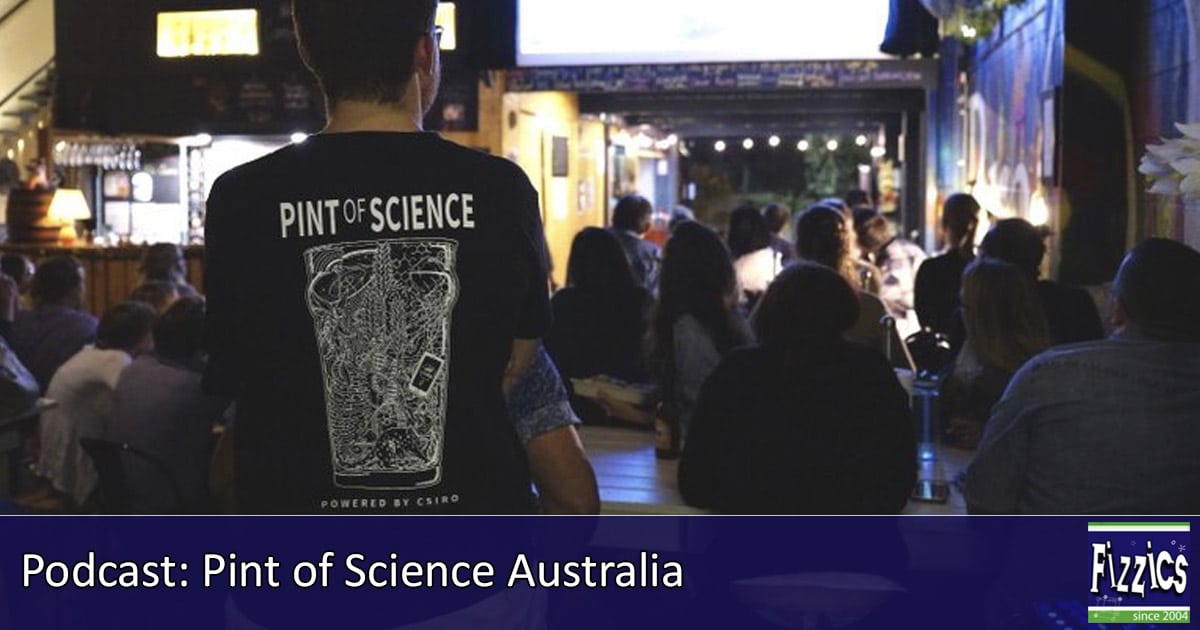
[00:05:00] Maria Roitman: Over those three nights, we’ve got 15 cities locked in with a bunch of venues in each city that host two to four speakers a night. Generally, doors will open at 6:00 or 6:30 depending on the venue. It’s a really informal atmosphere. There’s a moderator, an MC, and a host.
[00:05:25] Maria Roitman: We leave it up to our local volunteers to figure out what works best for their audience. Some choose to run a bit of trivia in between talks as well. It’s about fostering the researchers, giving them an opportunity to give a talk and stimulate some interaction through Q&A with the audience. Some speakers like to bring in props, some are more performers and do a little bit of instrumental work as well as talking about science. There’s really quite a diversity of experiences you might get depending on which night you go and who’s presenting.
[00:05:53] Ben Newsome: Sounds like a bit of a logistical feat. Fifteen sites, speakers all over the place, organising all the things. What cities are we talking about here, Jin-oh?
[00:06:07] Jin-oh Choi: We’re everywhere from Sydney and Melbourne, up into Queensland in places like the Sunshine Coast, Cairns, and Brisbane. We’re all across Australia. We’re also across in WA and Perth. I think the only city we don’t have is Darwin this year, unfortunately, but apart from that we’re in every state and most major cities, along with a lot of regional cities as well.
[00:06:43] Ben Newsome: I’m curious. Maria, you said 26 countries, so that’s not an overnight thing. That’s been going for a while. When did this start and whereabouts?
[00:06:54] Maria Roitman: It started in 2013 in the UK, but it came to Australia in 2014. We’re going to celebrate our 10-year anniversary next year. Jin-oh and the leadership team will have a bit of a chat about what that means to make it extra special. It’s certainly been a build-up over the years, and we are so reliant on volunteers donating their time to make it all happen because it is a logistical scramble at times. It’s a coordinated scramble, and our function on the central team is to provide as much support as we can to the local volunteers in each city to help get this festival up and running.
[00:07:41] Ben Newsome: For sure. I’d imagine, Jin-oh, do you have repeat offenders, so to speak, with the venues? Trying to find a venue who’s going to say, “Yes, you can totally take over my mic for the night.” Do you have people who come back? Because there’s one thing to have the volunteer side from a science perspective, but the venues are doing the same thing.
[00:08:01] Jin-oh Choi: We’ve got some great venues that often want to come back year in, year out. One of the great things for them is because we run across Monday, Tuesday, and Wednesday nights where they might be a bit light on customers, they want to get more audiences into their venues. We’re really thankful for all their support because at the end of the day, without the venues, we can’t hold our events.
[00:08:42] Ben Newsome: I agree with this. As a science communicator, we do a lot of public events all over the place. There’s the science narrative—we want to do the science thing—but you think about what the site gets out of it. I’ve done some work, thinking about programmes we’ve done down public streets where local cafe owners will have speakers. Trying to align these up is a logistical feat. However, they’re driving customers through their door, even just by people wondering what on earth is going on. I imagine that’s what the feedback might be.
[00:09:19] Maria Roitman: Absolutely. When the word gets out and we’ve got events sold out already for next week with tickets selling quickly, it brings a huge customer base of people who may not usually frequent that venue. They get to sit in a pretty comfortable space, but maybe they’ll come back to that brewery because they thought it had a nice atmosphere and served great food. It’s definitely a win-win situation.
[00:09:56] Ben Newsome: I’m curious, Jin-oh. You’ve seen a few of these presentations. Did any of these grab your mind, like, “There was this really great talk about this”? Did anything stand out as awesome?
[00:10:09] Jin-oh Choi: It’s always great when you learn something new. For example, last year in Geelong, I can’t remember the speaker’s name, but they were from Deakin University and spoke about the materials used for motorcycle protection.
[00:10:30] Jin-oh Choi: He went through a whole heap of unusual information because I hadn’t actually thought about it. I think that was the great thing for me. This particular speaker was talking about the materials of motorcycle protection and how, depending on what type of material it is, it impacts how much damage you might sustain from injuries. It was just something really unusual.
[00:11:05] Jin-oh Choi: That’s one of the best things about the festival. There are so many different topics on display, and you just don’t know what you’re going to find out. It might be something you have a general interest in, but it also might be something you hadn’t thought about, and you want to learn more.
[00:11:34] Ben Newsome: 100%. I think about the sheer creativity that’s out there with scientists and engineers. If you’re presenting your science—and if you’re listening in, by the way, and considering presenting next year—it might be a good idea. There’s this unanticipated consequence of presenting what you do. I’ve spoken with material scientists who are so well-versed in their materials that someone might listen and say, “Can I have a chat with you? Because that material might solve our current problem.”
[00:11:59] Ben Newsome: And it’s got nothing to do with motorbikes, it’s something totally different, some other ceramic or something. I guess, Maria, I’m just curious. Do you have to be the postdoctoral researcher with 50 years of study behind you? Or can you be a new up-and-comer? What’s the benchmark that you look for when it comes to speakers?
[00:12:19] Maria Roitman: We’re really keen to get a diversity of speakers in, and that applies to career stage as well as all other elements of diversity. Looking at career stage, we’ve got PhD candidates through to senior academics presenting their research, as well as research-active folks in industry who might not be in a traditional academic organisation.
[00:12:44] Maria Roitman: By the same token, something we’re really passionate about is better understanding who we get interest from for speakers, and who comes to these events. Are we reaching a diverse Australian public? Because that’s really what we’re aiming to do. That’s something we want to understand better and try to promote to folks who aren’t traditionally active in the science community.
[00:13:11] Ben Newsome: It makes total sense. I’ve been to some of these events before and they are a lot of fun. What’s interesting is watching the general public—some engaged, some less so. The ones who are on that fringe between engagement and not, they’re the really interesting conversations. The whole point of science communication is to communicate the science. That means not just talking to the choir, but to the people on the fringes. That’s where this has a lot of power and legs.
[00:13:42] Maria Roitman: Absolutely. Coming back to what Jin-oh was saying about the spread of misinformation and how quickly information can travel globally via social media. Having these locally embedded opportunities for the community to hear from experts in their own backyard is a nice reminder that we actually have expertise right around us. We don’t necessarily need to rely on headlines passing through Facebook and Twitter. We have reliable sources of information at our fingertips in our own communities.
[00:14:25] Ben Newsome: I think about the Three Minute Thesis that you see people present a lot. Jin-oh, are these sessions long talks, or are they really short and take questions and answers from the floor? How do they tend to work?
[00:14:38] Jin-oh Choi: We leave that setup to the local volunteers, but what we normally say is the talks might be 10 or 15 minutes in length. We want to make sure it’s not a one-hour lecture in a pub. They’re nice and quick, and then there might be some Q&A at the end of each talk, depending on the format they have.
[00:15:12] Ben Newsome: Now, this is not that far away. As I record this, it’s next week in this year, 2023. I suspect we really need to know these dates and where to go to find out about these things. Maria, what’s the website and all that?
[00:15:29] Maria Roitman: Our website is pintofscience.com.au. Find us there, all the information is there. Our festival in 2023 is next week, which is May 22, 23, and 24. We’ve got dates in our pocket to announce for next year, but we might hold off on that until this festival is over.
[00:15:54] Ben Newsome: If you’re listening to this and you missed said festival, it’s happening again! Definitely reach out and put it on your calendar. You might be thinking it’s not for you, but what if it helps hone your ability to present the content you’ve been researching for years? At some point, you might need to pitch your concept. You could practise a funding pitch, who knows? It’s up to you.
[00:16:23] Ben Newsome: I love this idea. Well done. I’m curious, what advice would you have for a group of researchers who are wondering if their thing is going to be good enough for a Pint of Science talk?
[00:16:51] Maria Roitman: I’m happy to go first, and Jin-oh, you can jump in after. My advice would be to give it a shot. Reach out to our team and have a conversation about the type of thing you’re interested in talking about. As a researcher, one of the things you want to do is get your message out there. Publishing papers traditionally is one way you can do that, but that might not reach the public.
[00:17:19] Maria Roitman: That might reach people who have the same level of understanding in your field. So take this opportunity to test the waters on how well you can condense your really complex and nuanced research topic into something that is easily understood. That’s a challenge, but my advice would be to take it and give it a red-hot go.
[00:17:45] Ben Newsome: Awesome. Jin-oh, what do you reckon?
[00:17:47] Jin-oh Choi: What we want to provide is a safe environment for researchers and speakers to just talk about their science. You’ll get assistance from us in terms of how to handle the audience and general tips on how to do presentations.
[00:18:05] Jin-oh Choi: From our point of view, it’s really about giving everyone that opportunity to present and talk about their science. It’s not just about talking to your peers and other academics. It’s about getting out there and being able to share your knowledge.
[00:18:35] Jin-oh Choi: That’s the key thing. Your knowledge should be shared as far as we can. You don’t know the people that you’ll impact in that room. That could be a parent who might bring along their son or daughter to an event, who’s maybe not quite sure about science or might have a passion for it. It’s really about sharing that knowledge. If there’s one key takeaway from me, it’s let’s get that knowledge out there in an easy, accessible manner.
[00:19:23] Ben Newsome: I agree. I will actually add a couple of ideas because I’ve been lucky to be invited as a judge for various things. These aren’t judged, by the way. These are just happy spaces. But if you are presenting something, especially to the general public, weave story into it. We get so caught up with your research because you live it, you breathe it, it’s what you do.
[00:19:51] Ben Newsome: Unless people can connect how it relates to their lives or how it related to your life—why it is that you do the thing that you do, what’s driving you—there’s less connection with your story and therefore your research as a whole. Keep that in mind. And less is more, sometimes. I’ve seen some awesome presentations with spectacularly complex graphs and 30 seconds to digest them. Think of your poor public as you present what you’re doing, because we know you’re passionate, but make sure they can consume the information you’ve been creating over time.
[00:20:19] Ben Newsome: Look, thank you so much, Maria and Jin-oh, for coming along to this. I really hope this goes well next week.
[00:20:27] Maria Roitman: Thank you so much for having us, Ben, and for having this awesome conversation with us. We’re really looking forward to the festival next week and for years to come.
[00:20:38] Jin-oh Choi: Thanks for your time, Ben.
[00:20:39] Announcer: We hope you’ve been enjoying the Fizzics Ed Podcast. We love making science make sense. Why don’t you book us for a science show or workshop in your school? If you’re outside of Australia, you can connect with us via a virtual excursion. See our website for more.
[00:20:56] Ben Newsome: I hope you enjoyed that chat all about Pint of Science. Go onto the website pintofscience.com.au to learn about all those events happening next week across 15 cities. If you’re overseas in any of those 26 countries, look up Pint of Science in your country and maybe go find out the original founders in the UK. I hope you enjoyed this. It was great hanging out with Jin-oh Choi and Maria Roitman. You’ve been listening to me, Ben Newsome from Fizzics Education. This is the Fizzics Ed Podcast, and I hope to catch you another time.
[00:21:25] Announcer: You’ve been listening to another Fizzics Ed Podcast. We’re excited about science! Subscribe to us on iTunes to download the next episode as soon as it’s released. And don’t forget, for hundreds of ideas, free experiments, our new Be Amazing book and more, go to fizzicseducation.com.au—that’s physics spelled F-I-double-Z-I-C-S.
[00:21:54] Announcer: This podcast is part of the Australian Educators Online Network. AEON.net.au.
Frequently Asked Questions
What is Pint of Science Australia?
Pint of Science Australia is a national not-for-profit organisation that aims to increase science appreciation by bringing research talks to local pubs. It bridges the gap between scientific research and the general public in an informal, relaxed setting.
When and where does the festival take place?
The festival runs over three consecutive nights in May. In Australia, it takes place across 15 cities, including Sydney, Melbourne, Brisbane, Perth, and regional hubs like Cairns and Geelong. It is part of a global movement occurring in 26 countries simultaneously.
What is the format of a typical Pint of Science event?
Each evening usually features two to four speakers delivering short, engaging talks (about 10 to 15 minutes each). These sessions often include audience Q&As, science-themed trivia, and live demonstrations or props to make the research accessible and fun.
Who can participate as a speaker?
The festival encourages a wide range of presenters, including PhD candidates, senior academics, and researchers working in industry. The goal is to showcase a diversity of career stages and scientific fields to reflect the Australian research community.
Why is science communication in a pub setting beneficial?
Hosting science talks in pubs makes the information more approachable and less intimidating than a traditional lecture hall. It helps combat misinformation by providing direct access to local experts and allows researchers to hone their storytelling and communication skills.
Extra thought ideas to consider
The Role of Storytelling in Public Engagement
Effective science communication relies on weaving research into a relatable narrative. When scientists share their personal journey and the “why” behind their work, it creates a human connection that helps the public better understand and retain complex information.
Combating Misinformation through Local Expertise
By providing a platform for local researchers, Pint of Science reminds the community that reliable scientific expertise is available right in their own backyard. This direct interaction helps build trust and provides a credible alternative to headlines found on social media.
Discussion points summarised from the FizzicsEd Podcast, verified and edited by Ben Newsome CF