Transcript
[00:00:00] ANNOUNCER: You’re listening to the Fizzics Ed podcast. For hundreds of ideas, free experiments, and more, go to fizzicseducation.com.au. And now, here’s your host, Ben Newsome.
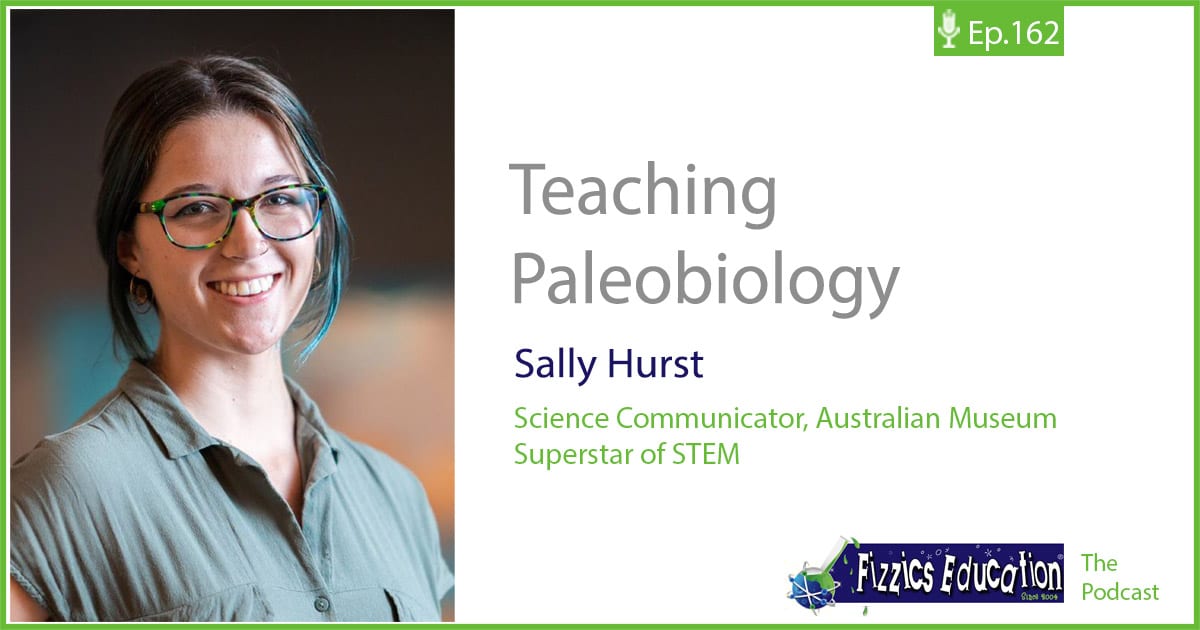
[00:00:19] Ben Newsome: Welcome again to another Fizzics Ed podcast. Glad to have you no matter where you are around this world of ours. We are talking STEM, and today we’re talking about palaeontology as we hang out with Sally Hurst, who is a museum education presenter at the Australian Museum, and she used to work at the National Dinosaur Museum. Now, by the way, she’s also a Superstar of STEM with Science & Technology Australia. One of the Superstars of STEM, she does an amazing job in inspiring women to get involved in science. Love her work, and today we get to find out just why she does what she does when it comes to palaeontology, her research in this, and why she is a mentor for young rural girls in a whole bunch of scholarship and coaching programmes. Let’s get right into it.
[00:01:00] Ben Newsome: This is quite a busy year for you as a Superstar of STEM.
[00:01:04] Sally Hurst: Yes, it’s a very exciting development. So hopefully, throughout this year and next, I’ll be heading to schools, I’ll be talking about STEM for girls and women across Australia and even the world and showing a pathway for if they wanted to do some of the things that I get to do in palaeontology or archaeology as well.
[00:01:25] Ben Newsome: And that’s what I want to know about. What do you get to do in palaeontology and so on?
[00:01:29] Sally Hurst: I am very lucky that at university I studied archaeology, which is the study of things like ancient humans, ancient civilisations, and palaeontology, which is things like fossils and dinosaurs. A lot of people do get them mixed up, so as a reminder I try and think that okay, palaeontology, that’s like Ross from Friends, and then archaeology is like Indiana Jones.
[00:01:59] Sally Hurst: But in both of them, I get to travel around and try and dig up different things from very different time periods and try and recreate a picture of the past. So if that’s with dinosaurs in Australia, it’s trying to figure out what dinosaurs were around, what kind of things they ate, working with museums and other experts from around the world and trying to get this information to the rest of the public who I think are equally as excited by it.
[00:02:35] Ben Newsome: For sure. And I was actually just thinking there that often as a student you’d think if I study this thing, it leads me onto this career and that’s my life for the next 50 years. And yet one of the managers from the Australian Space Agency, Brennan, he has an Egyptology background. There’s actually a photo of him literally in Egypt doing the archaeology things, and suddenly he’s now a manager within the Australian Space Agency. So it can be a very, very broad way that you can go in different ways.
[00:03:01] Sally Hurst: Yeah, absolutely. I’ve been very lucky that I have been able to do a lot of outreach and science communication. So even though my university studies were more based on going into academia, becoming a professor and writing, I’m actually like, I just don’t think that’s for me. I want to go out and talk to people. So I’ve been able to do that in my career as well.
[00:03:21] Ben Newsome: So when you do that sort of work, do you work mainly with high school students, primary students, or anyone who gets in front of you?
[00:03:29] Sally Hurst: Anyone who gets in front of me. I get to do a range. I’m part of a programme called Skype a Scientist and so that will match usually for me, it’s year three students I think are the most common group that I get, but it is open to any school group, it’s open to adult groups. And basically they will get to ask me questions about Egyptology or dinosaurs. And so I’ve been talking to people of all ages from all over the world through that programme.
[00:03:55] Sally Hurst: I’m hoping to do something a little bit more Australia based through the Superstars of STEM project, so do Zooms with schools anywhere around Australia. I’m based in New South Wales and Canberra a little bit, so if there’s any schools out there who want me to come and talk to them about dinosaurs, that’s definitely something I’m open to. And then at the Australian Museum as well, which is where I work, we often get school groups of all ages coming in, so it’s a little bit of everything.
[00:04:21] Ben Newsome: Massively, especially during Science Week, it’s very, very busy with what you guys get up to. We’ve been involved for many years. I was actually just thinking about the sort of crossover of techniques and skills that happen between archaeology and palaeontology. We work with a number of places, the Australian Age of Dinosaurs Museum, we hang out with the Royal Tyrrell Museum in Canada, and even a friend of mine in Penn Museum who does Egyptology as well. I kind of wonder about the techniques because we’re dealing with ancient artefacts. Some are more ancient than others, and yet there’s still preservation skills. What’s the crossover there?
[00:05:00] Sally Hurst: So I guess the general skills of how to dig stuff up is very applicable across both. Really depends on the environment where you are, what kind of things you’re digging up and even just how deep things are as to the kind of tools that you’ll be using, if it’s a tractor versus a toothbrush. But a lot of the time those things can be used across fields and a lot of the time we will kind of say, “Oh, archaeology’s doing this cool technique, maybe we can steal that for palaeontology.”
[00:05:28] Sally Hurst: And even things like most of the time, the kind of tools that we use as palaeontologists, especially when we get to the fine scale, there’s not often dedicated tools that are built for palaeontologists. So we are using toothbrushes, we are using paintbrushes, we are using dental picks. So we’re stealing little bits and pieces from everywhere else. And so there is a bit of crossover, so if we ever see that someone else is doing something good, we will try and adopt it as well.
[00:05:55] Ben Newsome: One of the things that fascinates me is how on earth these things get found in the first place? I mean, I think about the graziers in the middle of Queensland—going on the dinosaur side for a moment—that’s a network of farmers that say, “Hey, I’ve found a thing that’s not a rock, can someone come have a look?” But I mean, I was reading a thing about human remains right now around Tanzania, how there’s just these people who are just ingenious for finding scant remains. There’s not much of it around. How on earth do we do this? How do we predict where we should go to go find these things?
[00:06:32] Sally Hurst: So it is very tricky and a lot of the time it does take that expert knowledge of someone who can identify it on site. A lot of the time I will see a bone and I’ll be like, “I think it’s a cow,” but I really don’t know. And I grew up on a farm, I’m used to seeing bones. But then I’ve done something called a zooarchaeology course where we look at tiny little animal bones and try and identify them, sometimes just from one little bone.
[00:07:05] Sally Hurst: And the professors are amazing, they will look at that and be like, “Okay, that is that species of bird from this particular region.” And I look at it and go like, “Man, that looks like a piece of grass to me.” It’s tiny, tiny. So it does take a lot of expertise and practice to get that good. So if there is that network of farmers and non-traditional experts, who are so familiar with different material and the land as well for them to be able to spot that and go, “That is something different,” I think it’s incredible.
[00:07:38] Ben Newsome: I’m curious as an educator, if I really wanted to dive into it—just say I had a bunch of dinosaur nuts in my class, just to say that’s the way I’m going to teach this year because that’s the only way I’m going to grab their attention, let’s do this. How would we start? I mean, we’re not always going to be able to go out into a fossil bed. So I’m just curious around what would be a good thing to be like getting out tape and measuring different processes coming off bones? What would you do to start this off?
[00:08:08] Sally Hurst: I think so much of it is just exploring out in nature. I know field trips can be a bit of a logistic and organisational nightmare, but even if you’ve got a garden space in your school, it doesn’t have to be measuring bones. It can be measuring trees and rocks and different things. A lot of those skills of go from point A to point B, that’s transferable, it doesn’t really matter what the material is, it’s just getting practice with using these different instruments and things.
[00:08:40] Sally Hurst: I guess as well so many places do have little local museums, history societies that are hopefully close by, and they are such an untapped resource. They are often run by volunteers and they are often looking for more engagement with the community. So maybe they have some objects or artefacts or potentially even fossils that people have donated that kids can go in and actually interact with.
[00:09:05] Sally Hurst: I know that I have my own personal collection of fossils and so if I do ever go to a school to go and do a talk, I’ll bring my box of fossils and give kids some life experience interacting with this different material. And so if they ever are on a bushwalk or out on the farm and they see something different, they’ve already had the experience of, “Oh, I think this is something a bit different, how can I measure this? How can I have a go at identifying it?”
[00:09:28] Ben Newsome: What can be really fun is that it feels often as a layperson these things aren’t easy to find, but they don’t necessarily have to be a straight-up full-blown Ichthyosaur or something like that. If you’re on the beach, you could find sand, dry it out, right, and find forams. That is neat.
[00:09:46] Sally Hurst: Absolutely. And you can nowadays buy little microscopes that can attach to your phone camera. And so if you put something like sand under there, you will see so many amazing shapes. And same kind of thing, if you go and look at rock pools, a lot of the time embedded into the rocks you will see patterns of coral or shells which are potentially millions of years old.
[00:10:16] Sally Hurst: But I think as well turning away from, “Oh, I need to have something that I can bring home with me,” and rather turning to, “Let’s go to an aboriginal site somewhere in a National Park, let’s go and enjoy it and see what’s there,” rather than having something to take home with me. I think as well in so many National Parks, they are aware that they have fossils in their environment. And a lot of time it might be an entire cliff face where if you look really closely, you can see little individual fossils and things. So they are definitely out there.
[00:10:45] Ben Newsome: For sure. And it’s also thinking about what you know the Superstars of STEM programme is about, promoting STEM in lots of different ways and frankly career pathways and getting into it and getting involved. And so that begs the question: if you had teachers were trying to get kids to understand how on earth they could firstly study said field, then work in said field, then work in a museum doing it, what are the first steps for these kids?
[00:11:09] Sally Hurst: I mean, general curiosity is always the best thing. I think even if it’s something you do find—if it’s a leaf, a rock, anything—using those kind of critical thinking skills, doing a Google search, trying to figure out how you can identify it. That is so much of what I do in my research and work, so if you can get into those skills early, definitely a benefit.
[00:11:34] Sally Hurst: As students are moving into later years, things like year 10 work experience is incredible. I was lucky enough to do mine with the National Dinosaur Museum in Canberra back in the day; that was near where my mom’s farm was. And I worked there for six years afterwards. So that was again really good exposure.
[00:11:54] Sally Hurst: When it comes to things like studying high school subjects, any of your histories, pretty much any of your sciences will give you a great leg up. I didn’t actually do things like chemistry or biology when I was in high school; it was only when university came up that I was like, “Oh, I probably should have done this earlier.”
[00:12:13] Sally Hurst: But there are so many pathways. There are lots of archaeology degrees, ancient history degrees, general science degrees where you can start in something like biology and then you can always tailor your focus to dinosaurs or to Egyptian history or Australian history. There’s a lot of different ways people end up in museums and in this kind of research.
[00:12:36] Ben Newsome: And that brings up the point: what is your current research?
[00:12:39] Sally Hurst: So I actually run something called the Found a Fossil project. So I’ve recently completed my Masters of Research where this project was born. And it was basically asking the Australian community: if you ever found a fossil or an indigenous artefact, what would you actually do with it?
[00:12:59] Sally Hurst: Who would you tell? Where might you go for more information? Because there was nothing published on that. So for these laypersons around the country who are more likely finding these things—people like farmers, like indigenous communities who are living on the land—they’re out there a lot more often than us scientists are.
[00:13:21] Sally Hurst: So do they have correct information and guidelines about what you can do, who you can contact if you find something? So I have my Found a Fossil website which tries to provide all of that information for every state in Australia for if you do find something. Here’s the information, here’s where you can go, here’s who you can contact for identification, getting its significance assessed, hopefully with the aim of protecting this material for kids and for people of future generations.
[00:13:52] Ben Newsome: That’s really powerful, especially when you consider it’s wide. That actually could be a massive database when I think about it.
[00:13:59] Sally Hurst: Yeah, absolutely. And I think as well—so when I first started talking, I did actually specify some things are archaeology, some things are palaeontology. If you are someone who just is out on your farm and you do find something, and it looks a bit like a rock but not quite, it could be a fossil, it could be a stone tool or artefacts. Sometimes it is very hard to tell.
[00:14:23] Sally Hurst: And I think that was the thing as well that people were asking, “Well, why would you put fossils and artefacts together in a project when they are so different?” It is that case of if you’re on the land, you can potentially find both. So it’s good to have the information for both of them there.
[00:14:38] Ben Newsome: Well, it’s contextual. I mean, the reality is that they’re the ones finding it, that’s their world. They’ve got a thing in their hands and they want to know what to do with it.
[00:14:46] Sally Hurst: Yeah, absolutely. And I think previous to this project, it was really hard to find this information, especially adhering to things like state legislation and stuff. It was bloody hard work for me to go through it, and I’m trained how.
[00:15:02] Sally Hurst: And so if you are a farmer and you’re trying to do a Google search of “found a fossil, what do I do?”, it’s really hard to find that information. So that was why I named it Found a Fossil, so if anyone does do that Google search, hopefully my website will come up straight away.
[00:15:17] Ben Newsome: For sure. I mean, I kind of think about what can happen with that, too. So a good friend of mine, David Elliott, who’s the chairman of the Australian Age of Dinosaurs Museum…
[00:15:26] Sally Hurst: Yeah, I know David.
[00:15:27] Ben Newsome: Yeah, you undoubtedly would; it’s a small world in palaeontology. I wouldn’t be very surprised if you didn’t know him. And the story of him tripping over a bone is 100% very real.
[00:15:35] Sally Hurst: Absolutely. I love that story because I think so many people are like, “Oh, it’s not relevant to me, I would never find anything.” And yeah, you hear these stories of people on farms and even last year it happened as well; there was a site out near Gulgong in New South Wales where a farmer had driven over this fossil site every day for the past however many years. And then one day he actually stopped his tractor and was like, “Oh, what’s this rock I’ve run over?” And now it’s been said to be one of the best Miocene fossil sites potentially in Australia.
[00:16:13] Ben Newsome: I missed this! I literally was at that agricultural show, kid you not, about two or three weeks ago, and I didn’t know this happened there.
[00:16:21] Sally Hurst: Yeah, so it ended up being a great research project with the palaeontologists from the Australian Museum. And so they went out there and a lot of the time it is like, “Well, it could just be a rock,” so we’ll hedge our bets, but if it is something special, we’ll go and see just in case.
[00:16:36] Sally Hurst: And it was things like they found an insect which they could still see the pollen spores on its face. So something like these interactions in the ecosystem of a bee pollinating different flowers and stuff. We think it happens, but to have that solid evidence that yeah, this happened millions of years ago similar to how it does today.
[00:17:02] Sally Hurst: I think in previous fossil sites around Australia we had something like one spider specimen, and I think from this site that went up to 16 different spider specimens or something. So it was pretty amazing.
[00:17:14] Ben Newsome: Oh, wow! And then all of a sudden you’ve got a whole new branch to study and research all of a sudden.
[00:17:19] Sally Hurst: Exactly. But I think it’s such a great example to show that a lot of people think that all the dinosaurs, they’re already dug up, all the fossils, we’ve already found them, all the aboriginal sites, we already know about them. But a lot of time we are finding new things all the time. And so I think that spark of curiosity that actually you could find something, too, is something quite exciting to pass on.
[00:17:42] Ben Newsome: I’m curious actually, from an exciting standpoint, if someone dumped a quarter of a million dollars at you to go investigate a site, what period of time? Whereabouts?
[00:17:58] Sally Hurst: Yeah, okay. I love dinosaurs. I think they capture the imagination for me like nothing else can. They’re just so massive and monumental. And I think somewhere like Lightning Ridge in New South Wales is pretty amazing. So it’s got all of the opalised fossils.
[00:18:20] Sally Hurst: And a lot of the locals there, there are some who will donate their fossil finds if they find it, but at the same time, they can make a monetary value out of the opal itself. So there is some reluctance to donate at times, which is totally understandable; this is their wellbeing and this is their income.
[00:18:38] Sally Hurst: So I think if there was a way to channel that money into the communities to say, “Okay, well we can actually pay you what your fossil find is worth.” And the Australian Opal Centre in Lightning Ridge is doing an incredible job of that at the moment; they’re hoping to build a big museum up there.
[00:18:55] Sally Hurst: So I think, yeah, it’s a lot of dinosaurs up there. I’ve been lucky enough to go and dig there last year, so I think that would be extremely cool because they’re very—I think Australia might be the only place in the world where you can actually get these fossils of opalised vertebrates.
[00:19:11] Ben Newsome: I was just thinking about the value. I mean, I suppose value is in the eye of the beholder, but gosh, you can get an opal, different colours, but this one’s got a dinosaur bone in it? That’s a little bit special.
[00:19:22] Sally Hurst: Exactly. And it’s tricky because a lot of the time these museums don’t have a lot of money incoming, so we do often rely on things like government funding, things like the Cultural Gifts Program so people can get a tax incentive if they do donate things. But yeah, I think funnelling that money specifically into the community to fund a dig specifically to find some of these dinosaurs or something would be extremely cool.
[00:19:50] Ben Newsome: And create some model of partnership which can be emulated globally because otherwise you’ve got this issue of reticence. Why would I?
[00:19:58] Sally Hurst: Yeah, absolutely. And again, I think the museums and the people up there have already started on those partnerships and yeah, I think we can do more in that space; it would be very cool.
[00:20:09] Ben Newsome: Oh, fantastic. Look, love hearing about this sort of world. Congratulations again on being a Superstar of STEM. And I mean, yes, this is going to be a busy year with lots of different things. I’ve got a few friends who’ve been through it and I know it’s a crazy year. But the work you’re doing’s amazing. And so I just again, we’ve got to go to a website, don’t we?
[00:20:27] Sally Hurst: Yes, so definitely come and visit my Found a Fossil website if you want to know more about what you can do if you find things. And if you are interested in having me come to your school or talk to your school via Zoom, something like that, my contact details are all there and I would love to hear from you.
[00:20:47] Ben Newsome: 100%. And as normal, we put that information in the show notes; you can check that all out for sure. Thanks very much, Sally, for hanging out with me.
[00:20:53] Sally Hurst: No worries, have a lovely day.
[00:20:56] ANNOUNCER: We hope you’ve been enjoying the Fizzics Ed podcast. We love making science make sense. Why don’t you book us for a science show or workshop in your school? If you’re outside of Australia, you can connect with us via a virtual excursion. See our website for more.
[00:21:14] Ben Newsome: Well, there we go. We just heard from Sally Hurst, a Superstar of STEM with Science & Technology Australia and an amazing science communicator with the Australian Museum. And if you want to find about a little bit more what she gets up to, hang out with her on Twitter. So go to @Sally—that’s with a double L, Sally—K Hurst, H-U-R-S-T. I hope you enjoyed this particular chat. And as usual, we have more science chats coming on up on this podcast. You’ve been listening to me, Ben Newsome from Fizzics Education, and this is the Fizzics Ed podcast. Hope to catch you another time.
[00:21:44] ANNOUNCER: You’ve been listening to another Fizzics Ed Podcast. We’re excited about science. Subscribe to us on iTunes to download the next episode as soon as it’s released. And don’t forget, for hundreds of ideas, free experiments, our new Be Amazing book and more, go to fizzicseducation.com.au. That’s physics spelled F I Z Z I C S.
[00:22:12] ANNOUNCER: This podcast is part of the Australian Educators Online Network. AEON.net.au.
Frequently Asked Questions
What is the difference between palaeontology and archaeology?
While both fields involve digging into the past, palaeontology is the study of ancient life through fossils (like dinosaurs), whereas archaeology focuses on ancient human civilisations and their artefacts. Sally often uses the comparison of Ross from Friends versus Indiana Jones to help students remember the distinction.
What tools are used to excavate delicate fossils?
Palaeontologists often “steal” tools from other professions for fine-scale work. Common tools include toothbrushes, paintbrushes, and dental picks, as there are few tools manufactured specifically for the delicate task of cleaning fossils.
What should I do if I find a fossil or an indigenous artefact in Australia?
It is essential to identify the object and follow state legislation. Sally Hurst founded the Found a Fossil project to provide clear guidelines and contact details for every Australian state, helping finders connect with experts for identification and assessment.
Can non-scientists contribute to major fossil discoveries?
Yes, many significant finds in Australia are made by graziers and farmers. For example, a farmer near Gulgong discovered one of Australia’s best Miocene fossil sites simply by stopping his tractor to investigate a rock he had driven over many times before.
Why are the fossils at Lightning Ridge unique?
Lightning Ridge in New South Wales is famous for opalised fossils. Australia is one of the only places in the world where vertebrate remains, such as dinosaur bones, can be found completely turned into precious opal.
Extra thought ideas to consider
The Role of Non-Traditional Experts
Consider how the deep knowledge of landowners and indigenous communities acts as a primary sensor for scientific discovery. Scientists often rely on these networks to locate sites that would otherwise remain hidden across Australia’s vast landscape.
Transferable Skills in STEM
Think about how the meticulous nature of archaeology and palaeontology—measuring, mapping, and recording—applies to other fields. These skills are so versatile that researchers often move between disparate fields, such as archaeology and space agency management.
Discussion points summarised from the FizzicsEd Podcast, verified and edited by Ben Newsome CF