

Science Show Demonstrations
- Kid in a bubble – Wow! How is the mix so strong?
- Cube-shaped bubbles – Geometry & surface tension in action
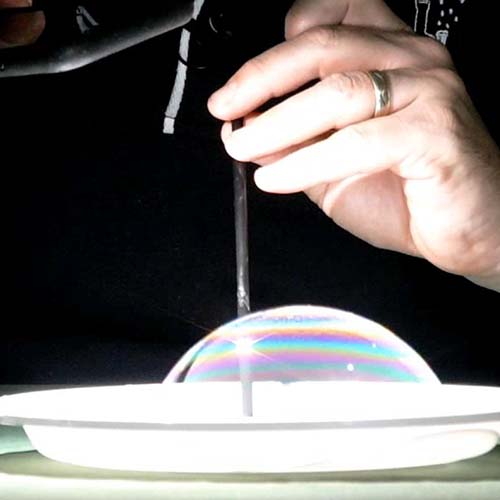
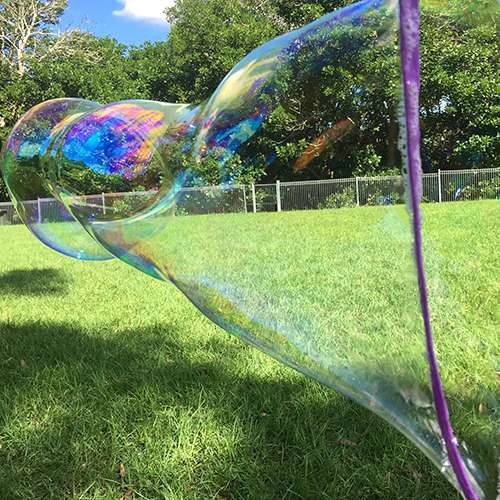
- Rainbow rings – Learn about light wave interference in bubbles
- Gigantic bubbles – Investigate the scientific method. So awesome!
- Bubble in a bubble – There’s a trick to this…
- Frozen bubbles – Frozen bubbles tell us about our climate
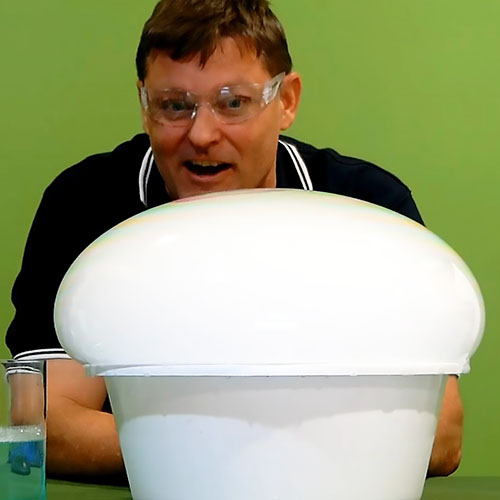
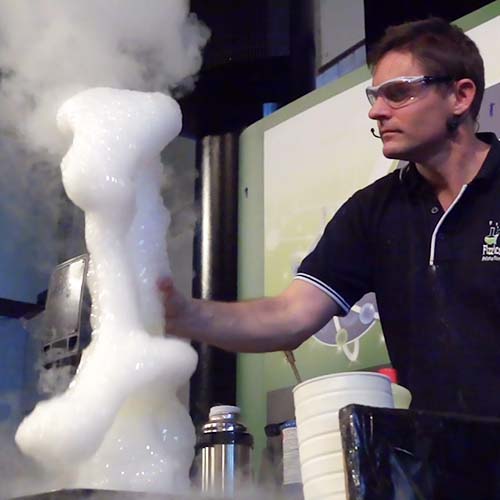
- Bubble volcano – An eruption of bubbles!
- Bouncing bubbles – How can the bubble mix be this strong?
- Molecular bubbles – Bubles form predicatable angles.. learn about chemistry!
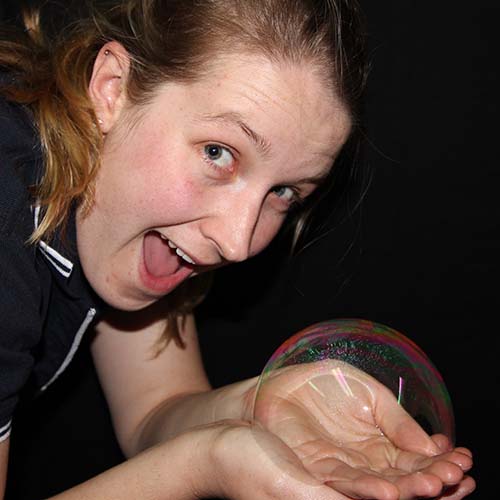
- Dancing bubble – Just for fun 🙂
- Colour mixing – Learn how colour addition works
- Newton colour wheel – Discover the science behind light
- Boo Bubbles – White orbs that delight students
Science show content
What Students Experience: The Physics of Surface Tension
This performance strips away the simplicity of the soap bubble to reveal the complex chemistry and physics beneath. Students engage with the scientific method as they predict, observe, and explain the behavior of liquids under different conditions.
1. Molecular Chemistry
We investigate what makes a bubble “strong.” Students explore the role of polymers and surfactants, discovering how varying ingredients influence the elasticity and longevity of the bubble mix.
2. Surface Tension & Light
Using large-scale demonstrations, we link surface tension to how water functions in nature. Students then witness light diffraction in action, learning how thin-film interference creates the shifting rainbows on a bubble’s surface.
3. Real-World Engineering
The show connects soapy fun to the real world. We discuss how architects and engineers use bubble geometry to design efficient structures and how biological systems utilize these same physical laws.
Highly Visual STEM Engagement
The Bubble Science show is a favorite for primary incursions because it makes abstract physics incredibly visual. It is an ideal anchor for units on States of Matter, Properties of Materials, or Light and Sight.
Our Commitment to Quality Science Education
A Trusted School Partner for 100’s of schools
Our 20-year history is built on delivering reliable, syllabus-aligned visits that engage students and meet the curriculum & practical requirements of the classroom.
Supporting Australian schools and teachers since 2004.
Guided by reviews from educators and principals.
Facilitated by experienced science educators focused on student learning.

Australian Curriculum Mapping
Australian National Curriculum Mapping for all our science incursions
Australian ACARA Content Outcomes:
Science F-10 Version 9.0
Foundation
- describe how objects move and how factors including their size, shape or material influence their movement AC9SFU02
- recognise that objects can be composed of different materials and describe the observable properties of those materials AC9SFU03
- explore the ways people make and use observations and questions to learn about the natural world AC9SFH01
- pose questions and make predictions based on experiences AC9SFI01
Year 2
- recognise that materials can be changed physically without changing their material composition and explore the effect of different actions on materials including bending, twisting, stretching and breaking into smaller pieces AC9S2U03
Year 1 & 2
- describe how people use science in their daily lives, including using patterns to make scientific predictions AC9S1H01, AC9S2H01
- pose questions to explore observed simple patterns and relationships and make predictions based on experiences AC9S1I01, AC9S2I01
- compare observations with predictions and others’ observations, consider if investigations are fair and identify further questions with guidance AC9S1I05, AC9S2I05
Year 3
- investigate the observable properties of solids and liquids and how adding or removing heat energy leads to a change of state AC9S3U04
Year 4
- examine the properties of natural and made materials including fibres, metals, glass and plastics and consider how these properties influence their use AC9S4U04
Year 3 & 4
- examine how people use data to develop scientific explanations AC9S3H01, AC9S4H01
- consider how people use scientific explanations to meet a need or solve a problem AC9S3H02, AC9S4H02
- pose questions to explore observed patterns and relationships and make predictions based on observations AC9S3I01, AC9S4I01
- compare findings with those of others, consider if investigations are fair, identify questions for further investigation and draw conclusions AC9S3I05, AC9S4I05
Australian National Curriculum Mapping for all our science workshops & shows

NSW K-10 Science Syllabus Mapping
NSW K – 10 Science Syllabus mapping
NSW Science & Technology Syllabus Content
A student:
- STe-4MW-ST identifies that objects are made of materials that have observable properties
- ST1-6MW-S identifies that materials can be changed or combined
- ST1-7MW-T describes how the properties of materials determine their use
- ST2-6MW-S describes how adding or removing heat causes a change of state
- ST2-8PW-ST describes the characteristics and effects of common forms of energy, such as light and heat
NSW Science and Technology K–6 Syllabus (Implementation from 2027)
For explanatory points & implementation advice, please visit the NESA Science site.
Early Stage 1
STE-PQU-01 poses questions based on observations to collect data
Stage 1
ST1-SCI-01 measures and describes changes in living things, materials, movement, Earth and the sky
- Recognise that properties of materials can be observed using the senses
- Observe and manipulate materials to describe their properties using Tier 2 vocabulary
- Pose questions about materials and describe how they are used in everyday objects
ST1-PQU-01 poses questions based on observations and information to investigate cause and effect
Stage 2
ST2-SCI-01 uses information to investigate the solar system and the effects of energy on living, physical and geological systems
- Recognise that matter is anything that has mass, takes up space and consists of very small particles
- Observe examples of matter that exist as a solid, which has a defined shape and volume; a liquid, which has a definite volume but not a definite shape; and a gas, which has neither a definite shape nor a definite volume
ST2-PQU-01 poses questions to create fair tests that investigate the effects of energy on living things and physical systems

VIC Science Syllabus Content
VIC Curriculum F–10 Version 2.0
For implementation advice, please visit the VIC Curriculum F-10 site.
Foundation to Level 2
- objects can be made of one or more different materials; these materials have observable properties. VC2S2U04
- materials can be combined in a variety of ways for particular purposes; the properties of objects and mixtures can differ from the properties of the materials from which they are made. VC2S2U05
- experiences can be used as a basis for posing questions to explore observed patterns and relationships, and to make predictions. VC2S2I01
- observations, findings and ideas can be shared with others by using everyday and some scientific vocabulary. VC2S2I06
Levels 3 and 4
- solids, liquids and gases have observable properties; adding or removing heat energy leads to a change of state between solids, liquids and gases. VC2S4U04
- the properties of natural and made materials, including fibres, metals, glass and plastics, influence their use and re-use. VC2S4U05
- scientific investigations to answer questions or test predictions can be planned and conducted using provided scaffolds, including identifying the attributes of fair tests, and considering the safe use of materials and equipment. VC2S4I02
VIC F – 6 Science Syllabus mapping
Print a PDF detailing VIC P-6 mapping
Show Requirements
🔬 Presentation Logistics
👨🎓 Capacity: Max 64 students per session.
🏫 Target: Designed for Years K to 4.
🪑 Chairs: Not required for this session.
⏰ Duration: 45 mins (+30 min set/pack).
💧 Critical Site Needs
🏗️ Sealed Surface: For safety and best results, a sealed surface (concrete, bitumen, or pavers) is required. Unsealed wood or carpet is not suitable.
🚰 Water Access: Access to a standard garden hose tap is essential for creating bubble solutions onsite.
* Materials may be varied to suit conditions. Chat with our presenter for specific focus requests.
Expand Your Science Day
Pair this show with one of our larger stage favorites for groups of up to 240:
Go Further!
Complete Units of Work to Support Your Teaching
Support your classroom with 270+ syllabus-linked lessons, high-quality videos, and marking rubrics.
Save time and engage students in STEM with high-quality videos, printable experiments, and full marking rubrics.






