


Science Show Activities
- Blood testing – Which fake blood clumps the same? Blood types matter…
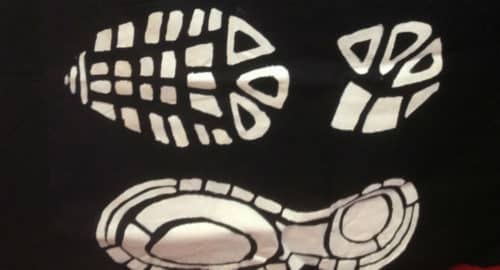
- Footprint comparison – Which suspect was outside the scene of the crime?
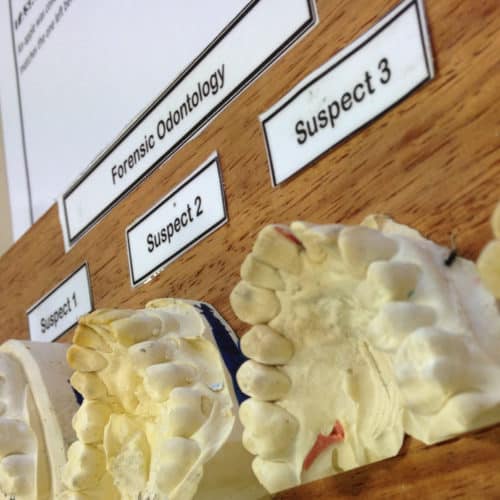
- Dental casts – Can you match the evidence to the right suspect?
- DNA – Who left a trace behind?
- Latent imagery – Oblique lighting can pick up traces of evidence…
- Soil pH testing – Soils ain’t soils!
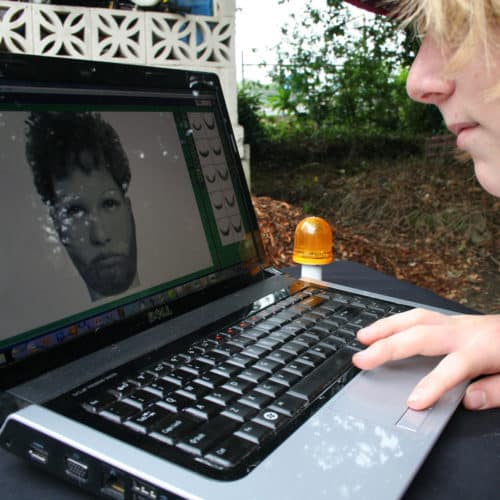
- Digital microscopy – Hair & fibre analysis
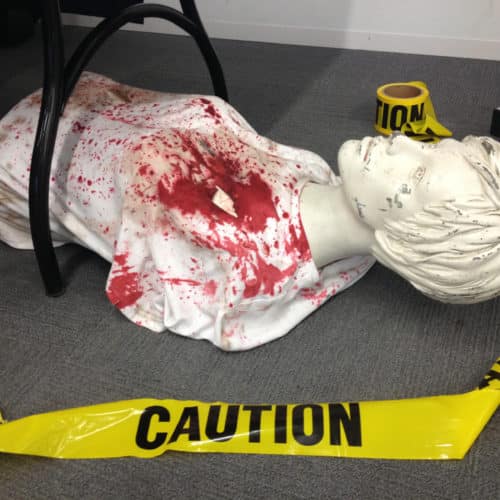
- Crime scene simulation – Discussion of how the chain of evidence makes it to court
- Fingerprinting – Fingerprints can be a calling card…
- Oil fluorescence – Different chemicals can glow differently under UV light…a clue perhaps!
Science workshop content
What Students Experience: Forensic Science Inquiry
Students step into the role of a forensic scientist, applying rigorous scientific methods to solve a mystery. This workshop is structured to move from understanding legal procedures to methodical, hands-on lab investigation.
1. Scene Briefing
The session begins with the chain of custody. Students are introduced to the roles of first responders, detectives, and scientists, following evidence from the crime scene to the prosecutor and eventually the courtroom.
2. Methodical Investigation
Acting as an unbiased team, students visit forensic stations in small groups. They methodically investigate specimens, analyze patterns, and prepare a suspect brief based strictly on the evidence found at each station.
3. Case Conclusion
We conclude by categorizing evidence as linked to the site, the room, or the victim. Students receive the “answers” and consider how the police and prosecutor will use their scientific findings to build a legal case.
Real CSI Moments: High School Workshops
Our Commitment to Quality Science Education
A Trusted School Partner for 20 Years
Fizzics Education delivers reliable, syllabus-aligned visits that engage students and meet the practical requirements of the classroom.
Using safe, relatable materials to teach rigorous scientific concepts.
Highly rated by teachers for classroom management and student engagement.
Experienced educators trained to facilitate student investigation.

Australian Curriculum Mapping
Australian National Curriculum Mapping for all our science incursions
Australian ACARA Content Outcomes:
Science F-10 Version 9.0
Year 7
- use a particle model to describe differences between pure substances and mixtures and apply understanding of properties of substances to separate mixtures AC9S7U06
Year 8
- compare physical and chemical changes and identify indicators of energy change in chemical reactions AC9S8U07
Year 7 & 8
- explain how new evidence or different perspectives can lead to changes in scientific knowledge AC9S7H01 AC9S8H01
- examine how proposed scientific responses to contemporary issues may impact on society and explore ethical, environmental, social and economic considerations AC9S7H03 AC9S8H03
- develop investigable questions, reasoned predictions and hypotheses to explore scientific models, identify patterns and test relationships AC9S7I01 AC9S8I01
- analyse data and information to describe patterns, trends and relationships and identify anomalies AC9S7I05 AC9S8I05
- construct evidence-based arguments to support conclusions or evaluate claims and consider any ethical issues and cultural protocols associated with using or citing secondary data or information AC9S7I07 AC9S8I07
Year 9 & 10
- explain how scientific knowledge is validated and refined, including the role of publication and peer review AC9S9H01 AC9S10H01
- Investigate how advances in technologies enable advances in science, and how science has contributed to developments in technologies and engineering AC9S9H02 AC9S10H02
- develop investigable questions, reasoned predictions and hypotheses to test relationships and develop explanatory models AC9S9I01 AC9S10I01
- analyse and connect a variety of data and information to identify and explain patterns, trends, relationships and anomalies AC9S9I05 AC9S10I05
- construct arguments based on analysis of a variety of evidence to support conclusions or evaluate claims, and consider any ethical issues and cultural protocols associated with accessing, using or citing secondary data or information AC9S9I07 AC9S10I07
Australian National Curriculum Mapping for all our science workshops & shows

NSW K-10 Science Syllabus Mapping
NSW Science 7–10 Syllabus (2023)
Stage 4
A student:
- identifies questions and makes predictions to guide scientific investigations SC4-WS-02
– Identify questions and problems that can be investigated scientifically
– Make predictions based on scientific knowledge and observations - explains how the properties of substances enable separation in a range of techniques SC4-SOL-01
– Identify the 3 main states of matter and how they are represented in the movement of water on earth
– Represent changes in the state of matter in terms of particle arrangement and movement
– Compare the properties of dilute, concentrated, saturated and supersaturated solutions
– Classify matter as pure substances, including elements and compounds, and impure substances, including mixtures based on their particle composition - explains how uses of elements and compounds are influenced by scientific understanding and discoveries relating to their properties SC4-PRT-01
– Identify some common elements in everyday objects
– Conduct a series of investigations to identify and compare the physical properties of metals, non-metals and metal - explains how energy causes geological and chemical change SC4-CHG-01
– Undertake experiments to identify the indicators of physical and chemical changes
– Describe the initial and final changes that are observed in a chemical reaction, including writing a word equation to represent a chemical reaction
– Investigate and observe energy changes in different chemical reactions
– Define open and closed systems to describe how energy is transferred into and out of systems, and how it cycles within a system
Stage 5
- asks questions or makes predictions using observations SCLS-WS-02
– Ask questions about familiar objects and events based on observations
– Make predictions based on observations
NSW K – 10 Science Syllabus mapping for all our NSW incursions

VIC Science Syllabus Content
VIC Curriculum F–10 Version 2.0
For explanatory points & implementation advice for each dot point, please visit the VIC Curriculum F-10 site.
Levels 7 and 8
- the particle and kinetic theories of matter can be used to describe the arrangement and motion of particles in a substance, including the attraction between particles, and to explain the properties and behaviour of substances, including melting point, boiling point, density, compressibility, gas pressure, viscosity, diffusion, sublimation, and expansion and contraction. VC2S8U05
- matter can be classified as pure substances such as elements and compounds or impure substances such as mixtures (including solutions), and can be modelled using the particle model; mixtures may have a uniform (homogeneous) or non-uniform (heterogeneous) composition and can be separated based on the properties of their components using techniques including filtration, decantation, evaporation, crystallisation, magnetic separation, distillation and chromatography. VC2S8U06
- physical changes can be distinguished from chemical changes; a chemical change can be identified by a colour change, a temperature change, the production of a gas (including laboratory preparation and testing of oxygen, carbon dioxide and hydrogen gases) or the formation of a precipitate. VC2S8U08
- investigable questions, reasoned predictions and hypotheses can be developed in guiding investigations to identify patterns, test relationships and analyse and evaluate scientific models. VC2S8I01
- scientific methods, conclusions and claims can be analysed to identify assumptions, possible sources of error, conflicting evidence and unanswered questions. VC2S8I06
- evidence-based arguments can be constructed to support conclusions or evaluate claims, including consideration of ethical issues and protocols associated with using or citing secondary data or information. VC2S8I07
- chemical reactions are described by the Law of Conservation of Mass and involve the rearrangement of atoms; they can be modelled using a range of representations, including word and simple balanced chemical equations. VC2S10U08
Levels 9 and 10
- chemical reactions include synthesis, decomposition and displacement reactions and can be classified as exothermic or endothermic; reaction rates are affected by factors including temperature, concentration, surface area of solid reactants, and catalysts. VC2S10U09
- investigable questions, reasoned predictions and hypotheses can be used in guiding investigations to test and develop explanatory models and relationships. VC2S10I01
- the validity and reproducibility of investigation methods and the validity of conclusions and claims can be evaluated, including by identifying assumptions, conflicting evidence, biases that may influence observations and conclusions, sources of error and areas of uncertainty. VC2S10I06
- arguments based on a variety of evidence can be constructed to support conclusions or evaluate claims, including consideration of any ethical issues and cultural protocols associated with accessing, using or citing secondary data or information. VC2S10I07
Session Requirements
👥 Capacity & Timing
👨🎓 Attendance: Maximum of 30 students.
🏫 Target: Appropriate for Years 7 to 10.
⏰ Duration: 60 – 90 minutes.
🛠️ Set/Pack: 45 mins setup and 30 mins pack up.
📍 Space & Power Needs
🏗️ Room Layout: 7 tables around the edge of the room.
🔌 Power: Access to at least 2 electrical power sockets.
↔️ Space: Wide floor space is required.
🪑 Seating: Chairs are not required.
Extend the Experience
Pair this workshop with one of our school favourites for up to 240 students:






