


Science Show Activities
- Blood testing – Which fake blood clumps the same? Blood types matter…
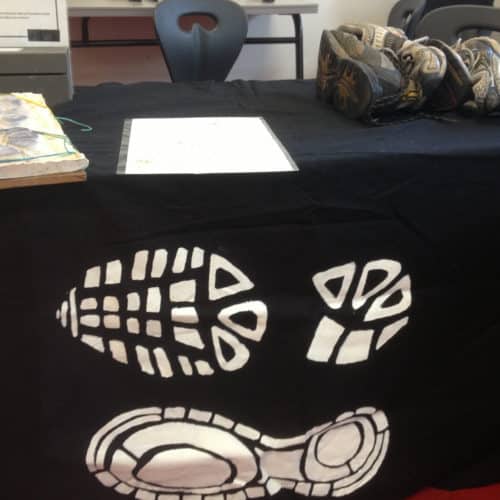
- Footprint comparison – Which suspect was outside the scene of the crime?
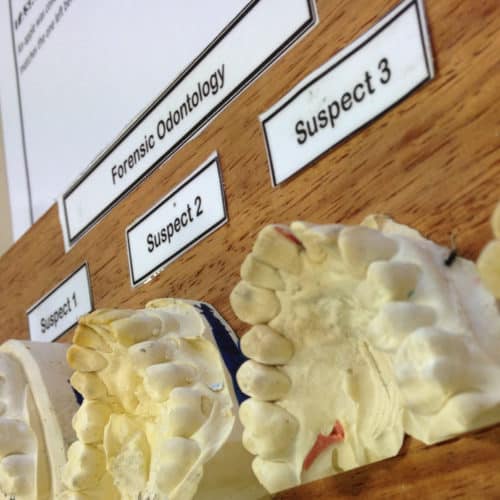
- Dental casts – Can you match the evidence to the right suspect?
- DNA – Who left a trace behind?
- Latent imagery – Oblique lighting can pick up traces of evidence…
- Soil pH testing – Soils ain’t soils!
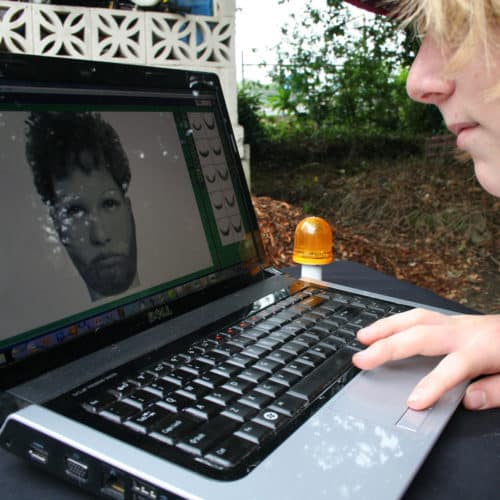
- Digital microscopy – Hair & fibre analysis
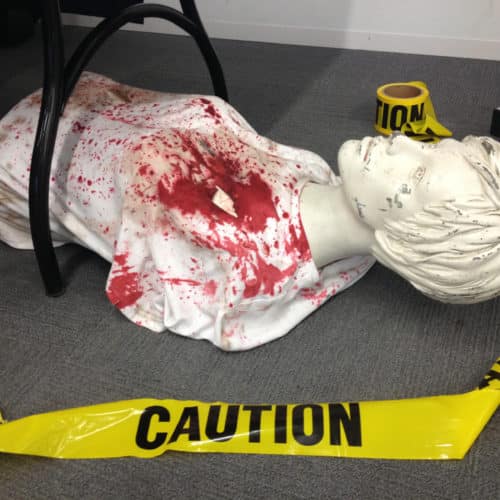
- Crime scene simulation – Discussion of how the chain of evidence makes it to court
- Fingerprinting – Fingerprints can be a calling card…
- Oil fluorescence – Different chemicals can glow differently under UV light…a clue perhaps!
Science workshop content
What Students Experience: Forensic Science Inquiry
Students step into the role of a forensic scientist, applying rigorous scientific methods to solve a mystery. This workshop is structured to move from understanding legal procedures to methodical, hands-on lab investigation.
1. Scene Briefing
The session begins with the chain of custody. Students are introduced to the roles of first responders, detectives, and scientists, following evidence from the crime scene to the prosecutor and eventually the courtroom.
2. Methodical Investigation
Acting as an unbiased team, students visit forensic stations in small groups. They methodically investigate specimens, analyze patterns, and prepare a suspect brief based strictly on the evidence found at each station.
3. Case Conclusion
We conclude by categorizing evidence as linked to the site, the room, or the victim. Students receive the “answers” and consider how the police and prosecutor will use their scientific findings to build a legal case.
Our Commitment to Quality Science Education
A Trusted School Partner for 20 Years
Fizzics Education delivers reliable, syllabus-aligned visits that engage students and meet the practical requirements of the classroom.
Using safe, relatable materials to teach rigorous scientific concepts.
Highly rated by teachers for classroom management and student engagement.
Experienced educators trained to facilitate student investigation.

Australian Curriculum Mapping
Australian National Curriculum Mapping for all our science incursions
Australian ACARA Content Outcomes:
Science F-10 Version 9.0
Year 3
- identify sources of heat energy and examine how temperature changes when heat energy is transferred from one object to another AC9S3U03
- investigate the observable properties of solids and liquids and how adding or removing heat energy leads to a change of state AC9S3U04
Year 4
- examine the properties of natural and made materials including fibres, metals, glass and plastics and consider how these properties influence their use AC9S4U04
Year 3 & 4
- examine how people use data to develop scientific explanations AC9S3H01, AC9S4H01
- consider how people use scientific explanations to meet a need or solve a problem AC9S3H02, AC9S4H02
- pose questions to explore observed patterns and relationships and make predictions based on observations AC9S3I01, AC9S4I01
- compare findings with those of others, consider if investigations were fair, identify questions for further investigation and draw conclusions AC9S3I05, AC9S4I05
Year 5
- explain observable properties of solids, liquids and gases by modelling the motion and arrangement of particles AC9S5U04
Year 6
- compare reversible changes, including dissolving and changes of state, and irreversible changes, including cooking and rusting that produce new substances AC9S6U04
Year 5 & 6
- investigate how scientific knowledge is used by individuals and communities to identify problems, consider responses and make decisions AC9S5H02, AC9S6H02
- pose investigable questions to identify patterns and test relationships and make reasoned predictions AC9S5I01, AC9S6I01
- compare methods and findings with those of others, recognise possible sources of error, pose questions for further investigation and select evidence to draw reasoned conclusions AC9S5I05, AC9S6I05
Australian National Curriculum Mapping for all our science workshops & shows

NSW K-10 Science Syllabus Mapping
NSW K – 10 Science Syllabus mapping
NSW Science Syllabus Content
A student:
- ST2-7MW-T investigates the suitability of natural and processed materials for a range of purposes
- ST3-6MW-S explains the effect of heat on the properties and behaviour of materials
- ST3-7MW-T explains how the properties of materials determines their use for a range of purposes
NSW Science and Technology K–6 Syllabus (Implementation from 2027)
For explanatory points & implementation advice, please visit the NESA Science and Technology K–6 Curriculum site.
Stage 2
- ST2-PQU-01 poses questions to create fair tests that investigate the effects of energy on living things and physical systems
- ST2-DAT-01 uses and interprets data to describe patterns and relationships
Stage 3
ST3-SCI-01 uses evidence to explain how scientific knowledge can be used to develop sustainable practices
- Recognise that in a fair test, an independent variable is changed, a dependent variable is measured, and controlled variables remain the same
- Pose questions to determine whether substances dissolve in water by identifying variables and conducting and evaluating fair tests
ST3-PQU-01 poses questions to identify variables and conducts fair tests to gather data
ST3-DAT-01 interprets data to support explanations and arguments

VIC Science Syllabus Content
VIC Curriculum F–10 Version 2.0
For explanatory points & implementation advice, please visit the VIC Curriculum F-10 site.
Levels 3 & 4
- solids, liquids and gases have observable properties; adding or removing heat energy leads to a change of state between solids, liquids and gases. VC2S4U04
- the properties of natural and made materials, including fibres, metals, glass and plastics, influence their use and re-use. VC2S4U05
- scientific investigations to answer questions or test predictions can be planned and conducted using provided scaffolds, including identifying the attributes of fair tests, and considering the safe use of materials and equipment. VC2S4I02
- scientific knowledge, skills and data can be used by people to explain how they will meet a need or solve a problem. VC2S4H02
Levels 5 & 6
- changes to substances may be reversible, in which case the substance may be recovered, or irreversible, in which case new substances are formed; for most substances a change of state or dissolving in water is reversible, while irreversible changes include cooking and rusting. VC2S6U04
- repeatable scientific investigations to answer questions can be planned and conducted, including, as appropriate, deciding the variables to be changed, measured and controlled in fair tests, considering potential risks, planning for the safe and ethical use of equipment and materials, and obtaining permissions for investigations conducted on Country and Place or in protected areas. VC2S6I02
- scientific knowledge, skills and data can be used by individuals and communities to identify problems, consider responses and make decisions. VC2S6H02
Session Requirements
👥 Capacity & Timing
👨🎓 Attendance: Max 32 students per class.
🏫 Target: Appropriate for Years 3 to 6.
⏰ Duration: 60 or 90-minute versions.
🛠️ Set/Pack: 45 mins setup + 30 mins pack down.
📍 Space & Power
🏗️ Room Layout: 7 tables arranged around the edge of the room.
📐 Floor Space: A wide floor space is essential for investigations.
🔌 Power: Access to at least 2 electrical power sockets.
🪑 Seating: Chairs are not required for students.
Go Further!
Complete Units of Work to Support Your Teaching
Support your classroom with 270+ syllabus-linked lessons, high-quality videos, and marking rubrics.
Save time and engage students in STEM year-round with high-quality videos, printable experiments, and full marking rubrics.
Extend the Experience
Pair this workshop with a larger stage show for groups of up to 240 students:






