



Science Show Activities
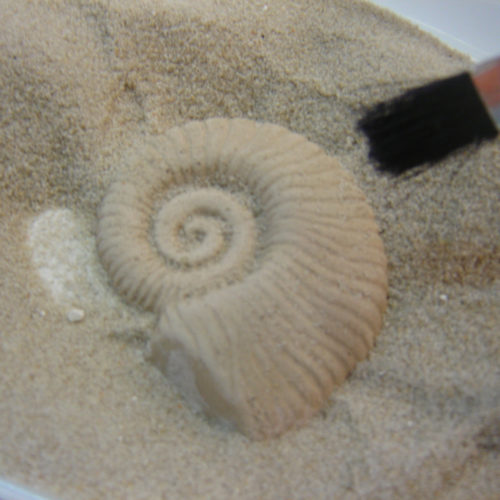
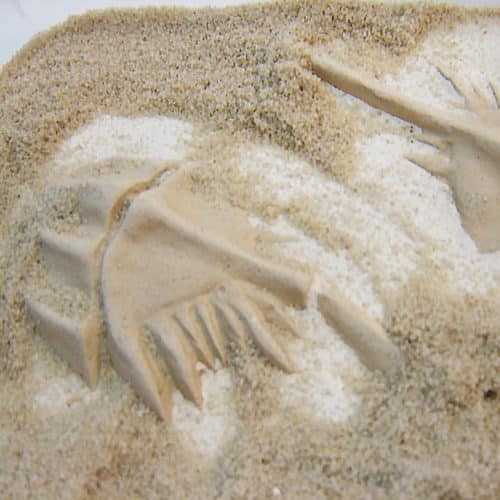
- Dinosaur dig out – Organise your team to excavate your specimens
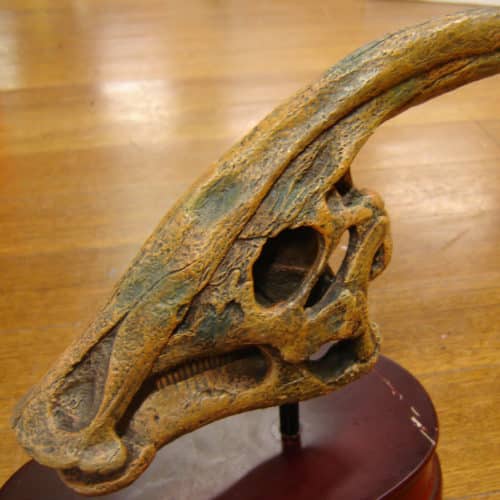
- Dan the Duck Bill – Replica of a parasaurolophus skull. It’s head crest made many loud sounds
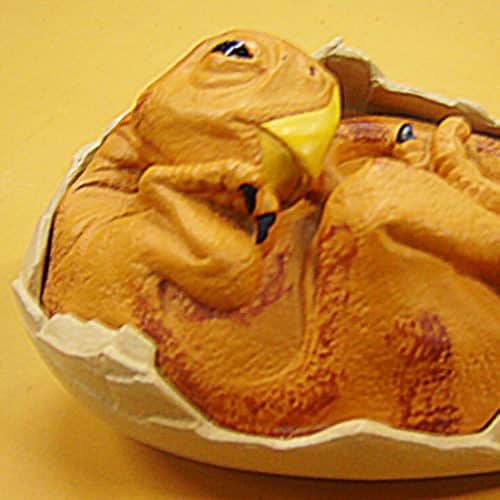
- Dino Eggs – What did they look like? What did the embryo’s look like inside?
- Sands of Time – Look at how sedimentation helps to form fossils
- Scaly skin – Compare modern animal skins to the replica dinosaur skin
- Casting creatures – Makes casts of ancient organism impressions
- Birds are Dinos? – Check out the archaeopteryx, a possible precursor to modern birds
- For the record – Geological record shows a mass extinction 65 million ago. Why did it occur?
- T-rex Puzzle – Mix and match the right bones to form a replica T-Rex skeleton.
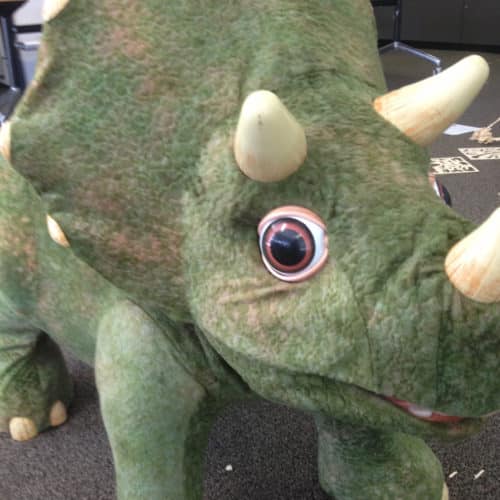
- Terry Triceratops – Meet the cuddly Triceratops puppet and learn about Cretaceous herbivores
- Talking Teeth – Work out which teeth belong to which extinct or modern animal
Science workshop content
What Students Experience: The Palaeontology Lab
Students step into the shoes of a working palaeontologist, moving from the theory of extinction to the practical reality of excavation and skeletal reconstruction. This workshop balances hands-on discovery with the latest scientific thinking.
1. The Excavation
After discussing fossil formation, students join a simulated dig. They sweep out and identify replicas, discovering the “rarity of giants”—simulating the realistic abundance of marine fossils compared to rare land-dwelling dinosaurs.
2. Skeletal Assembly
Replicating a real dig site, the class works together to assemble a replica T-Rex model from a pile of bones. This leads into hands-on exploration of fossilised eggs, teeth, skulls, and even replica dinosaur skin.
3. Behavioural Analysis
The session concludes with our animatronic Triceratops. We examine its features to discuss how palaeontologists determine diet and defence, and why its famous frill was likely a display feature rather than armour.
Our budding palaeontologists had a “roar-some” time today! It was fantastic to see the students so engaged in the excavation process and learning how to identify different fossils. A truly memorable science incursion!
View on FacebookOur Commitment to Quality Science Education
A Trusted School Partner for 20 Years
Fizzics Education delivers reliable, syllabus-aligned visits that engage students and meet the practical requirements of the Australian classroom.
Using high-quality replica materials to teach rigorous scientific concepts and field methods.
Highly rated by teachers for classroom management and student engagement during discovery.
Experienced educators trained to facilitate deep-dive inquiry and student investigation.

Australian Curriculum Mapping
Australian National Curriculum Mapping for all our science incursions
Australian ACARA Content Outcomes:
Science F-10 Version 9.0
Foundation
- explore the ways people make and use observations and questions to learn about the natural world AC9SFH01
- pose questions and make predictions based on experiences AC9SFI01
Year 1
- identify the basic needs of plants and animals, including air, water, food or shelter, and describe how the places they live meet those needs AC9S1U01
Year 2
- explore different actions to make sounds and how to make a variety of sounds, and recognise that sound energy causes objects to vibrate AC9S2U02
Year 1 & 2
- describe how people use science in their daily lives, including using patterns to make scientific predictions AC9S1H01, AC9S2H01
- pose questions to explore observed simple patterns and relationships and make predictions based on experiences AC9S1I01, AC9S2I01
- compare observations with predictions and others’ observations, consider if investigations are fair and identify further questions with guidance AC9S1I05, AC9S2I05
Year 3
- compare characteristics of living and non-living things and examine the differences between the life cycles of plants and animals AC9S3U01
Year 4
- explain the roles and interactions of consumers, producers and decomposers within a habitat and how food chains represent feeding relationships AC9S4U01
Year 3 & 4
- examine how people use data to develop scientific explanations AC9S3H01, AC9S4H01
- consider how people use scientific explanations to meet a need or solve a problem AC9S3H02, AC9S4H02
- pose questions to explore observed patterns and relationships and make predictions based on observations AC9S3I01, AC9S4I01
- compare findings with those of others, consider if investigations were fair, identify questions for further investigation and draw conclusions AC9S3I05, AC9S4I05
Year 5
- examine how particular structural features and behaviours of living things enable their survival in specific habitats AC9S5U01
Year 6
- investigate the physical conditions of a habitat and analyse how the growth and survival of living things is affected by changing physical conditions AC9S6U01
Year 5 & 6
- investigate how scientific knowledge is used by individuals and communities to identify problems, consider responses and make decisions AC9S5H02, AC9S6H02
- pose investigable questions to identify patterns and test relationships and make reasoned predictions AC9S5I01, AC9S6I01
- compare methods and findings with those of others, recognise possible sources of error, pose questions for further investigation and select evidence to draw reasoned conclusions AC9S5I05, AC9S6I05
Australian National Curriculum Mapping for all our science workshops & shows

NSW K-10 Science Syllabus Mapping
NSW K – 10 Science Syllabus mapping
NSW Science Syllabus Content
A student:
- ST2-4LW-S compares features and characteristics of living and non-living things
- ST3-4LW-S examines how the environment affects the growth, survival and adaptation of living things
- ST3-10ES-S explains regular events in the solar system and geological events on the Earth’s surface
NSW Science and Technology K–6 Syllabus (Implementation from 2027)
For explanatory points & implementation advice, please visit the NESA Science and Technology K–6 Curriculum site.
Early Stage 1
STE-SCI-01 identifies and describes characteristics of living things, properties of materials, and movement
- Examine animal bodies, their body coverings, and how and what they eat
- Observe and group animals based on their characteristics and justify the grouping
- Pose questions to compare the characteristics of living things and non-living things
Stage 1
ST1-SCI-01 measures and describes changes in living things, materials, movement, Earth and the sky
- Examine the evidence for extinct animals
Stage 2
ST2-SCI-01 uses information to investigate the solar system and the effects of energy on living, physical and geological systems
- Recognise that all animals are either invertebrates with no spine, or vertebrates with a spine
- Model how bones, muscles and joints work together to cause movement
Stage 3
ST3-SCI-01 uses evidence to explain how scientific knowledge can be used to develop sustainable practices
- Observe behavioural and structural adaptations of plants and animals, and suggest how these may help them survive in their environments
- Examine evidence that environments have changed over time and continue to change

VIC Science Syllabus Content
VIC Curriculum F–10 Version 2.0
For explanatory points & implementation advice, please visit the VIC Curriculum F-10 site.
Foundation to Level 2
- plants and animals have observable features that can be used to group them in different ways. VC2S2U01
- experiences can be used as a basis for posing questions to explore observed patterns and relationships, and to make predictions. VC2S2I01
- observations, findings and ideas can be shared with others by using everyday and some scientific vocabulary. VC2S2I06
Level 3 & 4
- living things have characteristics that distinguish them from non-living things and things that were once living, including fossils. VC2S4U01
- scientific investigations to answer questions or test predictions can be planned and conducted using provided scaffolds, including identifying the attributes of fair tests, and considering the safe use of materials and equipment. VC2S4I02
Level 5 & 6
- organisms have evolved over time, as seen in fossils and scientific records; the structural features and behaviours of living organisms enable them to thrive in their environments. VC2S6U02
- repeatable scientific investigations to answer questions can be planned and conducted, including, as appropriate, deciding the variables to be changed, measured and controlled in fair tests, considering potential risks, planning for the safe and ethical use of equipment and materials, and obtaining permissions for investigations conducted on Country and Place or in protected areas. VC2S6I02
Session Requirements
👥 Capacity & Timing
👨🎓 Attendance: Max 32 students per class.
🏫 Target: Appropriate for Years K to 6.
⏰ Duration: 60 or 90-minute versions.
🛠️ Set/Pack: 45 mins setup + 45 mins pack down.
📍 Space & Power
🏗️ Room Layout: 7 tables arranged around the edge of the room.
🔌 Power: Access to 2 standard electrical power sockets.
🪑 Seating: Chairs are not required for students during the session.
Go Further!
Complete Units of Work to Support Your Teaching
Support your classroom with 270+ syllabus-linked lessons, high-quality videos, and marking rubrics.
Save time and engage students in STEM year-round with high-quality videos, printable experiments, and full marking rubrics.
Extend the Experience
Pair this workshop with a larger stage show for groups of up to 240 students:






