




Science Show Demonstrations
- Seasons are changing – What has the Earth’s axis got to do with climate?
- Days length – Why is winter daylight so short?
- Day vs Night – Modelling this important cycle for all life
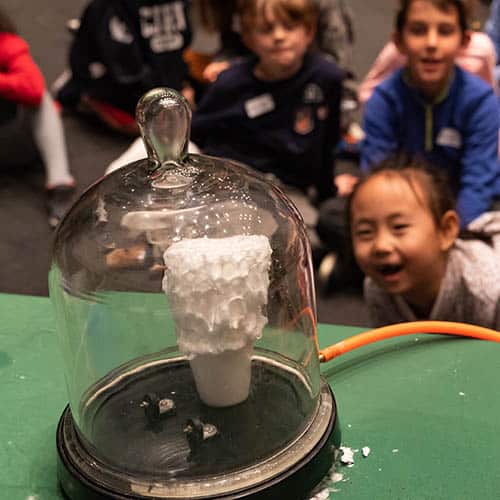
- Growing clouds – We create a real cloud in front of the class
- Foam expand – A highly visual model of a thunderstorm growing
- Windy days – Measure wind speed with an anemometer
- Tornado twister – Why do some storms start to spin?
- Upside down water cup – It’s all about pressure… and show why air can move
- Blown away – We learn how wind works!
- Wind vanes – Learn to measure wind direction
- Bernoulli bag fill – Slow air moves into fast air… why?
Science workshop content
What Students Experience: The Earth & Sky Lab
Designed for younger students, this workshop turns abstract concepts like “air pressure” and “planetary tilt” into tangible, hands-on discoveries. Students explore the connection between our planet’s movement and the weather we feel every day.
1. Cycles & Seasons
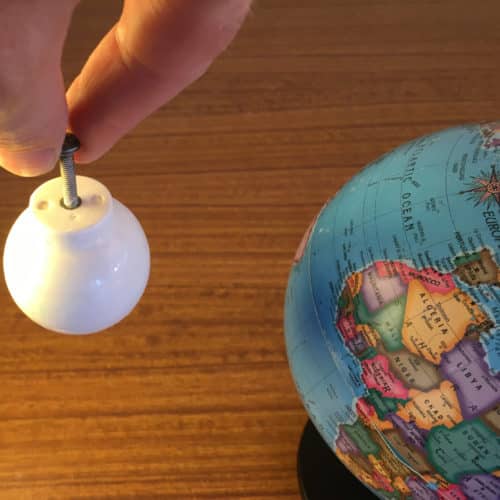
We begin by investigating Earth’s tilt. Students use globes and lights to witness how uneven heating creates our seasons and how the rotation of our planet gives us the day and night cycle.
2. The Weather Station
At our hands-on stations, students become meteorologists. They measure wind speed, create mini-tornadoes in a bottle, and perform “impossible” air pressure experiments like the upside-down water cup.
3. Atmospheric Physics
The finale features high-impact demonstrations. We form real clouds inside a vacuum chamber and use “tea bag rockets” to show how hot air rises, bridging the gap between Earth and Space.
Which space workshop or show should I choose?
Destination Moon
Large stage show covering Earth, Sun & Moon plus the Artemis missions.
Earth, Sun & Moon
Hands-on workshop covering Earth, Sun & Moon plus the Artemis missions.
Stars and Planets
Hands-on workshop covering the solar system and space exploration.
Earth & Space K to 2
Specifically designed for K-2 to cover seasons & observable weather changes.
Our K-2 students had a wonderful time exploring Earth and Space! It was great to see them so hands-on with the weather stations and learning about the seasons in such an engaging way.
Thank you for a fantastic Earth & Space workshop. The students were fascinated by the cloud formation and air pressure experiments. A high-quality STEM experience!
Our Commitment to Early Science Education
A Trusted School Partner for over 20 years.
We deliver reliable, syllabus-aligned visits that make complex Earth sciences accessible for K-2 students.
Using tactile tools designed for smaller hands and big curiosities.
Over 4 million Australian students reached with curriculum-focused STEM.
Our educators are specifically trained for early childhood engagement.

Australian Curriculum Mapping
Australian National Curriculum Mapping for all our science incursions
Australian ACARA Content Outcomes:
Science F-10 Version 9.0
Foundation
- describe how objects move and how factors including their size, shape or material influence their movement AC9SFU02
- recognise that objects can be composed of different materials and describe the observable properties of those materials AC9SFU03
- explore the ways people make and use observations and questions to learn about the natural world AC9SFH01
- pose questions and make predictions based on experiences AC9SFI01
Year 1
- describe daily and seasonal changes in the environment and explore how these changes affect everyday life AC9S1U02
- describe pushes and pulls in terms of strength and direction and predict the effect of these forces on objects’ motion and shape AC9S1U03
Year 2
- recognise Earth is a planet in the solar system and identify patterns in the changing position of the sun, moon, planets and stars in the sky AC9S2U01
- recognise that materials can be changed physically without changing their material composition and explore the effect of different actions on materials including bending, twisting, stretching and breaking into smaller pieces AC9S2U03
Year 1 & 2
- describe how people use science in their daily lives, including using patterns to make scientific predictions AC9S1H01, AC9S2H01
- pose questions to explore observed simple patterns and relationships and make predictions based on experiences AC9S1I01, AC9S2I01
- compare observations with predictions and others’ observations, consider if investigations are fair and identify further questions with guidance AC9S1I05, AC9S2I05
Australian National Curriculum Mapping for all our science workshops & shows

NSW K-10 Science Syllabus Mapping
NSW K – 10 Science Syllabus mapping
NSW Science & Technology Syllabus Content
A student:
- STe-6ES-S identifies how daily and seasonal changes in the environment affect humans and other living things
- STE-1WS-S observes, questions and collects data to communicate ideas
- ST1-10ES-S recognises observable changes occurring in the sky and on the land and identifies Earth’s resources
- ST1-1WS-S observes, questions and collects data to communicate and compare ideas
NSW Science and Technology K–6 Syllabus (Implementation from 2027)
For explanatory points & implementation advice, please visit the NESA Science and Technology K–6 Curriculum site.
Stage 1
ST1-SCI-01 measures and describes changes in living things, materials, movement, Earth and the sky
- Describe the visible features of the sky at night and in the day
- Recognise that the Sun provides Earth with light energy and the Moon reflects light energy from the Sun
- Recognise that the Sun rises in the east and sets in the west
- Model how the rotation of the Earth around its axis causes a repeating pattern of day and night
- Observe the Moon over a lunar cycle and describe its change in appearance using Tier 2 and Tier 3 vocabulary
ST1-PQU-01 poses questions based on observations and information to investigate cause and effect

VIC Science Syllabus Content
VIC Curriculum F–10 Version 2.0
For explanatory points & implementation advice, please visit the VIC Curriculum F-10 site.
Foundation to Level 2
- daily and seasonal changes in the weather and the environment can be observed and affect decisions made in everyday life. VC2S2U07
- Earth is one of 8 planets in our solar system; observing the sky reveals patterns in the changing positions of the Sun, Moon, planets and stars. VC2S2U08
- the way objects move depends on a variety of factors including their size, shape and material. VC2S2U10
- pushes and pulls are forces that can change an object’s movement or shape and can be represented in terms of strength and direction. VC2S2U11
- experiences can be used as a basis for posing questions to explore observed patterns and relationships, and to make predictions. VC2S2I01
- observations, findings and ideas can be shared with others by using everyday and some scientific vocabulary. VC2S2I0
Session Requirements
👥 Capacity & Timing
👨🎓 Attendance: Max 32 students per class.
🏫 Target: Appropriate for Years K to 2.
⏰ Duration: 60 or 90-minute versions.
🛠️ Set/Pack: 45 mins setup + 45 mins pack down.
📍 Space & Power
🏗️ Tables: 12 to 7 tables required for hands-on stations.
🔌 Power: Access to 2 standard electrical power sockets.
🪑 Seating: Chairs are not required for students.
Go Further!
Complete Units of Work to Support Your Teaching
Support your classroom with 270+ syllabus-linked lessons, high-quality videos, and marking rubrics.
Save time and engage students in STEM year-round with high-quality videos, printable experiments, and full marking rubrics.
Extend the Experience
Pair this workshop with a larger stage show for groups of up to 240 students:






