

Science Show Demonstrations
- Fire safety matters – Fire is hot. We go through the safety at home, school & beyond.
- Coloured flames – Learn how the colours of fireworks really work
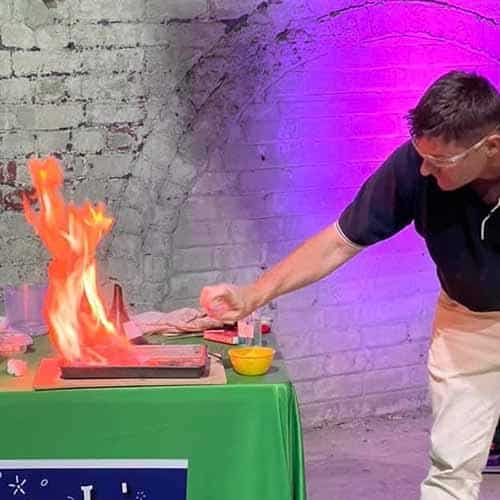
- Magic burning trick – How does the substance not burn, yet everything else does?
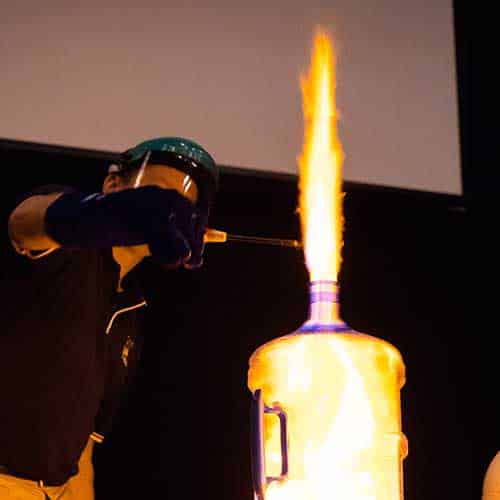
- Whoosh bottle – Learn how combustion chambers really work
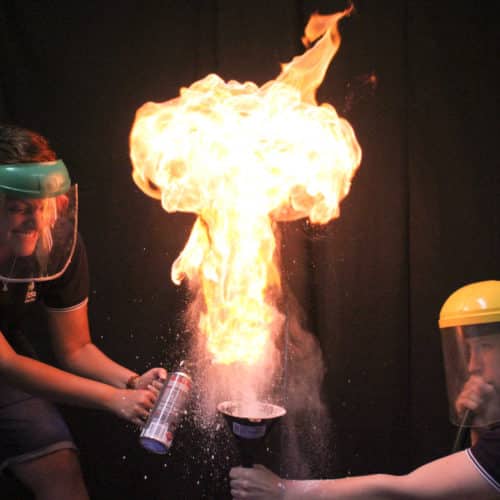
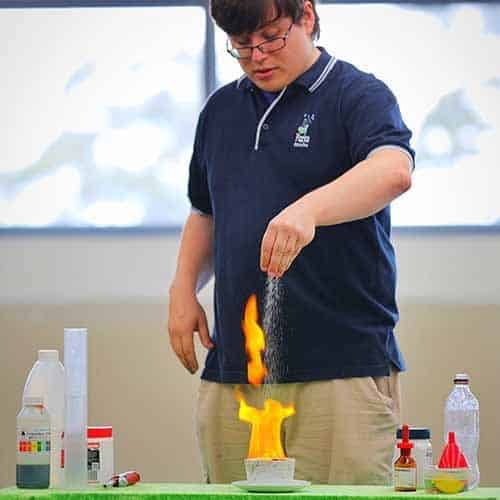
- Flour fireball – A spectacular way to learn about the fire triangle
- Tea bag rocket – Hot air rises… and so does this rocket
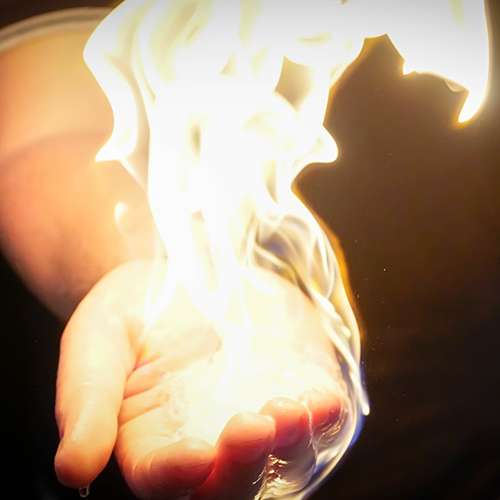
- Hands on fire – Yes, you read that correctly… safely learn about how insulation works!
- Water balloon & candle – Why doesn’t it pop?
- Sparkler science – Why do sparklers work and what are the chemical changes?
- Hydrogen pop – Highly explosive hydrogen under controlled conditions
Science show content
What Students Experience: The Science of Fire
This show is a spectacular exploration of thermodynamics and chemical reactions. We move beyond the “wow” factor to investigate the precise physics of combustion and the critical safety knowledge needed to understand energy transfer in the real world.
1. The Combustion Core
We start with the Fire Triangle. Students see demonstrations of combustion, surface area, and chemical reactions, learning how fuel, heat, and oxygen interact to release energy in spectacular ways.
2. Heat in Motion
How does heat move? We investigate convection, conduction, and insulation. From heat absorption to the engineering of rocket engines, students witness how energy is harnessed and transferred through different materials.
3. Safety & Environment
We relate our science to the Australian landscape. We discuss what exacerbates bushfires and introduce the Australian Fire Danger Rating System (AFDRS), grounding every demonstration in vital fire safety knowledge.
Our Commitment to Quality Science Education
A Trusted School Partner for 20 Years
Fizzics Education delivers reliable, syllabus-aligned visits that engage students and meet the practical requirements of the classroom.
Combustion and thermal energy demonstrations run as per museum protocols.
Highly rated by teachers for classroom management and curriculum alignment.
Experienced educators trained specifically to handle fire-based demonstrations safely.

Australian Curriculum Mapping
Australian National Curriculum Mapping for all our science incursions
Australian ACARA Content Outcomes:
Science F-10 Version 9.0
Year 3
- identify sources of heat energy and examine how temperature changes when heat energy is transferred from one object to another AC9S3U03
- investigate the observable properties of solids and liquids and how adding or removing heat energy leads to a change of state AC9S3U04
Year 4
- identify how forces can be exerted by one object on another and investigate the effect of frictional, gravitational and magnetic forces on the motion of objects AC9S4U03
- examine the properties of natural and made materials including fibres, metals, glass and plastics and consider how these properties influence their use AC9S4U04
Year 3 & 4
- examine how people use data to develop scientific explanations AC9S3H01, AC9S4H01
- consider how people use scientific explanations to meet a need or solve a problem AC9S3H02, AC9S4H02
- pose questions to explore observed patterns and relationships and make predictions based on observations AC9S3I01, AC9S4I01
- compare findings with those of others, consider if investigations were fair, identify questions for further investigation and draw conclusions AC9S3I05, AC9S4I05
Year 5
- explain observable properties of solids, liquids and gases by modelling the motion and arrangement of particles AC9S5U04
Year 6
- compare reversible changes, including dissolving and changes of state, and irreversible changes, including cooking and rusting that produce new substances AC9S6U04
Year 5 & 6
- investigate how scientific knowledge is used by individuals and communities to identify problems, consider responses and make decisions AC9S5H02, AC9S6H02
- pose investigable questions to identify patterns and test relationships and make reasoned predictions AC9S5I01, AC9S6I01
- compare methods and findings with those of others, recognise possible sources of error, pose questions for further investigation and select evidence to draw reasoned conclusions AC9S5I05, AC9S6I05
Australian National Curriculum Mapping for all our science workshops & shows

NSW K-10 Science Syllabus Mapping
NSW K – 10 Science Syllabus mapping
NSW Science Syllabus Content
A student:
- ST2-6MW-S describes how adding or removing heat causes a change of state
- ST2-8PW-ST describes the characteristics and effects of common forms of energy, such as light and heat
- ST2-9PW-ST describes how contact and non-contact forces affect an object’s motion
- ST3-6MW-S explains the effect of heat on the properties and behaviour of materials
- ST3-7MW-T explains how the properties of materials determines their use for a range of purposes
- ST3-8PW-ST explains how energy is transformed from one form to another
NSW Science and Technology K–6 Syllabus (Implementation from 2027)
For explanatory points & implementation advice, please visit the NESA Science and Technology K–6 Curriculum site.
Stage 2
ST2-SCI-01 uses information to investigate the solar system and the effects of energy on living, physical and geological systems
- Recognise that matter is anything that has mass, takes up space and consists of very small particles
- Observe examples of matter that exist as a solid, liquid, and gas and their properties
- Describe how adding and removing heat energy affects the movement and arrangement of particles when matter is changing state
- Recognise that heat energy can be transferred from warmer to cooler objects by conduction, convection and radiation
- Recognise that temperature is a measure of hotness or coldness, expressed in degrees Celsius
- Pose questions and conduct fair tests to compare how different materials absorb or reflect heat energy
- Describe how the properties of materials and transfer of heat energy impact everyday life
ST2-PQU-01 poses questions to create fair tests that investigate the effects of energy on living things and physical systems
Stage 3
ST3-SCI-01 uses evidence to explain how scientific knowledge can be used to develop sustainable practices
- Recognise that in a fair test, an independent variable is changed, a dependent variable is measured, and controlled variables remain the same
ST3-PQU-01 poses questions to identify variables and conducts fair tests to gather data

VIC Science Syllabus Content
VIC Curriculum F–10 Version 2.0
For explanatory points & implementation advice, please visit the VIC Curriculum F-10 site.
Levels 3 & 4
- solids, liquids and gases have observable properties; adding or removing heat energy leads to a change of state. VC2S4U04
- the properties of natural and made materials influence their use and re-use. VC2S4U05
- heat energy can be generated from different sources; temperature changes happen when heat is transferred. VC2S4U09
- scientific investigations can be planned and conducted identifying the attributes of fair tests. VC2S4I02
- observable properties of matter can be explained by modelling the motion and arrangement of particles. VC2S6U03
Levels 5 & 6
- changes to substances may be reversible or irreversible; new substances are formed in irreversible changes. VC2S6U04
- repeatable scientific investigations to answer questions can be planned and conducted safely and ethically. VC2S6I02
Session Requirements
ALARM ISOLATION REQUIRED
We cannot run this show without the school’s fire alarms being isolated for the duration of the session.
INDOOR VENUE ONLY
For safety and visibility of combustion demonstrations, this show cannot be run outside.
👥 Capacity & Timing
👨🎓 Attendance: Max 64 students per session.
🏫 Target: Appropriate for Years 3 to 6.
⏰ Duration: 45 minutes.
🛠️ Set/Pack: 45 mins setup + 45 mins pack down.
📍 Venue Requirements
🏗️ Setup: Two tables in a well-ventilated indoor area.
🪑 Seating: Chairs are not required for students.
🔥 Safety: Materials used may be varied to suit audience and environmental safety conditions.
Go Further!
Complete Units of Work to Support Your Teaching
Support your classroom with 270+ syllabus-linked lessons, high-quality videos, and marking rubrics.
Save planning time with high-quality videos, printable experiments, vocabulary lists, Scope & sequences, and marking rubrics.
Extend the Experience
Designed for groups of up to 240 students, pair this show with one of these school favourites:






