



Science Show Demonstrations
- Air vortices – Shooting compressed air rings over the class – discussion on pressure
- Bernoulli balloons – Try to blow the balloons apart – explains how air acts on surfaces
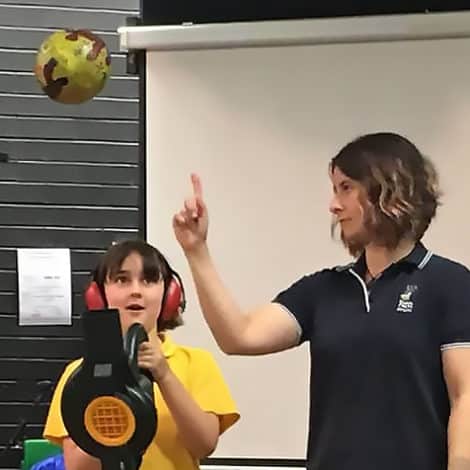
- Bernoulli balls – Float balls in mid-air, relating curved surfaces to wing design
- The impossible puff – Why is it hard to blow a ping pong ball out of a funnel?
- Flying toilet paper – Demonstration on how the Coanda effect helps planes to fly
- Tea bag rocket – Hot air rises. So, what about cold air?
- Crushing Cans – How powerful is atmospheric pressure?
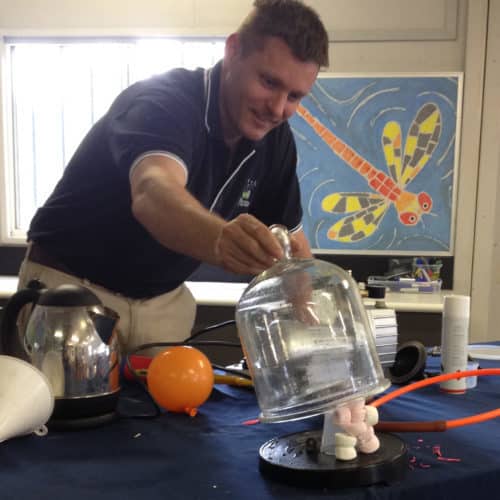
- Magdeburg hemispheres – Witness the classic experiment that demonstrated air pressure.
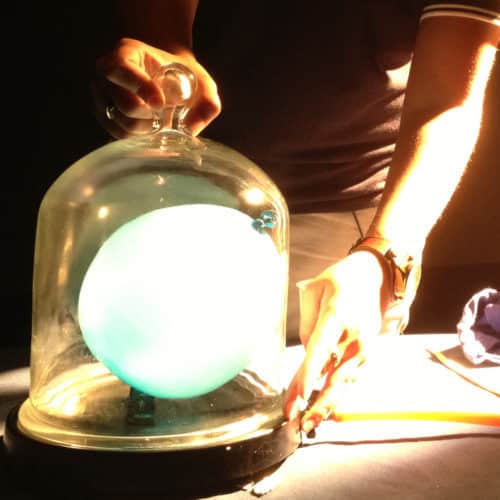
- Cream expansion – What happens to air bubbles in low pressure environments?
- Exploding balloon dog – Why does the balloon dog pop in a vacuum?
- Drink boiling water – Demonstration on what boiling really means.
- Dry ice column – How is acid rain formed? Why is it bad for the environment?
- Tornado tubes – Make a tornadoes in a bottle.
Science show content
What Students Experience: The Air Pressure Lab
Whether focusing on the mechanics of aviation or the power of meteorology, this show provides a visual masterclass in fluid dynamics. Students observe the invisible forces of our atmosphere through high-impact demonstrations that make abstract concepts tangible.
1. Atmospheric Fundamentals
We begin by manipulating air. Students explore what happens when we heat, cool, compress, or remove air to create a vacuum. By exploring pressure differentials and convection, we prove that air is a physical substance that exerts massive force.
2. Pathway A: The Science of Flight
Applying these fundamentals to aviation, we demonstrate the Bernoulli effect and the Coanda effect. Students identify the four forces acting on a wing—Lift, Thrust, Drag, and Gravity—to understand how aircraft stay airborne.
3. Pathway B: Weather & Storms
Alternatively, we explore meteorology. Students see how low-pressure systems cause storms and how weather fronts move. We demonstrate the physics of thunderstorms, tornadoes, and cyclones to explain atmospheric change.
Real Classroom Feedback
The Air Pressure Lab was a fantastic addition to our science unit! The students were amazed to see how pressure works in such a visual way. The vacuum chamber experiments were definitely the highlight.
A brilliant show! Our students loved the high-energy demonstrations of flight and air pressure. It made difficult concepts very easy for everyone to understand. Highly recommended.
⬅️ Swipe to see more examples ➡️
Our Commitment to Quality Science Education
A Trusted School Partner for 20 Years
Fizzics Education delivers reliable, syllabus-aligned visits that engage students and meet the practical requirements of the Australian classroom.
✓
✓

Australian Curriculum Mapping
Australian National Curriculum Mapping for all our science incursions
Australian ACARA Content Outcomes:
Science F-10 Version 9.0
Year 3
- identify sources of heat energy and examine how temperature changes when heat energy is transferred from one object to another AC9S3U03
- investigate the observable properties of solids and liquids and how adding or removing heat energy leads to a change of state AC9S3U04
Year 4
- identify sources of water and describe key processes in the water cycle, including movement of water through the sky, landscape and ocean; precipitation; evaporation; and condensation AC9S4U02
- identify how forces can be exerted by one object on another and investigate the effect of frictional, gravitational and magnetic forces on the motion of objects AC9S4U03
- examine the properties of natural and made materials including fibres, metals, glass and plastics and consider how these properties influence their use AC9S4U04
Year 3 & 4
- examine how people use data to develop scientific explanations AC9S3H01, AC9S4H01
- consider how people use scientific explanations to meet a need or solve a problem AC9S3H02, AC9S4H02
- pose questions to explore observed patterns and relationships and make predictions based on observations AC9S3I01, AC9S4I01
- compare findings with those of others, consider if investigations were fair, identify questions for further investigation and draw conclusions AC9S3I05, AC9S4I05
Year 5
- explain observable properties of solids, liquids and gases by modelling the motion and arrangement of particles AC9S5U04
Year 6
- compare reversible changes, including dissolving and changes of state, and irreversible changes, including cooking and rusting that produce new substances AC9S6U04
Year 5 & 6
- investigate how scientific knowledge is used by individuals and communities to identify problems, consider responses and make decisions AC9S5H02, AC9S6H02
- pose investigable questions to identify patterns and test relationships and make reasoned predictions AC9S5I01, AC9S6I01
- compare methods and findings with those of others, recognise possible sources of error, pose questions for further investigation and select evidence to draw reasoned conclusions AC9S5I05, AC9S6I05
Australian National Curriculum Mapping for all our science workshops & shows

NSW K-10 Science Syllabus Mapping
NSW K – 10 Science Syllabus mapping
NSW Science Syllabus Content
A student:
- ST1-10ES-S recognises observable changes occurring in the sky and on the land and identifies Earth’s resources
- ST2-9PW-ST describes how contact and non-contact forces affect an object’s motion
- ST2-10ES-S investigates regular changes caused by interactions between the Earth and the Sun, and changes to the Earth’s surface
- ST3-6MW-S explains the effect of heat on the properties and behaviour of materials
- ST3-9PW-ST investigates the effects of increasing or decreasing the strength of a specific contact or non-contact force
NSW Science and Technology K–6 Syllabus (Implementation from 2027)
For explanatory points & implementation advice, please visit the NESA Science and Technology K–6 Curriculum site.
Stage 2
ST2-SCI-01 uses information to investigate the solar system and the effects of energy on living, physical and geological systems
- Recognise that matter is anything that has mass, takes up space and consists of very small particles
- Observe matter in solid, liquid, and gas states with defined properties for each
- Observe and describe water changing states using Tier 2 and Tier 3 vocabulary
- Describe how heat energy affects the movement and arrangement of particles during changes of state
- Recognise that heat energy can be transferred by conduction, convection and radiation
- Recognise that temperature is a measure of hotness or coldness expressed in degrees Celsius
- Describe how materials and heat transfer impact everyday life
ST2-PQU-01 poses questions to create fair tests that investigate the effects of energy on living things and physical systems
Stage 3
ST3-SCI-01 uses evidence to explain how scientific knowledge can be used to develop sustainable practices
- Identify the technologies used to collect weather data and describe how they are used
- Describe the differences between climate and weather
- Research the effects of natural events on the atmosphere
- Explain the effects of natural events and human activities on climate
ST3-PQU-01 poses questions to identify variables and conducts fair tests to gather data

VIC Science Syllabus Content
VIC Curriculum F–10 Version 2.0
For explanatory points & implementation advice, please visit the VIC Curriculum F-10 site.
Levels 3 & 4
- solids, liquids and gases have observable properties; changes of state occur with heat transfer. VC2S4U04
- the properties of natural and made materials influence their use and re-use. VC2S4U05
- water is an important resource that cycles through the landscape, sky and ocean via evaporation, condensation and precipitation. VC2S4U07
- heat energy can be generated from different sources; temperature changes occur during transfer. VC2S4U09
- forces, including frictional and gravitational, affect the motion of objects. VC2S4U10
- scientific investigations can be planned and conducted using fair test scaffolds. VC2S4I02
Levels 5 & 6
- observable properties of matter can be explained by modelling particle motion and arrangement. VC2S6U03
- extreme weather conditions can affect Earth’s surface and atmosphere; impacts can be reduced by human actions and technology. VC2S6U06
- repeatable scientific investigations can be planned to test variables and identify potential risks. VC2S6I02
Session Requirements
👥 Capacity & Timing
👨🎓 Attendance: Max 64 students per class.
🏫 Target: Appropriate for Years 3 to 6.
⏰ Duration: 60 minutes.
🛠️ Set/Pack: 45 mins setup + 45 mins pack down.
📍 Space & Power
🏗️ Layout: Access to 2 tables is required for demonstration equipment.
🔌 Power: Access to 2 electrical power sockets.
🪑 Seating: Chairs are not required for students.
Go Further!
Complete Units of Work to Support Your Teaching
Support your classroom with 270+ syllabus-linked lessons, high-quality videos, and marking rubrics.
Save time and engage students in STEM year-round with high-quality videos, printable experiments, vocabulary lists, and marking rubrics.
Extend the Experience
Pair this show with a larger stage show for groups of up to 240 students:






