


Science Show Activities
- Fire tornado! – A demonstration of vortices found in fire storms.
- Bernoulli bags – Fast moving air pulls in more air … causing damage in the process.
- Cloud in a chamber – Learn how low pressure systems cause clouds and downpours.
- Upside water cup – Air pressure is stronger than you think!
- Pandemic spread – Just how do pandemics spread? Sadly all to easily…
- Tsunami terror – Deformations of the sea floor move oceans.
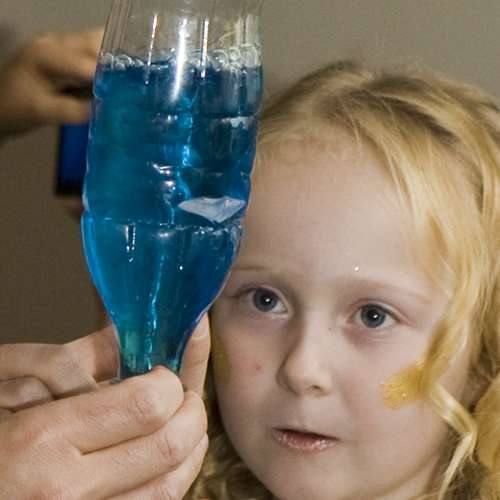
- Tornado in a bottle – Model the movement of air in a tornado.
- Shaky seismograph – Investigate a seismograph in your classroom.
- Asteroid impact – Potential world changers are in our solar system. How bad is it?
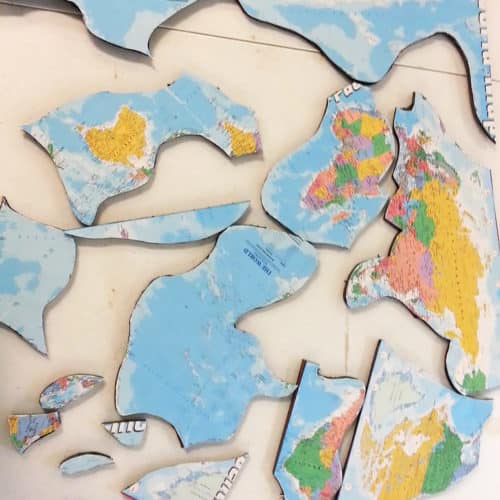
- Tectonic Jigsaw – Investigate how plate tectonics form our world.
- Designing for disaster – Learn how building design can limit damage. Especially in grain silos!
- Lava viscosity – The type of rock involved in eruptions affect how big the eruption is.
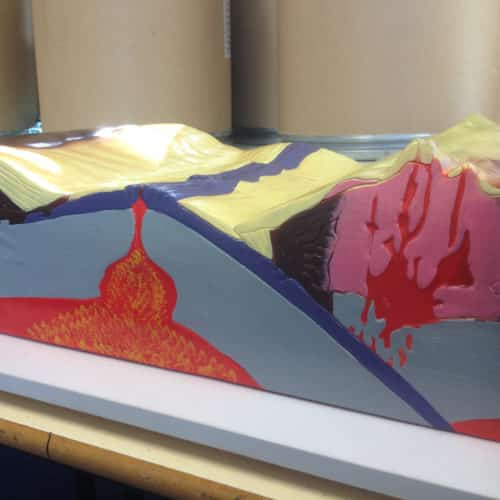
- Volcano – How do they erupt and are they different?
Science workshop content
What Students Experience: The Dynamic Earth
We begin by defining what a natural disaster is and discussing its profound impact on both humans and the environment. It is vital that students understand we are investigating real events; we approach these topics with empathy, acknowledging the communities affected by these occurrences.
The journey starts with Plate Tectonics. We demonstrate how the massive movements of Earth’s crust trigger earthquakes, tsunamis, and volcanic eruptions. Students then move into hands-on rotation stations, becoming scientists as they measure seismic waves with a seismometer, solve tectonic puzzles, and explore the physics of windstorms and tornadoes.
Geological Forces
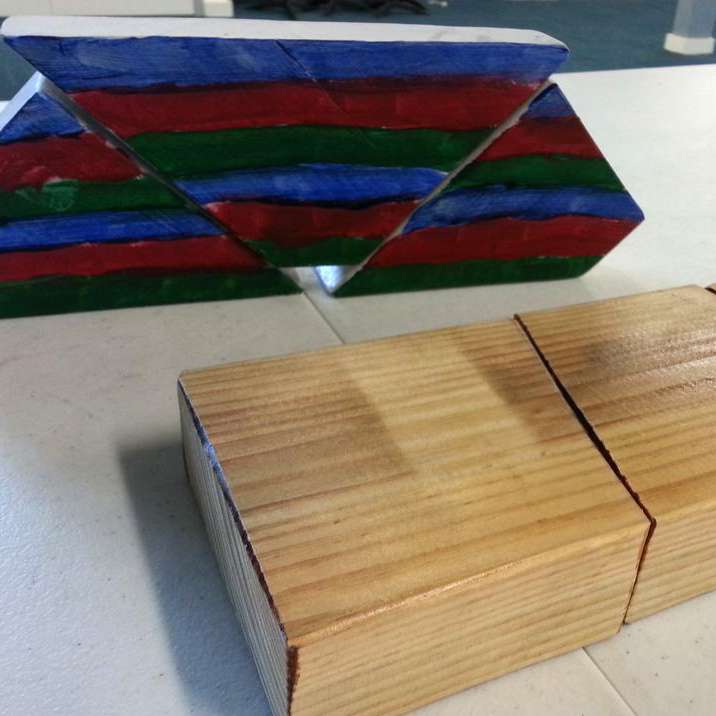
Students investigate folding and faults, using viscosity analogies to understand why some volcanoes erupt explosively while others flow calmly.
Atmospheric Science
Through air pressure experiments, students model the high-energy environments that create destructive tornadoes and windstorms.
Global Challenges
The session concludes with a look at epidemiology and bushfire science, including a controlled fireball demonstration to show fuel volatility.
Real Classroom Feedback
What an impactful day of learning! Our students were fascinated by the plate tectonics demonstrations and loved using real scientific tools like the seismometer.
The Dynamic Earth workshop was outstanding. It perfectly balanced complex Earth science with hands-on discovery. The tornado models were a big hit with the students!
⬅️ Swipe to see more examples ➡️
Rigorous Earth Science
20 Years of STEM Leadership
Fizzics Education provides the specialised equipment—from seismometers to pressure models—that allows students to safely simulate and study the world’s most powerful natural hazards.

Australian Curriculum Mapping
Australian National Curriculum Mapping for all our science incursions
Australian ACARA Content Outcomes:
Science F-10 Version 9.0
Year 3
- identify sources of heat energy and examine how temperature changes when heat energy is transferred from one object to another AC9S3U03
- compare the observable properties of soils, rocks and minerals and investigate why they are important Earth resources AC9S3U02
- investigate the observable properties of solids and liquids and how adding or removing heat energy leads to a change of state AC9S3U04
Year 4
- identify how forces can be exerted by one object on another and investigate the effect of frictional, gravitational and magnetic forces on the motion of objects AC9S4U03
- examine the properties of natural and made materials including fibres, metals, glass and plastics and consider how these properties influence their use AC9S4U04
Year 3 & 4
- examine how people use data to develop scientific explanations AC9S3H01, AC9S4H01
- consider how people use scientific explanations to meet a need or solve a problem AC9S3H02, AC9S4H02
- pose questions to explore observed patterns and relationships and make predictions based on observations AC9S3I01, AC9S4I01
- compare findings with those of others, consider if investigations were fair, identify questions for further investigation and draw conclusions AC9S3I05, AC9S4I05
Year 5
- describe how weathering, erosion, transportation and deposition cause slow or rapid change to Earth’s surface AC9S5U02
- explain observable properties of solids, liquids and gases by modelling the motion and arrangement of particles AC9S5U04
Year 6
- compare reversible changes, including dissolving and changes of state, and irreversible changes, including cooking and rusting that produce new substances AC9S6U04
Year 5 & 6
- investigate how scientific knowledge is used by individuals and communities to identify problems, consider responses and make decisions AC9S5H02, AC9S6H02
- pose investigable questions to identify patterns and test relationships and make reasoned predictions AC9S5I01, AC9S6I01
- compare methods and findings with those of others, recognise possible sources of error, pose questions for further investigation and select evidence to draw reasoned conclusions AC9S5I05, AC9S6I05
Australian National Curriculum Mapping for all our science workshops & shows

NSW K-10 Science Syllabus Mapping
NSW K – 10 Science Syllabus mapping for all our incursions
NSW Science Syllabus Content
A student:
- recognises observable changes occurring in the sky and on the land and identifies Earth’s resources ST1-10ES-S
- investigates regular changes caused by interactions between the Earth and the Sun, and changes to the Earth’s surface ST2-10ES-S
- explains regular events in the solar system and geological events on the Earth’s surface ST3-10ES-S
NSW Science and Technology K–6 Syllabus (Implementation from 2027)
For explanatory points & implementation advice for each dot point, please visit the NESA Science and Technology K–6 Curriculum site
Stage 2
ST2-SCI-01
uses information to investigate the solar system and the effects of energy on living, physical and geological systems
- Research and describe the changes to the landscape caused by earthquakes and volcanoes
- Research, describe and model the internal structure of Earth
- Describe and model how forces produced by moving water cause erosion
ST2-PQU-01 poses questions to create fair tests that investigate the effects of energy on living things and physical systems
Stage 3
ST3-SCI-01
uses evidence to explain how scientific knowledge can be used to develop sustainable practices
- Research the effects of natural events on the atmosphere
- Explain the effects of natural events and human activities on climate
ST3-PQU-01 poses questions to identify variables and conducts fair tests to gather data
Print a PDF which details K to 6 mapping of all our NSW science visits

VIC Science Syllabus Content
VIC Curriculum F–10 Version 2.0
For explanatory points & implementation advice for each dot point, please visit the VIC Curriculum F-10 site.
Levels 3 & 4
- the properties of natural and made materials, including fibres, metals, glass and plastics, influence their use and re-use. VC2S4U05
- forces, including frictional, gravitational, electrostatic and magnetic, can be exerted by one object on another through direct contact or from a distance and affect the motion (speed and direction) of objects. VC2S4U10
- weather events and climate have impacts on the land, air, water and living things; human activity can affect climate. VC2S4U08
- scientific investigations to answer questions or test predictions can be planned and conducted using provided scaffolds, including identifying the attributes of fair tests, and considering the safe use of materials and equipment. VC2S4I02
Levels 5 & 6
- geological processes including weathering, erosion, transportation and deposition can cause slow or rapid changes to Earth’s surface. VC2S6U05
- sudden geological changes or extreme weather conditions can affect Earth’s surface and atmosphere; the impacts of natural hazards, including earthquakes, volcanic eruptions, wildfires and floods, can be reduced by human actions and technological innovations. VC2S6U06
- repeatable scientific investigations to answer questions can be planned and conducted, including, as appropriate, deciding the variables to be changed, measured and controlled in fair tests, considering potential risks, planning for the safe and ethical use of equipment and materials, and obtaining permissions for investigations conducted on Country and Place or in protected areas. VC2S6I02
Session Requirements
👥 Capacity & Timing
👨🎓 Attendance: Max 32 students per session.
🏫 Target: Appropriate for Years 1 to 6.
⏰ Duration: 60 or 90 minutes.
🛠️ Set/Pack: 45 mins setup + 45 mins pack down.
📍 Space & Power
🏗️ Layout: 7 tables arranged in a U-shape.
🔌 Power: Access to 2 electrical power sockets.
🚨 Safety: Fire alarms off where possible (for firestorm demo).
💡 Expert Delivery: To provide the best possible learning experience, materials may be varied to suit the conditions and the audience. Please chat with our presenter if you’d like a specific focus covered.
Did you know about our larger stage shows?
Designed to engage up to 240 students, pair this workshop with one of these school favourites:






