


Engaging for students!
What Students Experience: The Design Studio
This workshop is designed to complement our
Forces, Friction and Movement
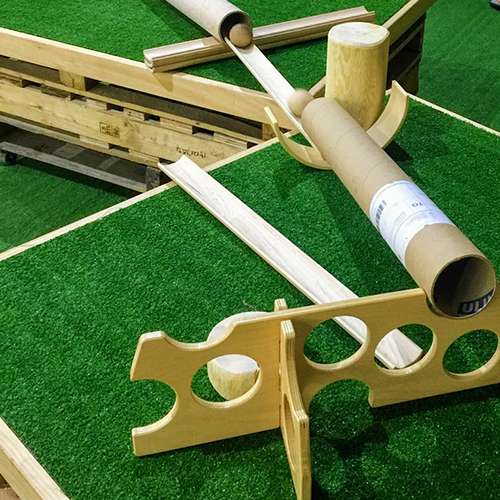
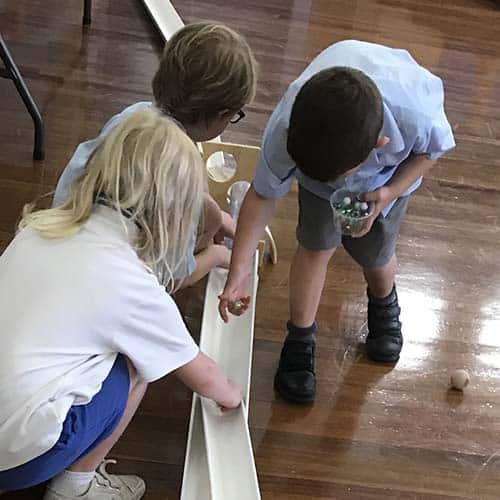
programme through a series of student-centred design challenges. The lesson is entirely driven by the students, with our presenter and the classroom teacher working directly with them to facilitate inquiry and a deeper understanding of why things move.
The Loop Challenge
Can they make the ball loop-the-loop? Students must calculate the necessary potential energy and speed to overcome gravity at the peak of the circle.
Projectile Motion
How far can they make the ball jump? By modifying ramp angles and exit velocities, students explore the physics of flight and landing precision.
Efficiency & Speed
How fast can the ball move? Students iterate their designs to minimise friction and maximise momentum, testing if additional materials can improve the run.
Real Classroom Feedback
A fantastic hands-on session! Our students loved the challenge of the Design Studio, testing their ramps and loops while learning about friction and gravity.
View on FacebookThe students were totally engaged in their engineering mission. The rapid prototyping and testing cycle really brought the scientific process to life in our classroom.
View on FacebookA brilliant workshop that encourages persistence and problem-solving. The girls were determined to get their ball loops working perfectly!
View on Facebook⬅️ Swipe to see more examples ➡️
Authentic Engineering Design
A Trusted STEM Partner for 20 Years
Our presenters are experts at guiding student-led inquiry, ensuring that every design failure becomes a valuable learning opportunity in the scientific process.

Australian Curriculum Mapping
Australian National Curriculum Mapping for all our science incursions
Australian ACARA Content Outcomes:
Science F-10 Version 9.0
Foundation
- describe how objects move and how factors including their size, shape or material influence their movement AC9SFU02
- explore the ways people make and use observations and questions to learn about the natural world AC9SFH01
- pose questions and make predictions based on experiences AC9SFI01
Year 1
- describe pushes and pulls in terms of strength and direction and predict the effect of these forces on objects’ motion and shape AC9S1U03
Year 2
- recognise that materials can be changed physically without changing their material composition and explore the effect of different actions on materials including bending, twisting, stretching and breaking into smaller pieces AC9S2U03
Year 1 & 2
- describe how people use science in their daily lives, including using patterns to make scientific predictions AC9S1H01, AC9S2H01
- pose questions to explore observed simple patterns and relationships and make predictions based on experiences AC9S1I01, AC9S2I01
- compare observations with predictions and others’ observations, consider if investigations are fair and identify further questions with guidance AC9S1I05, AC9S2I05
Year 4
- identify how forces can be exerted by one object on another and investigate the effect of frictional, gravitational and magnetic forces on the motion of objects AC9S4U03
Year 3 & 4
- examine how people use data to develop scientific explanations AC9S3H01, AC9S4H01
- consider how people use scientific explanations to meet a need or solve a problem AC9S3H02, AC9S4H02
- pose questions to explore observed patterns and relationships and make predictions based on observations AC9S3I01, AC9S4I01
- compare findings with those of others, consider if investigations were fair, identify questions for further investigation and draw conclusions AC9S3I05, AC9S4I05
Design and Technologies F-10 Version 9.0
Foundation
- generate, communicate and evaluate design ideas, and use materials, equipment and steps to safely make a solution for a purpose AC9TDEFP01
Years 1 & 2
- explore how technologies including materials affect movement in products AC9TDE2K02
- generate and communicate design ideas through describing, drawing or modelling, including using digital tools AC9TDE2P01
- use materials, components, tools, equipment and techniques to safely make designed solutions AC9TDE2P02
- evaluate the success of design ideas and solutions based on personal preferences and including sustainability AC9TDE2P03
- sequence steps for making designed solutions cooperatively AC9TDE2P04
Years 3 & 4
- describe how forces and the properties of materials affect function in a product or system AC9TDE4K02
- explore needs or opportunities for designing, and test materials, components, tools, equipment and processes needed to create designed solutions AC9TDE4P01
- generate and communicate design ideas and decisions using appropriate attributions, technical terms and graphical representation techniques, including using digital tools AC9TDE4P02
- select and use materials, components, tools, equipment and techniques to safely make designed solutions AC9TDE4P03
- use given or co-developed design criteria including sustainability to evaluate design ideas and solutions AC9TDE4P04
- sequence steps to individually and collaboratively make designed solutions AC9TDE4P05
Australian National Curriculum Mapping for all our science workshops & shows

NSW K-10 Science Syllabus Mapping
NSW K – 10 Science Syllabus mapping for all our incursions
NSW Science Syllabus Content
A student:
- observes the way objects move and relates changes in motion to push and pull forces STe-5PW-ST
- develops solutions to an identified need STe-2DP-T
- investigates how forces and energy are used in products ST1-9PW-ST
- uses materials, tools and equipment to develop solutions for a need or opportunity ST1-2DP-T
- describes how contact and non-contact forces affect an object’s motion ST2-9PW-ST
- selects and uses materials, tools and equipment to develop solutions for a need or opportunity ST2-2DP-T
NSW Science and Technology K–6 Syllabus (Implementation from 2027)
For explanatory points & implementation advice for each dot point, please visit the NESA Science and Technology K–6 Curriculum site
Early Stage 1
STE-SCI-01
identifies and describes characteristics of living things, properties of materials, and movement
- Test how the movement of an object is affected by its shape
- Experiment to observe how an object’s movement is affected by its material
STE-PQU-01 poses questions based on observations to collect data
STE-DDT-01
identifies and uses technologies to make products to address user needs or opportunities
- Design and build a simple product that addresses a user need or opportunity
Stage 1
ST1-SCI-01
measures and describes changes in living things, materials, movement, Earth and the sky
- Recognise that a force is a push or a pull that can make things either start moving, stop moving, change speed, direction or shape
- Pose questions and test the effects of forces on an object’s movement
- Test how frictional forces affect moving objects
ST1-PQU-01 poses questions based on observations and information to investigate cause and effect
ST1-DDT-01
uses technologies and materials to design and make products to address user needs or opportunities
- Recognise that a design process breaks large projects into manageable, logical steps
- Apply one or more steps of a design process to make a product
Stage 2
ST2-PQU-01 poses questions to create fair tests that investigate the effects of energy on living things and physical systems
ST2-DDT-01
uses a design process to create products to address user needs or opportunities
- Explore the design of a structure, product or place and identify how user needs are addressed
- Generate, develop and communicate design ideas
- Test construction methods and materials to build a designed model
- Build, test and evaluate a designed model
Print a PDF which details K to 6 mapping of all our NSW science visits

VIC Science Syllabus Content
VIC Curriculum F–10 Version 2.0
Science
For explanatory points & implementation advice for each dot point, please visit the VIC Curriculum F-10 site.
Foundation to Level 2
- the way objects move depends on a variety of factors including their size, shape and material VC2S2U10
- pushes and pulls are forces that can change an object’s movement or shape and can be represented in terms of strength and direction VC2S2U11
- experiences can be used as a basis for posing questions to explore observed patterns and relationships, and to make predictions VC2S2I01
- observations can be compared to predictions and the observations of others, which may lead to further questions being identified VC2S2I05
Levels 3 & 4
- the properties of natural and made materials, including fibres, metals, glass and plastics, influence their use and re-use. VC2S4U05
- forces, including frictional, gravitational, electrostatic and magnetic, can be exerted by one object on another through direct contact or from a distance and affect the motion (speed and direction) of objects. VC2S4U10
- scientific investigations to answer questions or test predictions can be planned and conducted using provided scaffolds, including identifying the attributes of fair tests, and considering the safe use of materials and equipment. VC2S4I02
- repeatable scientific investigations to answer questions can be planned and conducted, including, as appropriate, deciding the variables to be changed, measured and controlled in fair tests, considering potential risks, planning for the safe and ethical use of equipment and materials, and obtaining permissions for investigations conducted on Country and Place or in protected areas. VC2S6I02
Design and Technologies
Foundation to Level 2
- explore how technologies affect movement in products and systems VC2TDE2C01
- explore the characteristics and properties of materials and components that are used to create designed solutions VC2TDE2C04
- explore needs or opportunities, materials, components, tools and processes for designing and creating designed solutions VC2TDE2D01
- explore, generate and communicate design ideas through describing, drawing or modelling, using manual and digital tools VC2TDE2D02
- use materials, components, tools and techniques to safely make designed solutions VC2TDE2D03
- describe and select design ideas and solutions based on personal preferences and including sustainability VC2TDE2D04
- sequence steps for making designed solutions cooperatively VC2TDE2D05
Levels 3 & 4
- describe how forces affect function in a product or system VC2TDE4C01
- describe how the properties of materials affect function in a product or system VC2TDE4C04
- explore needs or opportunities for designing and testing materials, components, tools and processes needed to create designed solutions VC2TDE4D01
- generate and communicate design ideas and decisions using technical terms and graphical representation techniques, using manual and digital tools VC2TDE4D02
- select and use materials, components, tools and techniques to safely make designed solutions VC2TDE4D03
- use given or predetermined design criteria including sustainability to evaluate design ideas and solutions VC2TDE4D04
- sequence steps to individually and collaboratively make designed solutions VC2TDE4D05
Session Requirements
👥 Capacity & Timing
👨🎓 Attendance: Max 30 students per class.
🏫 Target: Appropriate for Years K to 4.
⏰ Duration: 60 minutes.
🛠️ Set/Pack: 45 mins setup + 45 mins pack down.
📍 Space & Setup
🏗️ Space: A school hall is preferrable for this workshop to allow for maximum design range.
✨ Experience: We tailor our materials to suit the conditions and the specific age group of your audience.
Go Further!
Complete Units of Work to Support Your Teaching
Support your classroom with 270+ syllabus-linked lessons, high-quality videos, and marking rubrics.
Save planning time with high-quality videos, printable experiments, quizzes, vocabulary lists, and marking rubrics.
Did you know about our larger stage shows?
Designed to engage up to 240 students, pair this workshop with one of these school favourites:






