


Science Show Demonstrations
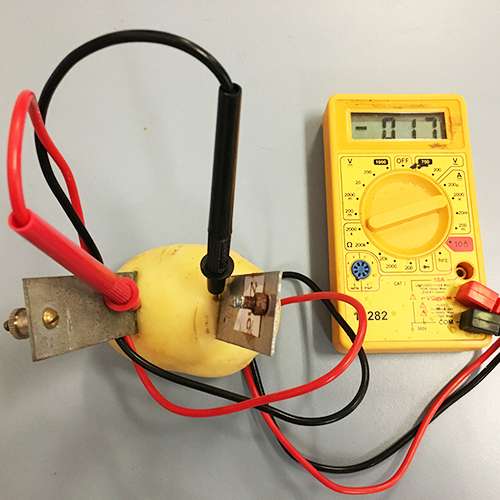
- Potato problems – Which pair of electrodes produce the largest voltage?
- Piaget’s Pendulum – Is it the length of string or the mass that matters?
- Eulers Disc – Statistically, what is the average length of spin. Why?
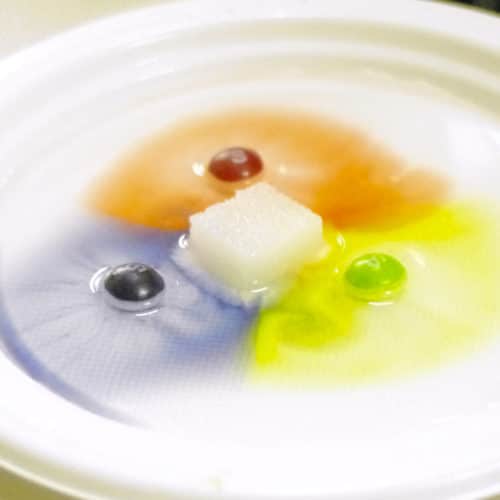
- Mixing it up – Does surface area make a difference with dissolving rates?
- Hot or cold skittles – How much of an impact does heat have?
- Gas release via displacement – Which product releases the most carbon dioxide?
- Bicarbonate soda rocket – Does more vinegar make it go higher?
- Crushers – How much pressure can paper cylinders take?
- Ice block conundrum – Which will melt the ice first… metal or plastic?
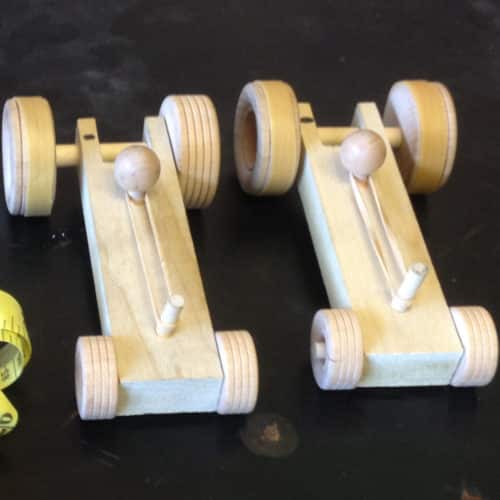
- Rubber band race cars – Does a car go twice as far when you stretch the band twice as much?
Science workshop content
What Students Experience
This immersive short course transforms students into active researchers. Through high-impact demonstrations and focused inquiry, students journey through the core pillars of scientific discovery, learning to look at the world through the lens of a professional scientist.
Hands-On Inquiry
Students rotate through hands-on stations focused on force, energy, and chemistry. This module introduces the scientific method through direct observation, challenging students to identify patterns and ask “why.”
Variable Isolation
Time is specifically spent making sure students understand fair testing and variable isolation. We strip back the complexity to show how controlled changes lead to reliable scientific data.
The Hypothesis
Students master hypothesis formation, learning to create testable predictions based on evidence. This skill forms the foundation of scientific literacy and prepares them for high school science lab work.
Our Commitment to Quality Science Education
A Trusted School Partner for 100’s of schools
At Fizzics Education, we know science is naturally captivating. Our 20-year history is built on delivering reliable, syllabus-aligned visits that engage students and meet the curriculum & practical requirements of the classroom.
Supporting Australian schools and teachers since 2004.
Guided by reviews from educators and principals.
Facilitated by experienced science educators focused on student learning.

Australian Curriculum Mapping
Australian National Curriculum Mapping for all our science incursions
Australian ACARA Content Outcomes:
Science F-10 Version 9.0
Year 3
- identify sources of heat energy and examine how temperature changes when heat energy is transferred from one object to another AC9S3U03
- investigate the observable properties of solids and liquids and how adding or removing heat energy leads to a change of state AC9S3U04
Year 4
- examine the properties of natural and made materials including fibres, metals, glass and plastics and consider how these properties influence their use AC9S4U04
Year 3 & 4
- examine how people use data to develop scientific explanations AC9S3H01, AC9S4H01
- consider how people use scientific explanations to meet a need or solve a problem AC9S3H02, AC9S4H02
- pose questions to explore observed patterns and relationships and make predictions based on observations AC9S3I01, AC9S4I01
- compare findings with those of others, consider if investigations were fair, identify questions for further investigation and draw conclusions AC9S3I05, AC9S4I05
Year 5
- identify sources of light, recognise that light travels in a straight path and describe how shadows are formed and light can be reflected and refracted AC9S5U03
- explain observable properties of solids, liquids and gases by modelling the motion and arrangement of particles AC9S5U04
Year 6
- compare reversible changes, including dissolving and changes of state, and irreversible changes, including cooking and rusting that produce new substances AC9S6U04
Year 5 & 6
- investigate how scientific knowledge is used by individuals and communities to identify problems, consider responses and make decisions AC9S5H02, AC9S6H02
- pose investigable questions to identify patterns and test relationships and make reasoned predictions AC9S5I01, AC9S6I01
- compare methods and findings with those of others, recognise possible sources of error, pose questions for further investigation and select evidence to draw reasoned conclusions AC9S5I05, AC9S6I05
Australian National Curriculum Mapping for all our science workshops & shows

NSW K-10 Science Syllabus Mapping
NSW K – 10 Science Syllabus mapping
NSW Science Syllabus Content
A student:
- ST2-8PW-ST describes the characteristics and effects of common forms of energy, such as light and heat
- ST2-9PW-ST describes how contact and non-contact forces affect an object’s motion
- ST3-6MW-S explains the effect of heat on the properties and behaviour of materials
- ST3-8PW-ST explains how energy is transformed from one form to another
- ST3-9PW-ST investigates the effects of increasing or decreasing the strength of a specific contact or non-contact force
NSW Science and Technology K–6 Syllabus (2027)
For explanatory points & implementation advice, visit the NESA site.
- ST1-PQU-01 poses questions based on observations and information to investigate cause and effect
Stage 2
- ST2-SCI-01 uses information to investigate the solar system and the effects of energy on living, physical and geological systems
Energy is required to change the properties of matter
- Observe and describe water changing from solid to liquid to gas and back again, using Tier 2 and Tier 3 vocabulary
- Describe how adding and removing heat energy affects the movement and arrangement of particles when matter is changing state
Heat energy can be transferred
- Recognise that heat energy can be transferred from warmer to cooler objects by conduction, convection and radiation
- Recognise that temperature is a measure of hotness or coldness, measured using a thermometer and often expressed in degrees Celsius
- Describe how the properties of materials and transfer of heat energy impact everyday life
- Pose questions and conduct fair tests to compare how different materials absorb or reflect heat energy
- ST2-PQU-01 poses questions to create fair tests that investigate the effects of energy on living things and physical systems
Stage 3
- ST3-SCI-01 uses evidence to explain how scientific knowledge can be used to develop sustainable practices
A fixed amount of usable matter makes up all the material on Earth
- Recognise that in a fair test, an independent variable is changed, a dependent variable is measured, and controlled variables remain the same
- Pose questions to determine whether substances dissolve in water by identifying variables and conducting and evaluating fair tests
Earth’s climate is affected by natural and human activities
- Identify the technologies used to collect weather data and describe how they are used
- ST3-PQU-01 poses questions to identify variables and conducts fair tests to gather data

VIC Science Syllabus Content
VIC Curriculum F–10 Version 2.0
Science
Levels 3 and 4
- solids, liquids and gases have observable properties; adding or removing heat energy leads to a change of state between solids, liquids and gases. VC2S4U04
- the properties of natural and made materials, including fibres, metals, glass and plastics, influence their use and re-use. VC2S4U05
- heat energy can be generated from different sources; temperature changes may happen when heat is transferred from one object to another. VC2S4U09
- forces, including frictional, gravitational, electrostatic and magnetic, can be exerted by one object on another through direct contact or from a distance and affect the motion (speed and direction) of objects. VC2S4U10
- scientific investigations to answer questions or test predictions can be planned and conducted using provided scaffolds, including identifying the attributes of fair tests, and considering the safe use of materials and equipment. VC2S4I02
Levels 5 & 6
- light can be produced from many sources; light travels in a straight path, can form shadows, and can be absorbed, transmitted, reflected or refracted by objects. VC2S6U08
- the observable properties of matter (solids, liquids and gases) can be explained by modelling the motion and arrangement of their particles; mixtures (including solutions) can be formed by combining 2 or more different substances. VC2S6U03
- changes to substances may be reversible, in which case the substance may be recovered, or irreversible, in which case new substances are formed; for most substances a change of state or dissolving in water is reversible, while irreversible changes include cooking and rusting. VC2S6U04
- repeatable scientific investigations to answer questions can be planned and conducted, including, as appropriate, deciding the variables to be changed, measured and controlled in fair tests, considering potential risks, planning for the safe and ethical use of equipment and materials, and obtaining permissions for investigations conducted on Country and Place or in protected areas. VC2S6I02
Session Requirements
👥 Capacity & Timing
👨🎓 Attendance: Max 32 students per workshop.
🏫 Target: Appropriate for Years 3 to 6.
🛠️ Setup: 45 mins setup required.
📦 Pack up: 45 mins pack up required.
📍 Space & Power
🏗️ Layout: 7 tables required for active stations.
🔌 Power: Access to 3 electrical power sockets.
🪑 Seating: Chairs are not required for students.
Go Further!
Complete Units of Work to Support Your Teaching
Support your classroom with 270+ syllabus-linked lessons, high-quality videos, and marking rubrics.
Save time & engage students in STEM with high-quality videos, printable experiments, quizzes, vocabulary lists, Scope & sequences, cross-curricular teaching ideas, marking rubrics & more.
Did you know about our larger stage shows?
Designed to engage groups of up to 240 students, pair this workshop with a school favourite:






