



Explore a variety of light concepts in this interactive school science show:
- Learn about the duality of light; is it a wave or particle or both?
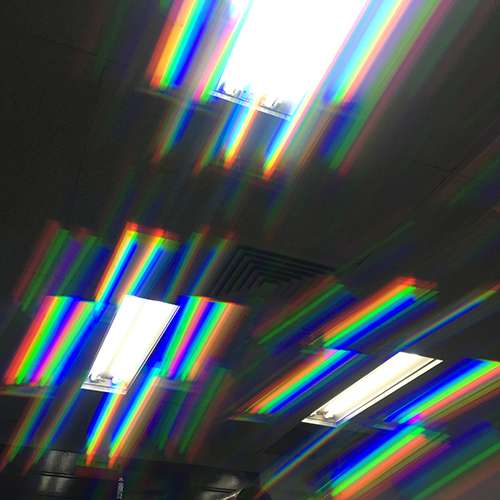
- Investigate the visible light spectrum, including colour addition and subtraction
- Discover how the Doppler effect has been used to explain the structure of the Universe
- Explore luminescent minerals and other objects using ultraviolet light
- Find out why sunsets are red and learn about colour and energy relationships
- Make coloured shadows and create hovering image illusions using persistence of vision
- Learn about translucent, transparent and opaque materials
- Learn about refraction vs. reflection
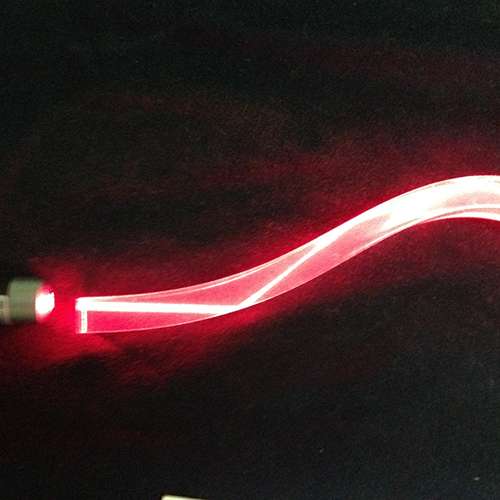
- Investigate optical fibre and it’s use in hi-speed broadband technology
- Find out about your colour vision; can you see all of the spectrum?
Available as a secondary school science incursion within Australia or as a video conference to any school around the globe!
 Rated Excellent on Trustpilot – read our reviews
Contact us
Online Class Version
We’ve run live interactive distance programs since 2010 and are highly experienced in making online classes engaging for students on a variety of web conferencing platforms.
- All of the activities listed below will be covered during the conference.
- Upon booking, you will receive a PDF outlining the materials that you can have on hand to make the workshop more interactive. It’s not a problem if you can’t source all of the materials, as we’ll have these on hand for the workshop
- Full child protections are in place
- We usually connect to classes & homes via Zoom, however if you wish to use a different software we can work with you on getting the connection live.
If you connect with us via Zoom
- Full system requirements for Zoom here
- Each student should test their Zoom connection here.
- Once the date & time is arranged we will send you simple connection instructions (one click & you’re in!)
Science Show Demonstrations
- Sunsets – Just why are sunsets red anyway? Why not blue or green?
- Laser lights – Investigate energy levels with different colour lasers against photolumiscent vinyl
- Colour mixing – Mix primary light colours … why are the secondary colours different to paint?
- Bubble Films – See light split through a bubble film. Nice… and demonstrates wave theory
- Float that image – Create a 3D floating image hovering in mid-air
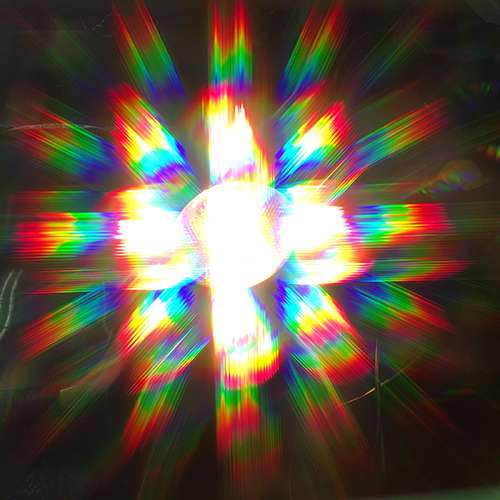
- Magic specs – These diffraction lenses are great for investigating lasers
- Glowing rocks – Some minerals fluoresce under UV light… can you identify which ones?
- Hidden beaker – Canola oil and this beaker have almost the same refractive index… lets hide it
- Hide me – Transparent materials are quite difference to translucent ones.
- Optical illusions – Light can be quite tricky, can you spot how they might work?
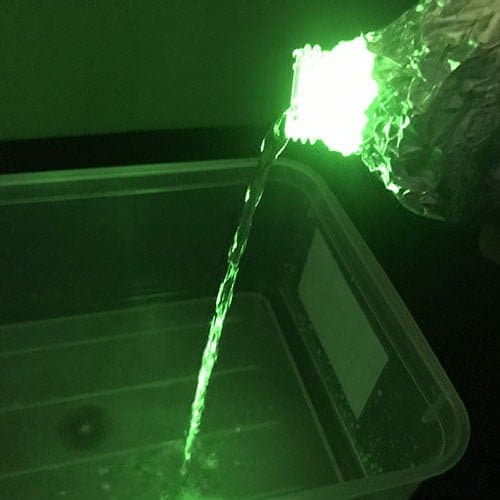
- Optical fibre – Pretty…. and it can be used to transport massive amounts of information
- Colourful chemistry – Some chemicals react to heat and change in colour… check them out!
- Colour vision – Our Director is colour blind… are your students?
- Shiny disco ball – Mirrors and light… what more can we say? Send images around the room!
- Mega lens – Use this lenticular lens and magnify things, including you.
- Lasers – Investigate how lasers work and see them through a cloud… neat!

Australian Curriculum Mapping
Australian National Curriculum Mapping for all our science incursions
Australian ACARA Content Outcomes:
Science F-10 Version 9.0
Year 7 & 8
- explain how new evidence or different perspectives can lead to changes in scientific knowledge
AC9S7H01 AC9S8H01 - examine how proposed scientific responses to contemporary issues may impact on society and explore ethical, environmental, social and economic considerations AC9S7H03 AC9S8H03
- develop investigable questions, reasoned predictions and hypotheses to explore scientific models, identify patterns and test relationships AC9S7I01 AC9S8I01
- analyse data and information to describe patterns, trends and relationships and identify anomalies AC9S7I05 AC9S8I05
- construct evidence-based arguments to support conclusions or evaluate claims and consider any ethical issues and cultural protocols associated with using or citing secondary data or information AC9S7I07 AC9S8I07
Year 9
- use wave and particle models to describe energy transfer through different mediums and examine the usefulness of each model for explaining phenomena AC9S9U04
Year 9 & 10
- explain how scientific knowledge is validated and refined, including the role of publication and peer review
AC9S9H01 AC9S10H01 - Investigate how advances in technologies enable advances in science, and how science has contributed to developments in technologies and engineering AC9S9H02 AC9S10H02
- develop investigable questions, reasoned predictions and hypotheses to test relationships and develop explanatory models AC9S9I01 AC9S10I01
- analyse and connect a variety of data and information to identify and explain patterns, trends, relationships and anomalies AC9S9I05 AC9S10I05
- construct arguments based on analysis of a variety of evidence to support conclusions or evaluate claims, and consider any ethical issues and cultural protocols associated with accessing, using or citing secondary data or information AC9S9I07 AC9S10I07
Australian National Curriculum Mapping for all our science workshops & shows

NSW K-10 Science Syllabus Mapping
NSW Science 7–10 Syllabus (2023)
Stage 4
A student:
- identifies questions and makes predictions to guide scientific investigations SC4-WS-02
– Identify questions and problems that can be investigated scientifically
– Make predictions based on scientific knowledge and observations
Stage 5
- asks questions or makes predictions using observations SCLS-WS-02
– Ask questions about familiar objects and events based on observations
– Make predictions based on observations - describes the features and applications of different forms of waves SC5-WAM-01
– Use the wave model to explain how energy is transferred without the net transfer of particles
– Use models to compare and describe the features of transverse and longitudinal waves
– Compare the different wave regions of the electromagnetic spectrum
– Investigate the features of waves, including amplitude, frequency, speed and wavelength by exploring a range of wave types
– Investigate the properties of light, including absorption, reflection, refraction and scattering
– Investigate applications of absorption, reflection and refraction in everyday life
– Explain how the electromagnetic spectrum is used to learn about stars
NSW K – 10 Science Syllabus mapping for all our NSW incursions

VIC Science Syllabus Content
VIC Curriculum F–10 Version 2.0
For explanatory points & implementation advice for each dot point, please visit the VIC Curriculum F-10 site.
Levels 7 and 8
- wave and particle models can be used to describe energy transfer (conduction, convection and radiation) through different media; waves (electromagnetic and mechanical) have different properties, features (including amplitude, wavelength, frequency and speed) and applications. VC2S10U14
- investigable questions, reasoned predictions and hypotheses can be developed in guiding investigations to identify patterns, test relationships and analyse and evaluate scientific models. VC2S8I01
- scientific methods, conclusions and claims can be analysed to identify assumptions, possible sources of error, conflicting evidence and unanswered questions. VC2S8I06
- evidence-based arguments can be constructed to support conclusions or evaluate claims, including consideration of ethical issues and protocols associated with using or citing secondary data or information. VC2S8I07
Levels 9 & 10
- wave and particle models can be used to describe energy transfer (conduction, convection and radiation) through different media; waves (electromagnetic and mechanical) have different properties, features (including amplitude, wavelength, frequency and speed) and applications. VC2S10U14
- investigable questions, reasoned predictions and hypotheses can be used in guiding investigations to test and develop explanatory models and relationships. VC2S10I01
- the validity and reproducibility of investigation methods and the validity of conclusions and claims can be evaluated, including by identifying assumptions, conflicting evidence, biases that may influence observations and conclusions, sources of error and areas of uncertainty. VC2S10I06
- arguments based on a variety of evidence can be constructed to support conclusions or evaluate claims, including consideration of any ethical issues and cultural protocols associated with accessing, using or citing secondary data or information. VC2S10I07
Requirements
- The ability to darken the room is essential. Choose the best room you have wherever possible.
- Appropriate for Years 7 to 10 with a maximum of 60 students per show.
- 2 Tables arranged at front of the room. Chairs are not required.
- Access to 3 electrical power sockets and a white screen or white board
- Duration 60 minutes, set up time 45 minutes and pack up time 45 minutes.






