
Oreo cookie moon phases
Use Oreo cookies or chocolate biscuits to model the 8 phases of the moon! A classic science activity that anyone can do from home or at school.
Adult supervision for setup
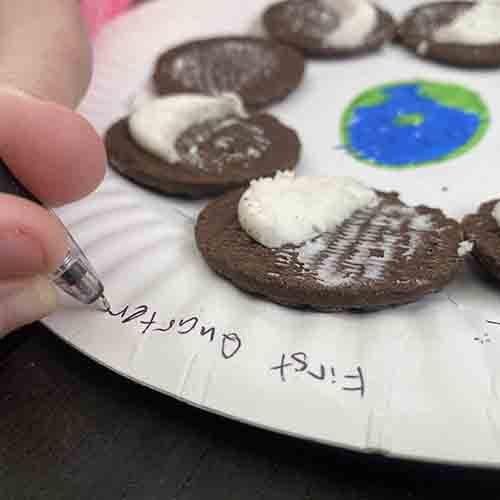
You will need
- Oreo cookies (or any other cream-filled chocolate cookies you have on hand). We used some generic ones in this version.
- A blunt table knife (aka butter knife)
- A paper plate
- A pen
- One green and one blue texta
Method
-
Draw your own version of Earth on the paper plate! You can be as imaginative as you want 🙂

-
Carefully split each cream-filled chocolate cookie in half.
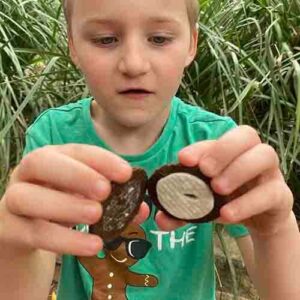
-
Use a blunt table knife to scrape away the cream filling on each biscuit. Try to avoid touching the cream filling that is to stay, otherwise, it can be hard to make it smooth again.
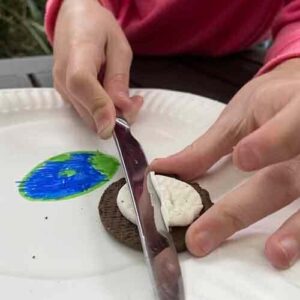
-
Continue to scrape away the cream filling from the biscuit halves until you have the following 8 phases of the moon represented and in order around the plate:
-
- New moon.
- Waxing Crescent.
- First Quarter.
- Waxing Gibbous.
- Full moon.
- Waning Gibbous.
- Third Quarter.
- Waning Crescent.
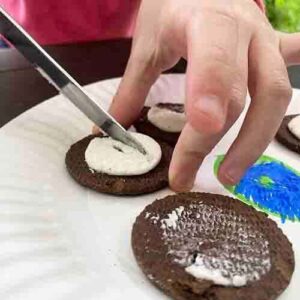
-
-
Write each moon phase in order around the edge of the plate. Add arrows between each cookie and make sure that cookie represents the right moon phase.

-
All finished! Time to eat your moon phases too 🙂

-
Go further – buy 5 x student activity sheets as extension worksheets.
This student science booklet has been created by experienced science educators from the Fizzics Education team.
Use these student worksheets as blackline masters for your science class!


-
School science visits since 2004!
– Curriculum-linked & award-winning incursions.
– Over 40 primary & high school programs to choose from.
– Designed by experienced educators.
– Over 2 million students reached.
– Face to face incursions & online programs available.
– Early learning centre visits too!

-

The science behind it
More information
Weirdly, it takes 27 days, 7 hours & 43 minutes for the moon to complete an orbit around the Earth however the cycle of the 8 Moon phases take 29.5 days due to changes in the relative position of the Sun, Moon and the Earth.
New Moon
- Occurs when the Moon is between the Earth and the Sun, making the illuminated side of the Moon face away from us
Waxing Crescent
- The beginnings of the Moon to have its surface illuminated where we can see it.
First Quarter
- Half of the Moon is illuminated as the Moon continues it becomes more lit up by the Sun (on the way to Full Moon).
Waxing Gibbous
- The Moon is almost now completely illuminated and we’re on our way towards the Full Moon
Full Moon
- Occurs when the Earth is between the Moon and the Sun, so that when we look at the Moon its entire face is illuminated.
Waning Gibbous
- The Moon begins to become less illuminated as we travel towards New Moon.
Third Quarter
- Half of the Moon is now in darkness, due to the position of the Sun causing shadowing on half of the Moon,
Waning Crescent
- Almost the whole surface of the Moon is now in darkness, as the illumination is nearly all on the side of the Moon that we can’t see. Next step, back to New Moon!
You can model the phases of the Moon with a lamp, ball and Earth model.

Teacher's note
Curriculums change, and so does the way you implement them in your classroom. Please use your own experience and knowledge of your students to use these resources to best effect for student learning.
Still want the curriculum links?
Here are the suggested links:
Australian Curriculum (ACARA) Science:
NSW Science syllabuses:
Victorian Curriculum Science:
Want this experiment — and many more — running in your classroom?
Have us visit your school — every student gets three hands-on experiments in 60–90 minutes with a qualified presenter.








