
Test your taste buds!
Learn about proving and disproving theories with the classic primary school experiment of making a tongue taste map! Simple to do at home or the classroom!
Adult supervision for setup

You will need
- Four cups of water
- Wooden tongue depressors, i.e. icecream sticks
- Lemon juice; be aware of potential citrus allergies!
- Salt
- Sugar
- A taste test subject!
Method
-
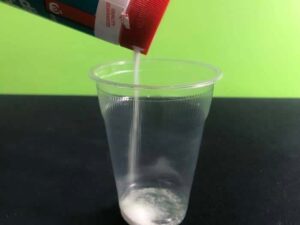
Dissolve sugar crystals into one cup, salt into another cup and pour lemon juice into a third cup.
Leave the fourth cup as a ‘control’, i.e. something you can compare against.
-
Mix a wooden ice-cream stick through one solution and place it on the tip of your tongue.
Record the taste i.e salty, bitter, sweet, no taste. Wash your mouth out with pure water.
Now repeat steps 3 and 4 for the back, sides and middle of your tongue.

-
Were there areas of the tongue that didn’t strongly sense the taste?
Now repeat the steps 3, 4 and 5 for the other solutions.
What were your results? Now read below to find out true answer…
Maybe try blind folding a friend, can they tell which solution is which?
-
School science visits since 2004!
– Curriculum-linked & award-winning incursions.
– Over 40 primary & high school programs to choose from.
– Designed by experienced educators.
– Over 2 million students reached.
– Face to face incursions & online programs available.
– Early learning centre visits too!

-

-
Get the Unit of Work on the human body here!
- Learn about the major body systems
- Dive into the five senses
- How does digestion, respiration, circulation and many other processes work and more!
Includes cross-curricular teaching ideas, student quizzes, a sample marking rubric, scope & sequences & more

The science behind it
Why Does This Happen?
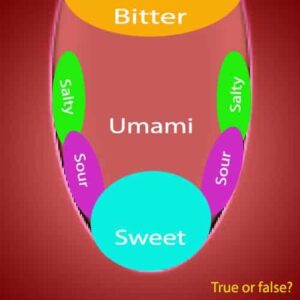
‘Tongue taste maps’ have been a classic experiment for primary school-aged children for many years. Many textbooks will incorrectly reveal that there are indeed areas of taste on your tongue, i.e. some areas taste salt better than sugar etc. The problem is that this has been based on faulty science!
There are no specific areas on your tongue exclusively for salt, sugar or sour tastes.
The popular belief that there are specific taste areas over the tongue comes from a German study conducted in 1901, where the information presented was not clear and thus misinterpreted!
Your sense of taste comes from small structures called taste buds, collectively called ‘papillae’. These papillae occur on top of the tongue, epiglottis and soft palate within your mouth. Sensitivity to all tastes is apparent throughout the tongue, with stronger sensations being produced in different areas due to differing numbers of papillae on the tongue. There are five taste sensations: sweet, sour, bitter, savoury and salty. Your food’s taste comes from a mixture of signals being sent to the brain from the papillae within your mouth.

Teacher's note
Curriculums change, and so does the way you implement them in your classroom. Please use your own experience and knowledge of your students to use these resources to best effect for student learning.
Still want the curriculum links?
Here are the suggested links:
Australian Curriculum (ACARA) Science:
NSW Science syllabuses:
Victorian Curriculum Science:
Want this experiment — and many more — running in your classroom?
Have us visit your school — every student gets three hands-on experiments in 60–90 minutes with a qualified presenter.








