
Water Density and Ocean Currents
Get a better undersanding of how water density affects or ocean currents with this great experiment that kids can do at home or in the classroom!
Adult supervision for setup

You will need
- One clear 5 litre plastic container with a lid
- Two 1-litre measuring bowls filled with water
- Red and blue food colouring
- Modelling clay
- Salt and a measuring spoon
Method
-
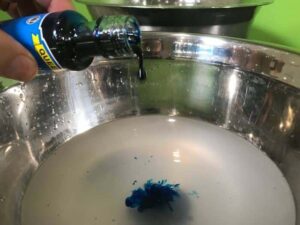
Add four drops of blue food colouring to one bowl and 4 drops of red food colouring to the other bowl. Be careful, if the colours are too strong you may not be able to see the result clearly.
-
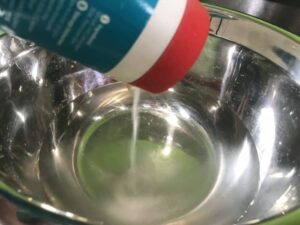
Add at least twelve tablespoons of salt to the blue solution. Stir well to dissolve all the crystals.
-
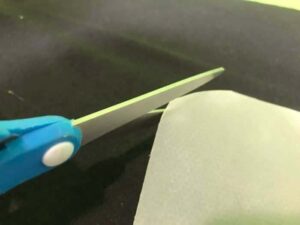
Cut your plastic lid in half so that it can be inserted into your container vertically. Try to make the the shape of the cut lid match the inner contour of your container as much as possible. If you dont want to use the lid, cardboard will work however it will not be as re-usable.
-
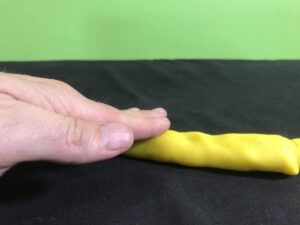
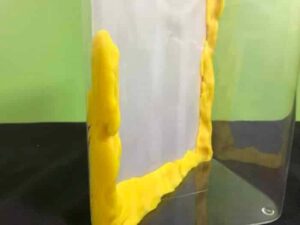
Roll out some moulding clay into a ‘snake’. Place the ‘snake’ around the edges of the lid, making sure that the clay is adhered to bothe sides of the lid. Insert the lid into the container.
-
Carefully seal all gaps between the plastic surfaces with the moulding clay
-
Gently pour both liquids at the same time into the container, one side red and the other blue. If too much is added on one side the uneven water pressure may cause your lid seals to break.
You should now have a container with two different coloured liquids separated by a plastic lid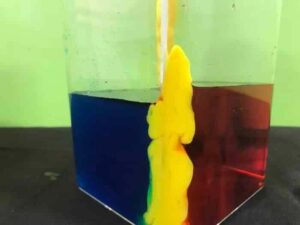
-
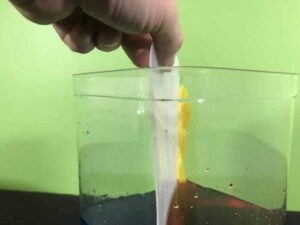
In one movement, pull the lid vertically out of the container. The two different solutions will now mix together. If all has gone well you should find that the blue saline solution will clearly be below the red freshwater as two distinct regions.
-
School science visits since 2004!
– Curriculum-linked & award-winning incursions.
– Over 40 primary & high school programs to choose from.
– Designed by experienced educators.
– Over 2 million students reached.
– Face to face incursions & online programs available.
– Early learning centre visits too!
-
Get the Ocean Science Unit of Work!
Dive into ocean science as we look at the abiotic factors that affect life in our oceans.
- How far does light pass through water?
- How does pressure change as we go deeper underwater?
- How do ocean currents form and more!
Includes cross-curricular teaching ideas, student quizzes, a sample marking rubric, scope & sequences & more

-

The science behind it
Why Does This Happen?
The Science of Water Density and Ocean Currents
Put simply, an object’s density is related to the amount of “stuff” in a given space. In scientific terms, density is the ratio of an object’s mass to its volume (Density = Mass ÷ Volume). By adding salt to the water, you increased its mass without significantly changing its volume, making it denser and causing it to sink below the freshwater. On average, seawater contains about 35 grams of dissolved salts for every litre of water.
These density gradients are the engine rooms for our global ocean currents. In polar regions, water becomes very cold and salty (as salt is “squeezed out” when sea ice forms), making it incredibly dense. This water sinks to the ocean floor and begins a slow journey toward the equator. To replace this sinking water, warmer surface water from the tropics is pulled toward the poles.
This massive, interconnected system of moving water is known as Thermohaline circulation (from thermo meaning temperature and haline meaning salt). It acts like a giant conveyor belt, redistributing heat around the planet and regulating our climate.
This movement isn’t just about temperature; it’s about life! As these deep, cold currents move, they eventually rise back to the surface in a process called upwelling. This brings nutrient-rich water from the deep ocean up to the sunlight. Australian southern fisheries thrive on these upwellings, as the boost in nutrients supports the tiny plankton that form the base of the entire marine food web.
Variables to test
Find out more on variables here.
-
Liquid Immiscibility
Do you see the same thing occur if you use canola oil instead of freshwater? Oil is less dense than water, but unlike salt, it won’t mix (it is insoluble). How does this affect the layers? -
Solute Type
What happens if you replace the salt with sugar? Sugar also increases the density of water, but does it take more or less sugar to make the water sink as fast as the salt solution? -
Saturation Levels
What happens if you keep adding salt until no more can dissolve (creating a saturated solution)? Does the speed of the sinking current increase with the concentration of salt? -
Temperature Interaction
Try using hot salty water versus cold freshwater. This pits thermal expansion against salinity—which factor do you think has a stronger effect on the water’s density?
Remember to change only one variable at a time to ensure your results are valid. This is the key to a successful scientific investigation!

Teacher's note
Curriculums change, and so does the way you implement them in your classroom. Please use your own experience and knowledge of your students to use these resources to best effect for student learning.
Still want the curriculum links?
Here are the suggested links:
Australian Curriculum (ACARA) Science:
NSW Science syllabuses:
Victorian Curriculum Science:
Want this experiment — and many more — running in your classroom?
Have us visit your school — every student gets three hands-on experiments in 60–90 minutes with a qualified presenter.








