
Ice-cream in a bag
See how to make your own ice cream with easy to find and cheap materials. Easy to make, Part of > 150 free science experiments
Adult supervision for setup

You will need
- Half a cup of milk
- Half a cup of cream
- Chocolate or strawberry topping
- A medium strong plastic freezer bag
- 2 Zip-loc bags
- Half a cup of salt
- Crushed ice and a hand towel
- A mixing bowl
- A spoon
Method
-
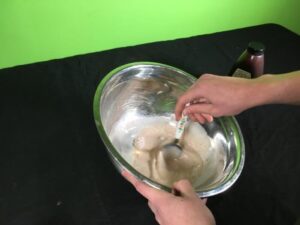
Mix the milk, cream and topping in the mixing bowl.
-
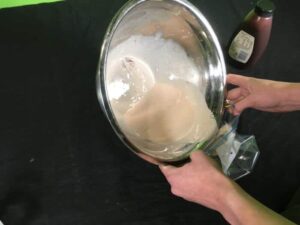
Pour the mixture into a Zip-loc bag.
-
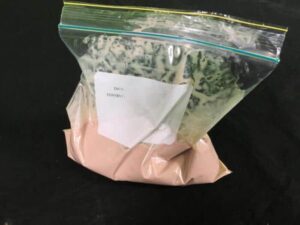
Squeeze the air out of the bag and seal it.
-
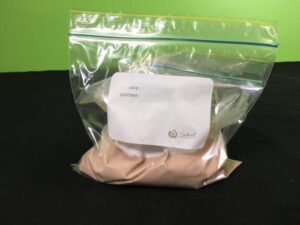
Place the bag with the mixture into another bag, and seal it again.
-
In the mixing bowl, mix the crushed ice and table salt.
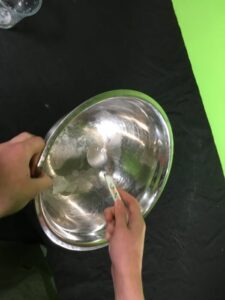
-
Place the Zip-loc bag containing the mixture into a freezer bag.
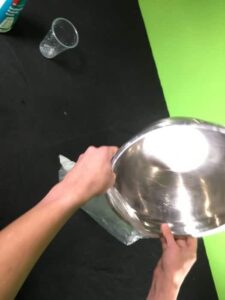
-
Fill the freezer bag with the crushed ice and salt mixture.
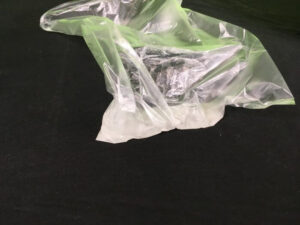
-
Place your sealed bag of cream mixture into the freezer bag with crushed ice and salt. Push out the air and seal the bag.
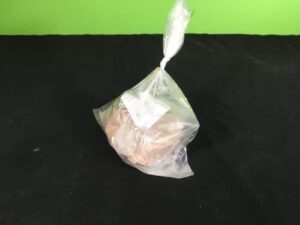
-
Holding the bag in a hand towel, gently massage or shake the freezer bag to cool the ice cream mixture. Make sure the crushed ice surrounds the inner Zip-loc bag.
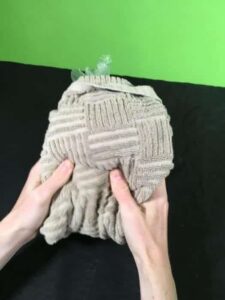
-
After about 15 – 20 minutes of gently moving the ice around the bag of cream, your ice cream is ready to eat!

-
Get the Unit of Work on Heat Energy here!
- What actually is heat?
- How does heat move through different materials?
- How does heat change the properties of materials and more!
Includes cross-curricular teaching ideas, student quizzes, a sample marking rubric, scope & sequences & more

-
School science visits since 2004!
– Curriculum-linked & award-winning incursions.
– Over 40 primary & high school programs to choose from.
– Designed by experienced educators.
– Over 2 million students reached.
– Face to face incursions & online programs available.
– Early learning centre visits too!

-

The science behind it
Why Does This Happen?
The Science of Ice Cream in a Bag
Normally, pure water freezes at 0°C. However, when you add salt to ice, you are witnessing a phenomenon called freezing point depression. The salt disrupts the ability of water molecules to form a solid crystalline structure (ice), requiring much colder temperatures for freezing to occur.
By adding salt to your ice bag, you lower the freezing point significantly. For instance, a 10% salt solution lowers the freezing point to -6°C, while a 20% solution can drop it as low as -16°C. This creates a “supercooled” saltwater slush that stays liquid at temperatures far below the normal freezing point of water.
Because this saltwater slush is much colder than regular ice, it can pull thermal energy (heat) away from the cream mixture inside the inner bag much faster. As the cream loses heat to the surrounding salt-ice mixture, the fat and water molecules inside the cream begin to slow down and bond together, transforming the liquid into delicious, solid ice cream!
Variables to test
Find out more on variables here.
-
Solute Concentration
Try the experiment without salt. Without the freezing point depression effect, can the ice get the cream cold enough to freeze before it all melts? -
Thermal Intensity
With heavy-duty gloves on and adult supervision, try using dry ice (solid CO2) instead of salt and ice. Since dry ice is -78.5°C, how does this extreme temperature gradient affect the freezing time and texture? -
Fat Content & Viscosity
Try pure thickened cream versus a mixture of cream and water. How does the concentration of fat globules change the smoothness and the time required for a phase change? -
Agitation Speed
Does shaking the bag faster result in smoother ice cream? Shaking helps break up large ice crystals as they form, which usually results in a creamier texture.
To ensure your results are valid, try to keep the starting temperature of your cream the same for every test. This ensures that any change in freezing time is due to the variable you are testing!

Teacher's note
Curriculums change, and so does the way you implement them in your classroom. Please use your own experience and knowledge of your students to use these resources to best effect for student learning.
Still want the curriculum links?
Here are the suggested links:
Australian Curriculum (ACARA) Science:
NSW Science syllabuses:
Victorian Curriculum Science:
Want this experiment — and many more — running in your classroom?
Have us visit your school — every student gets three hands-on experiments in 60–90 minutes with a qualified presenter.








