
Make Coloured Shadows
Create cool and colourful shadows with this Amazing Science Experiment! Test how many different colours you can see and have fun doing it 🙂
Adult supervision for setup
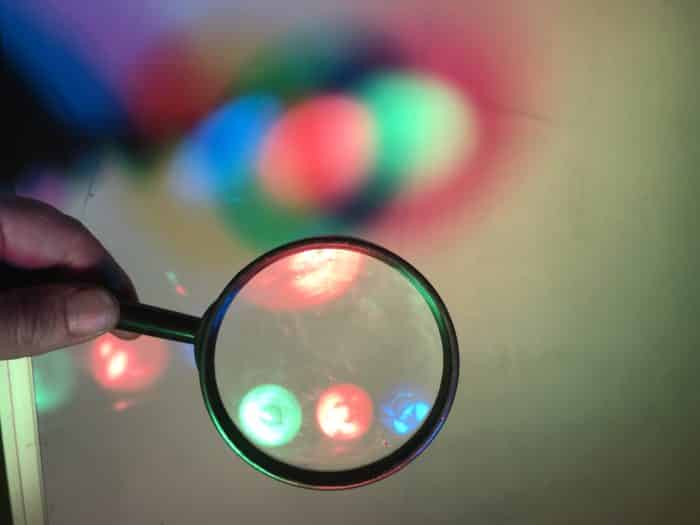
You will need
- Three strong flashlights
- Red, blue and green cellophane
- Three rubber bands
- A clean whiteboard or wall
- A dark room
- Optional: A magnifier for focusing the light
- Note: If you have red, green and blue spotlights, use them instead of the torch and cellophane.
Method
-
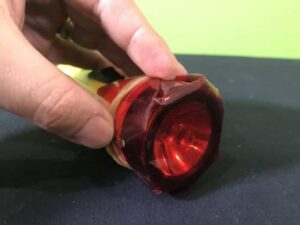
Place the red cellophane over the flashlight so that the light is coloured red. Secure with a rubber band.
-
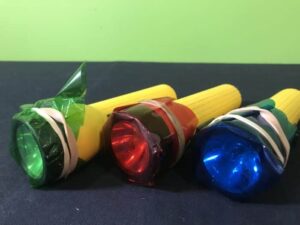
Repeat the process, so that you have a ‘green flashlight’ a ‘blue flashlight’ and a ‘red flashlight’ to use.
-
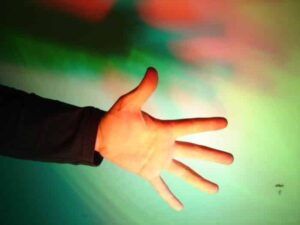
Shine all of the flashlights onto the wall, angle all the torches until you see a faint white light on the wall. Try placing objects in front of the lights to make shadows. What colours do you make? Why?
-
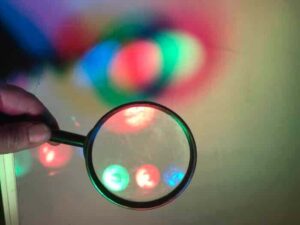
Try placing a magnifier into the lights to form an image on the white screen of the lamps! As you move the magnifier closer to the white screen you should be able to show that the individual coloured light images converge and then mix together.
-
School science visits since 2004!
– Curriculum-linked & award-winning incursions.
– Over 40 primary & high school programs to choose from.
– Designed by experienced educators.
– Over 2 million students reached.
– Face to face incursions & online programs available.
– Early learning centre visits too!
-

-
Get the Unit of Work on Light & Colour here!
- What is colour addition vs subtraction?
- What is opacity, translucence & transparency?
- What is the difference between refraction & reflection?
- Explore UV light, lenses, thermochromism and more!
Includes cross-curricular teaching ideas, student quizzes, a sample marking rubric, scope & sequences & more
The science behind it
Why does this work?
The Science of Coloured Shadows
Most people think of shadows as being grey or black, but they can actually be incredibly vibrant! This experiment explores Additive Colour Theory, showing how the primary colours of light combine to create white light and various secondary colours.
Colour Addition
White light is comprised of all the colours of the rainbow. By using three torches with red, green, and blue filters, you are working with the primary colours of light. When these three overlap perfectly, they “add up” to produce white light.
- Primary Colours: Red, Green, and Blue (RGB).
-
Secondary Colours: These are formed when only two primary colours overlap:
- Red + Blue = Magenta
- Blue + Green = Cyan
- Red + Green = Yellow
Why are the shadows coloured?
When you place an object (like a stick) in front of the three light sources, it blocks light from each torch at a slightly different angle.
A “coloured shadow” appears because the object might block the red light, but the blue and green light can still reach that exact spot on the wall. Since Blue + Green = Cyan, you see a cyan shadow! The colour of the shadow is actually the combination of whatever light sources weren’t blocked by the object.
Colour addition simulator
This is for red, green and blue light (not paint).
Variables to test
Find out more on variables here.
-
Filter Variation
Try different coloured cellophane filters. What happens to the “white” centre if you use two reds and one blue? How does spectral balance affect the outcome? -
Surface Reflectance
Try shining the coloured lights on walls that have different colours. How does a yellow wall change the appearance of your cyan shadow? (Hint: The wall itself will absorb some of the reflected light!) -
Distance and Sharpness
Move the object closer to the wall and then closer to the torches. How does the angle of incidence change the size and blurriness (the penumbra) of the coloured shadows?

Teacher's note
Curriculums change, and so does the way you implement them in your classroom. Please use your own experience and knowledge of your students to use these resources to best effect for student learning.
Still want the curriculum links?
Here are the suggested links:
Australian Curriculum (ACARA) Science:
NSW Science syllabuses:
Victorian Curriculum Science:
Want this experiment — and many more — running in your classroom?
Have us visit your school — every student gets three hands-on experiments in 60–90 minutes with a qualified presenter.








