
How can icebergs be blue and why is this related to sunsets?
Why are icebergs blue & why is this related to sunsets? In this fun and messy experiment we try and demonstrate why this is! Click to find out more!
Adult supervision for setup
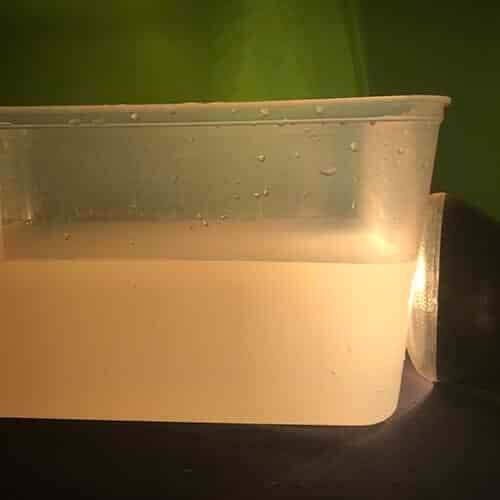
You will need
- One large clear container filled with 5 litres of water
- Milk
- A strong source of light, eg. spotlight, projector lamp
- A darkened room
Method
-
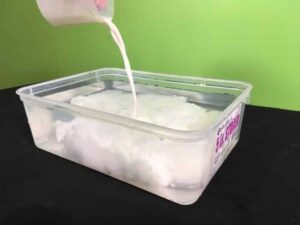
Pour about 100ml of milk into the water. It is often best to use only a little at first. Try the following steps out and only add more if the intended effects is not apparent.
-
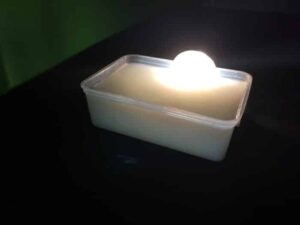
Turn the spotlight on and darken the room
-
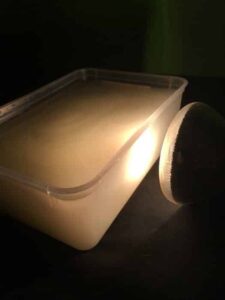
Turn the light to face the milky water.
-
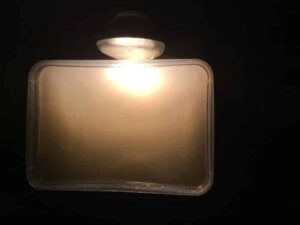
The water near the milk will look white, yet if you look on the other side of the container the colour should be a mixture of orange and red. Something has been happened to the light as it passes through the milk solution.
-
School science visits since 2004!
– Curriculum-linked & award-winning incursions.
– Over 40 primary & high school programs to choose from.
– Designed by experienced educators.
– Over 2 million students reached.
– Face to face incursions & online programs available.
– Early learning centre visits too!
-

The science behind it
Why Does This Happen?
The demonstration just performed is a classic way of showing how sunsets work. White light is comprised of all of the colours of the rainbow i.e. the light spectrum. The different colours you see represent the different wavelengths of light.
An orange object is only ‘orange’ when you see the orange wavelength of light being reflected off it.
When light travels through a substance, some of the visible light wavelengths are absorbed whilst the other light is reflected. As the light entered the milk solution the light in the blue end of the visible spectrum was scattered by the suspended milk solids. This left the lower energy wavelengths of orange and red to pass through the solution, creating the orange/red colour seen in the experiment.
So how does this relate to sunsets?
The daytime sky appears blue because this blue light is scattered more readily towards us, known as Rayleigh scattering. During sunset the sunlight is still scattered, however, the blue light is scattered away from our eyes leaving the oranges and reds you see.
So how does this relate to blue icebergs?
In an average iceberg, there are large amounts of trapped air bubbles. The air scatters the light passing through the iceberg and all the visible wavelengths of light toward you, making it appear white.
However, an iceberg formed underwater, away from the air, will have little to no air bubbles within it.
Passing light through such an iceberg will have the weaker red wavelength of light be absorbed by the ice, leaving the more high energy blue light to pass through the iceberg and into your eye, and so you see it as being blue.
Note: Mixing coloured light together always makes white; this is known as colour addition.
Variables to test
- Try differing amounts or types of milk
- Does this still work with different strength lights?
- What happens if you use a coloured light instead?
Teacher's note
Curriculums change, and so does the way you implement them in your classroom. Please use your own experience and knowledge of your students to use these resources to best effect for student learning.
Still want the curriculum links?
Here are the suggested links:
Australian Curriculum (ACARA) Science:
NSW Science syllabuses:
Victorian Curriculum Science:
Want this experiment — and many more — running in your classroom?
Have us visit your school — every student gets three hands-on experiments in 60–90 minutes with a qualified presenter.








