
Make Your Own Bite Impression
Create your own bit impression to look at your teeth.
Adult supervision for setup

You will need
- Carbon paper
- Normal paper
- Dough
Method
-
Mix the ingredients together and knead the dough until soft.
Spread the dough onto wax paper and cut round shapes using a knife, jar, glass or cookie cutter.
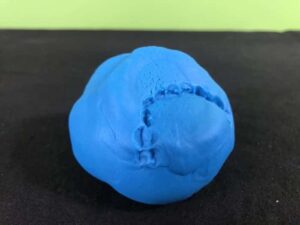
Press objects into the soft dough to make ‘fossil’ impressions.
The dough can be left to harden overnight.
-
See if you can pick out your individual teeth and decide how they would be best used, side to side plant chewing, or sharp cutters for tearing meat.
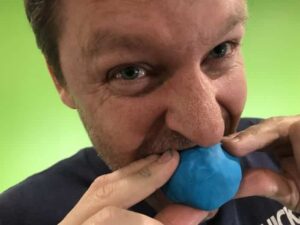
You can also get an impression of your teeth by biting into some dough, just ignore the taste!
Get the bite of your family and friends!
-
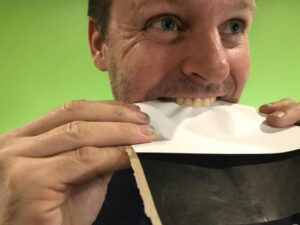
Try biting down on a folded piece of paper with a slip of carbon paper inside. Does this work too?
-
School science visits since 2004!
– Curriculum-linked & award-winning incursions.
– Over 40 primary & high school programs to choose from.
– Designed by experienced educators.
– Over 2 million students reached.
– Face to face incursions & online programs available.
– Early learning centre visits too!
-

-
Get the Unit of Work on the human body here!
- Learn about the major body systems
- Dive into the five senses
- How does digestion, respiration, circulation and many other processes work and more!
Includes cross-curricular teaching ideas, student quizzes, a sample marking rubric, scope & sequences & more
The science behind it
Why Does This Happen?
Biting into dental moulds is an essential step in dentistry that allows dentists to create accurate dental models, which can be used to plan and execute dental operations. These moulds are made of a putty-like material that hardens after it is placed in the patient’s mouth for a few minutes, creating a replica of their teeth and gums. The moulds are then used to create casts, which are 3D replicas of the patient’s teeth and gums.
Dental casts provide a detailed and accurate representation of the patient’s oral anatomy, allowing dentists to study the structure of their teeth, gums, and jaw. By examining these models, dentists can identify any issues with a patient’s oral health and plan treatments accordingly. For example, if a patient has misaligned teeth, the dentist may use the cast to plan a course of orthodontic treatment to realign the teeth.
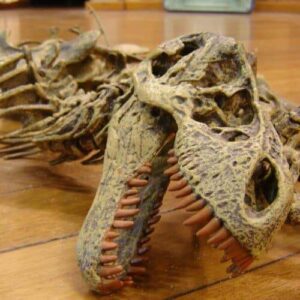
The use of casts and moulds in dentistry has some similarities to the process of creating casts and moulds for dinosaur fossils. When paleontologists discover a dinosaur fossil, they carefully extract it from the ground and create a mould of the bones using a similar putty-like material used in dentistry. This mould is then filled with plaster or another material to create a 3D replica of the bones.
Just as dental casts allow dentists to study the structure of a patient’s teeth and gums, dinosaur fossil casts provide paleontologists with a detailed look at the anatomy of the dinosaur. This information can help them understand how the dinosaur moved, what it ate, and how it interacted with its environment.
In both dentistry and paleontology, casts and moulds are essential tools that provide valuable information to professionals in their respective fields. Whether it’s planning a dental procedure or studying a dinosaur’s anatomy, these 3D replicas provide an accurate and detailed look at the subject, helping professionals to make informed decisions and discoveries.

Teacher's note
Curriculums change, and so does the way you implement them in your classroom. Please use your own experience and knowledge of your students to use these resources to best effect for student learning.
Still want the curriculum links?
Here are the suggested links:
Australian Curriculum (ACARA) Science:
NSW Science syllabuses:
Victorian Curriculum Science:
Want this experiment — and many more — running in your classroom?
Have us visit your school — every student gets three hands-on experiments in 60–90 minutes with a qualified presenter.








