
Extract DNA
Extract DNA from bananas, strawberries & more using easily accessible materials. An easy experiment to do at home or in the classroom!
Adult supervision for setup

You will need
- 2 clear plastic cups
- wooden kebab stick or similar
- Methylated spirits
- Detergent
- Salt
- ‘Chux’ wipe (kitchen cloth).
- Banana or strawberries
- Warm and cold water nearby
- Resealable plastic bag (eg. Zip-Loc TM )
- Rubber band (optional)
Method
-
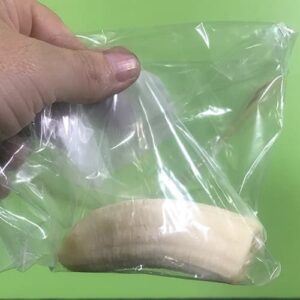
Peel a banana and place half of it into a resealable zip-loc bag and close the bag. You can also use another cup instead if you don’t have a zip-loc bag.
-
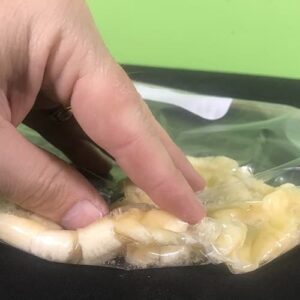
On a hard surface like a tabletop or kitchen counter, mush the banana in the bag for about a minute.
-
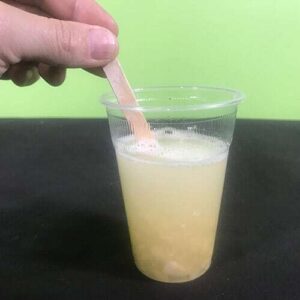
Fill a cup with a half cup of warm water, a teaspoon of salt and a half of a teaspoon detergent. Mix the contents gently, mashing the banana as much as possible. You do not want the mixture to become too foamy. The mechanical movement breaks apart the cell walls, the detergent breaks the cell membranes and the salt brings the DNA (Deoxyribose Nucleic Acid) into solution.
-
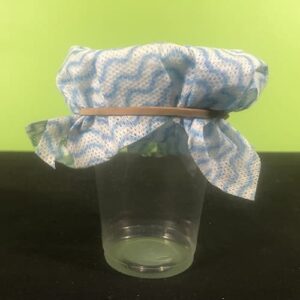
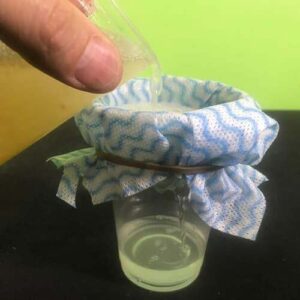
Place the bottom half of a filter cloth in a clear cup. The top part of the filter should be folded over the rim of the glass to keep it in place. You can use a rubber band to secure the cloth, or simply hold it in place with one hand. Gently push down with your hand in the middle of the cloth to form an indentation.
-
“Strained crushed banana for DNA extraction… just needs methylated spirits”
Carefully pour the contents of the bag into the filter made out of a kitchen cloth and let it sit for several minutes until all of the liquid has dripped down into the cup. (You can now throw out the filter and its mushy contents).
-
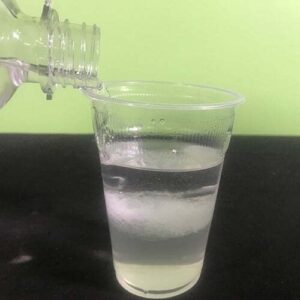
“Methylated spirits precipitating DNA out of banana solution “
With the help of an adult, tilt the cup and slowly pour the methylated spirits down the side of the cup until there is a layer that is 2.5 to 5 centimetres thick. You want to keep the alcohol and the liquefied banana as separate as possible, so perform this step slowly. The methylated spirits precipitates the DNA out of solution.
-
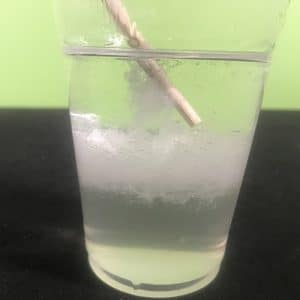
You should see what looks like fine white threads suspended between the two layers of liquid. This is precipitated DNA!
-
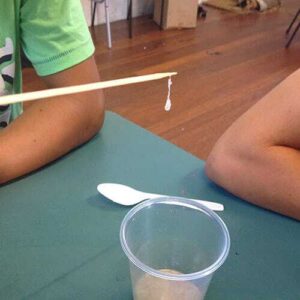
Stick the wooden skewer into the cup and stir the boundary layer between the two liquids. Spin the wooden skewer in place so that cloudy layer spools around it. Remove the stirrer and capture some of the stringy middle layer on your stirrer. The substance that you see on the stirrer is DNA!

-
Try this another time with cold water to see if there is a difference in the amount of DNA your extract (variable testing!)
-
School science visits since 2004!
– Curriculum-linked & award-winning incursions.
– Over 40 primary & high school programs to choose from.
– Designed by experienced educators.
– Over 2 million students reached.
– Face to face incursions & online programs available.
– Early learning centre visits too!
-

The science behind it
Why does this DNA extraction work?
Through this procedure, you were able to extract the separate strands of DNA out of nuclei of the banana cells. The detergent broke apart the cellular membranes and the salt binds to the DNA to make it less able to remain soluble in water (it neutralizes the charge of the DNA and it is less able to bind to water). Once the DNA was in the banana solution, you were able to use methylated spirits to precipitate DNA out of the solution as DNA is insoluble in alcohol-based solutions.
Facebook Live video on extracting DNA
Join us on our Facebook site for live science!
https://www.facebook.com/fizzicseducation/videos/305920097006437/
Basics background information on DNA
Deoxyribonucleic Acid (DNA) was first identified and isolated by Friedrich Miescher in 1871, and the double helix structure of DNA was first discovered by James Watson and Francis Crick, using experimental data collected by Rosalind Franklin and Maurice Wilkins. DNA is found in the nucleus of living cells and it is this complex chemical that codes for how living things grow and function, with this code being transferred to subsequent generations.
DNA has a basic structure of a sugar-phosphate backbone with 4 base pairs that alternate through the middle of the helix. The standard picture you see is a helical structure as below, however, there are several ways the DNA helix is known to spiral, including left and right-handed versions.
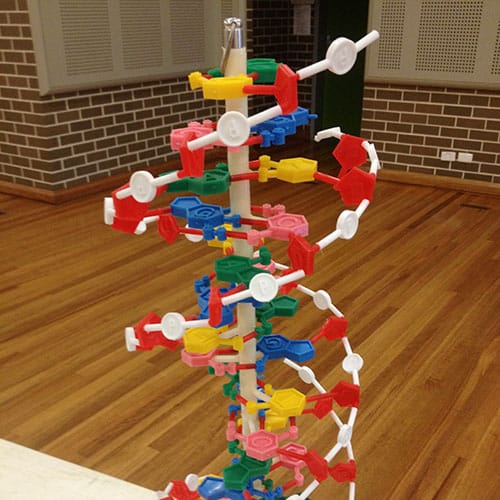
DNA model:
Red = Ribose sugar,
White = Phospate
Pink, Blue, Yellow and Green = the Base pairs (Guanine/Cytosine & Adenine/Thymine)
There are 4 base pairs within DNA which always pair the same way, Guanine binds with Cytosine and Adenine binds with Thymine. The amazing thing about DNA is that it’s the alternating base pairs that creates the genetic code of every known living thing, from a butterfly to an elephant. Segments, or pieces, of DNA are called “genes”. Each gene determines something about our bodies—a trait. In our DNA there are genes that are responsible for hair colour, eye colour, earlobe shape and so on. Some characteristics, like eye colour, are more or less determined directly by DNA whereas other traits are determined both by DNA and by your environment as you grow up such as how tall or short you become as an adult (due to potential differences in diet). DNA is constantly maintained in cells by a number of enzymes, allowing for insertion errors and random mutations to be removed however not all of these are caught and as such the DNA slowly changes over time (helping to cause aging in the process).
Every human share 99 percent of his or her DNA with every other person, most likely due to a major event that nearly brought the human species of the brink of extinction thousands of years ago. We share most of our genes with fellow primates such as chimpanzees and with other mammals such as mice. We even have genes in common with the banana plant!
Further reading
Genetics is a very complex subject and a simple DNA extraction experiment is only just starting the journey! We recommend you spend some time reading up on some extra sites to further your knowledge:
Article on Journal of Nature (high school and university level but great overview)
Teacher's note
Curriculums change, and so does the way you implement them in your classroom. Please use your own experience and knowledge of your students to use these resources to best effect for student learning.
Still want the curriculum links?
Here are the suggested links:
Australian Curriculum (ACARA) Science:
NSW Science syllabuses:
Victorian Curriculum Science:
Want this experiment — and many more — running in your classroom?
Have us visit your school — every student gets three hands-on experiments in 60–90 minutes with a qualified presenter.








