
Erupt a Volcano
Science lesson resources for kids from Preschool and Secondary school. Make science fun with Fizzics
Adult supervision for setup
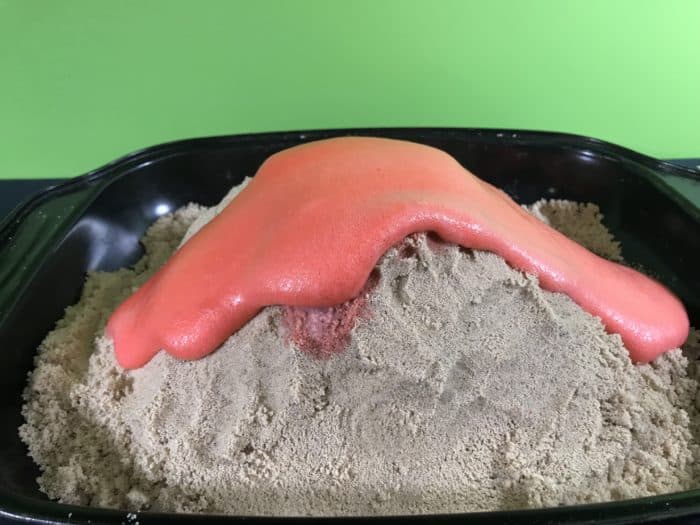
You will need
- 100 mL Vinegar
- 4 tablespoons of bicarbonate soda mixed in 150mL water
- 150mL Detergent
- A few drops of Orange or Red Food Colouring
- A 500mL container
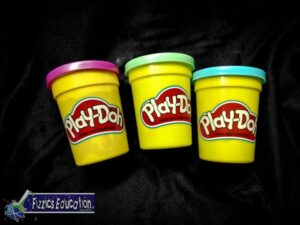
- And for a more realistic looking volcano, brown coloured play dough
Method
-
Mix the detergent, food colouring and vinegar in the 500 mL container.
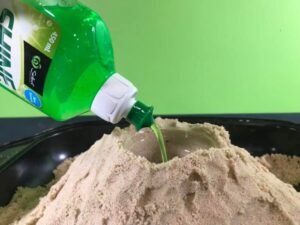
-
Put the mixture outside, or at least in a place where you are allowed to get messy.
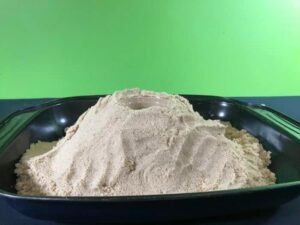
-
Mix the bicarbonate soda and water into a glass and stir.
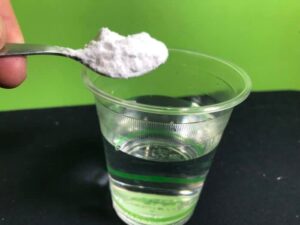
-
Pour the Bicarbonate soda and water mixture into the 500mL container; the container with your detergent, food colouring and vinegar mixture.
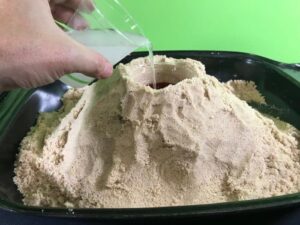
-
And Stand back.
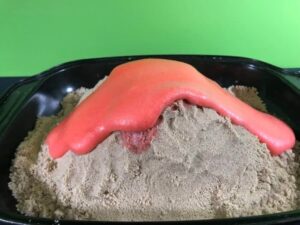
-
If you want, you can make a mode of a volcano out of the playdough or plaster to. You could even 3D print one!
-
Live remote classes with experienced distance educators
Discover >30 virtual workshops designed to engage students isolated at home.
- Direct curriculum links
- Up to 30 homes can connect together.
- Live classes – students can question & answer our educators and participate in experiments using household materials
- Simple connection via one-click connect
- Based on 10 years of distance education experience & global best practice
Multi-award-winning distance classes available to keep up student enthusiasm & enrichment!
The science behind it
Why Does This Happen:
Reacting vinegar and bicarbonate soda together produces carbon dioxide and water.
The reaction is as follows
Vinegar + Bicarbonate Soda —> Carbonic Acid + Sodium Acetate
The carbonic acid is unstable though, so it breaks down into liquid water and carbon dioxide as a gas, causing the massive ‘build up’ of pressure you saw in the experiment.
The water is left in the vinegar solution whilst the carbon dioxide rises and fills the balloon on the bottle.
The Continental Drift theory put forward by Alfred Wegener in 1912 describes the Earths outer layer, the crust, as being made up of giant ‘plates’ that drift apart and together over millions of years. These plates, now known as tectonic plates, sit on the outer mantle of the Earth known as the asthenosphere. The asthenosphere contains solid rock that moves like a very slow fluid over geological time because of enormous pressures within the the Earth. The movement of the asthenosphere carries the tectonic plates together and apart.
It is along these divergent and convergent plate boundaries where earthquakes and volcanic eruptions mainly occur, as well as mountain and ocean trench creation.
Other areas for volcanic activity are ‘hotspots’ far from the plate boundaries. These are areas where the hot magma from the outer mantle has melted the crust, forming a vent for a volcano to form. Once magma is erupted from the a volcano it is called lava, which can be between 700°C and 1200°C.
Teacher's note
Curriculums change, and so does the way you implement them in your classroom. Please use your own experience and knowledge of your students to use these resources to best effect for student learning.
Still want the curriculum links?
Here are the suggested links:
Australian Curriculum (ACARA) Science:
NSW Science syllabuses:
Victorian Curriculum Science:
Want this experiment — and many more — running in your classroom?
Have us visit your school — every student gets three hands-on experiments in 60–90 minutes with a qualified presenter.








