
Create a Milk Rainbow
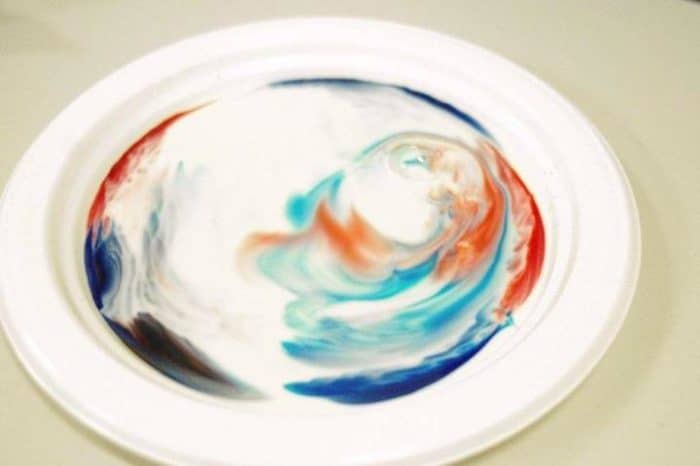
The milk rainbow experiment is a fantastic activity for exploring surface tension, solubility and detergent's action on animal fats. It's also colourful!
Adult supervision for setup
You will need
- Full-cream cow’s milk
- Food Colouring
- Dishwashing detergent
- A saucer
Method
-
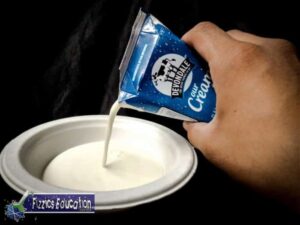
Pour some milk into a saucer (ignoring your cat: this is for the cause of science).
-
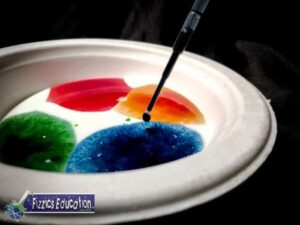
Drop four different colour drops of food colouring near the edge of the saucer.
-
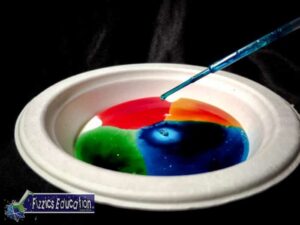
In the centre, add one drop of dishwashing detergent.
-
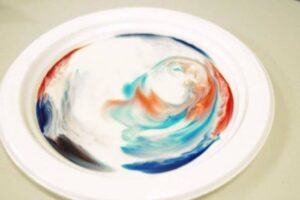
… and watch the result!
-
Get the Unit of Work on Mixtures here!
- How can we separate mixtures?
- What are the different techniques?
- From chromatography to magnetism, join us to explore the variety of ways we can separate mixtures!
Includes cross-curricular teaching ideas, student quizzes, a sample marking rubric, scope & sequences & more
-
School science visits since 2004!
– Curriculum-linked & award-winning incursions.
– Over 40 primary & high school programs to choose from.
– Designed by experienced educators.
– Over 2 million students reached.
– Face to face incursions & online programs available.
– Early learning centre visits too!
-

The science behind it
Why Does This Happen:
The Science of the Milk Rainbow
The “Milk Rainbow” is a beautiful display of surface tension and molecular interaction. Milk is mostly water, but it also contains hidden globules of fat and proteins.
Surface tension acts like an invisible “skin” on the liquid, caused by the cohesive forces between water molecules. When you add a drop of dish detergent, you are introducing a surfactant. Detergent molecules have two ends: one that loves water (hydrophilic) and one that loves fat (hydrophobic).
As soon as the detergent touches the milk, two things happen simultaneously:
- Surface Tension Tug-of-War: The detergent rapidly reduces the surface tension at the point of contact. The surrounding milk still has a higher surface tension and pulls away from the weak spot, dragging the food dye along with it.
- Fat Chasing: The hydrophobic ends of the detergent molecules move through the milk to find and bind to the fat globules. This movement causes the milk to churn and swirl, creating the rainbow patterns as the water-based food dye is carried into the newly available spaces.
Variables to test
Find out more on variables here.
-
Fat Concentration
Try different types of milk, such as skim, full-cream, and cream. Since the reaction depends on lipid (fat) molecules, does the milk with the highest fat content produce the most dramatic movement? -
Thermal Energy
Does the temperature of the milk matter? Heat increases the kinetic energy of molecules and lowers surface tension. Does the rainbow swirl faster in warm milk than in cold milk? -
Alternative Surfactants
Does hand soap or laundry liquid work as well as dish detergent? This tests the efficacy of different chemical cleaners in breaking down surface tension. -
Non-Dairy Alternatives
Try almond, soy, or oat milk. Since these have different protein and fat structures compared to cow’s milk, does the “rainbow” behave differently?
Remember, to keep your experiment valid, try to use the same amount of milk and the same number of drops of food dye for each test!

Teacher's note
Curriculums change, and so does the way you implement them in your classroom. Please use your own experience and knowledge of your students to use these resources to best effect for student learning.
Still want the curriculum links?
Here are the suggested links:
Australian Curriculum (ACARA) Science:
NSW Science syllabuses:
Victorian Curriculum Science:
Want this experiment — and many more — running in your classroom?
Have us visit your school — every student gets three hands-on experiments in 60–90 minutes with a qualified presenter.








