
Make a cartesian diver
Find out about Scuba Steve the Cartesian diver by trying this experiment. Learn about bouyancy using a pipette and some household items.
Adult supervision for setup
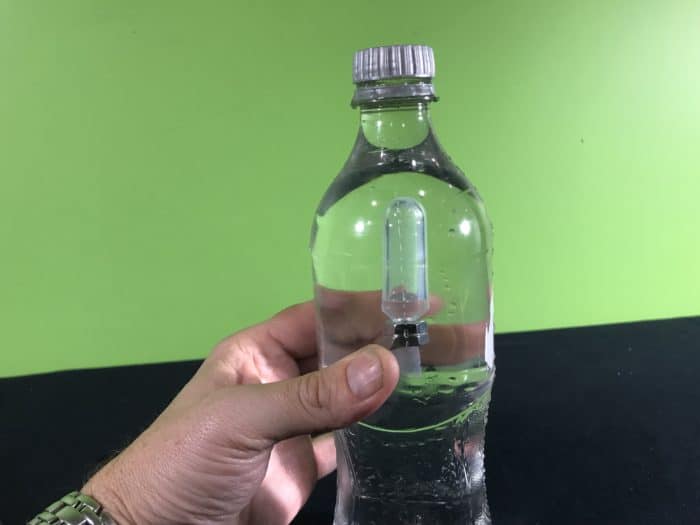
You will need
- A small soft drink bottle
- A plastic pipette
- Water
- Scissors
- Two nuts to fit the pipette
- Optional: a pen lid with plasticine to weight it down (though less effective)
Method
-
Cut the length of the pipette off, leaving 2cm before the bulb.
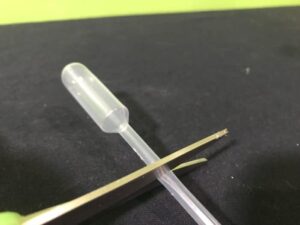
-
Fit two metal nuts to the bottom of the cut pipette (or add plasticine to the pen cap).
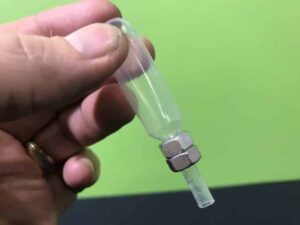
-
Fill the bottle with water all the way to the brim.
Float the cut pipette in the water and adjust the weight to allow it to float.
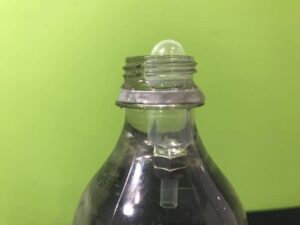
-
Close the bottle and tighten the lid. Ensure that there is no air gap below the lid at all (otherwise you’ll be compressing that air as well and it be harder for the activity to work).
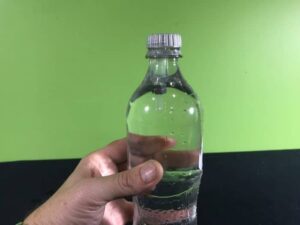
-
Squeeze the bottle and the cartesian diver should sink, letting go the cartesian diver should rise.
As you squeeze the bottle, look inside the pipette and you should see the air bubble get smaller inside. Once you stop squeezing the bottle, the air bubble expands and the cartesian diver becomes more buoyant.
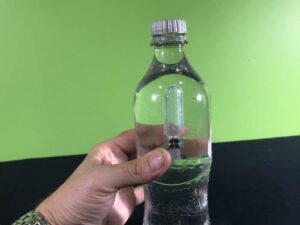
-
School science visits since 2004!
– Curriculum-linked & award-winning incursions.
– Over 40 primary & high school programs to choose from.
– Designed by experienced educators.
– Over 2 million students reached.
– Face to face incursions & online programs available.
– Early learning centre visits too!
-

-
Get the Unit of Work on Pressure here!
Want to dive into air pressure?
Get the 60-minute video + PDFs + curriculum links for your class here!
The science behind it
Why Does This Happen?
The Science of the Cartesian Diver
The Cartesian Diver (also known as SCUBA Steve, SCUBA Sally or Diver Dan) is a classic experiment that demonstrates the relationship between pressure, density, and buoyancy. It relies on two key scientific principles: Pascal’s Principle and Boyle’s Law.
When you squeeze the bottle, you are increasing the pressure on the water. According to Pascal’s Principle, this pressure is transmitted equally throughout the entire fluid. Because water is incompressible (it can’t be squashed), but air is compressible, the pressure forces water up into the opening of the diver, squashing the air bubble inside.
As the air bubble gets smaller, the diver’s overall average density increases because it now contains more water and less air. Once the diver becomes denser than the surrounding water, it loses its buoyancy and sinks. When you release the bottle, the pressure drops, the air bubble expands (Boyle’s Law), the diver becomes less dense, and it floats back to the top!
Real-life SCUBA divers and submarines use this exact same science. Submarines have “ballast tanks” that they fill with water to sink and pump full of air to surface.
Variables to test
Find out more on variables here.
-
Container Volume
Try large versus small bottles. Does the size of the bottle change how much force you need to apply to increase the internal pressure enough to sink the diver? -
Ballast Weight
What happens if you add more weight to the pipette or pen lid? If the diver starts with very little air, does it become neutrally buoyant (hovering in the middle)? -
Alternative Diver Designs
Can you use another device with an air gap inside, like a tomato sauce packet or a Freddo Frog wrapper? This tests if the shape of the air pocket affects the diver’s performance. -
Liquid Density
Does this still work if you change to another liquid, like salty water or oil? Different liquids have different viscosities and densities, which will change how much pressure is required to compress the air.
No matter which variable you try, remember to change only one thing and keep the rest of the experiment the same. This ensures your results are valid and is the foundation of the scientific method!

Teacher's note
Curriculums change, and so does the way you implement them in your classroom. Please use your own experience and knowledge of your students to use these resources to best effect for student learning.
Still want the curriculum links?
Here are the suggested links:
Australian Curriculum (ACARA) Science:
NSW Science syllabuses:
Victorian Curriculum Science:
Want this experiment — and many more — running in your classroom?
Have us visit your school — every student gets three hands-on experiments in 60–90 minutes with a qualified presenter.








