
How drinking bird toys work
Ever wondered how the drinking bird toys work? This is a great experiment to show you and the kids the secrets behind them at home or in school!
Adult supervision for setup
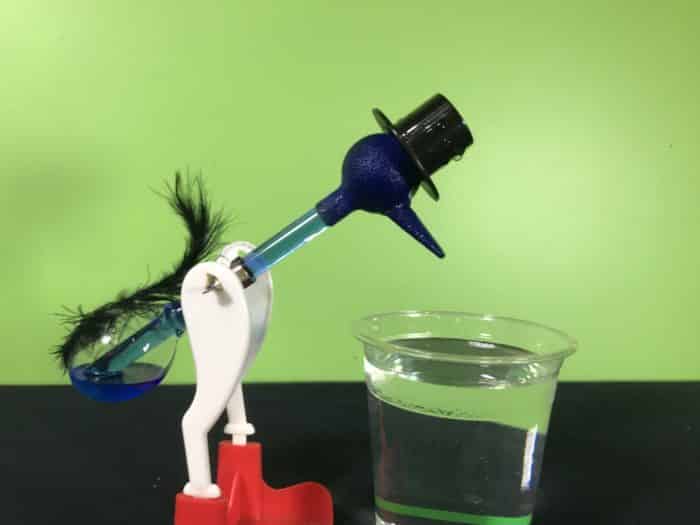
You will need
- A drinking bird toy from our online store
Method
-
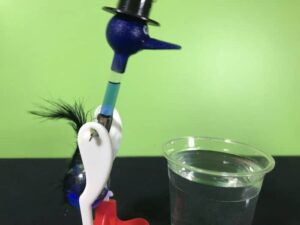
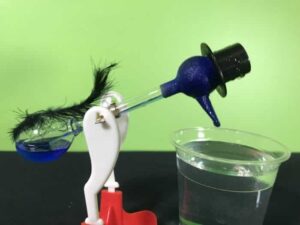
Fill a glass with cold water and place the drinking bird close to the cup so that the bird’s legs are a little higher than the glass.
-
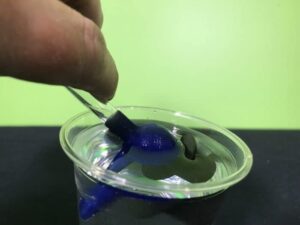
Place the head into the water and make sure it gets completely wet.
-
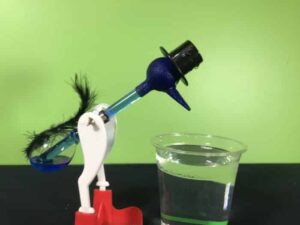
Let go of the drinking bird and it will start bobbing up and down.
If it doesn’t move, adjust the neck of the bird up and down through the collar.
-
This toy tends to work best at about 25°C
-
School science visits since 2004!
– Curriculum-linked & award-winning incursions.
– Over 40 primary & high school programs to choose from.
– Designed by experienced educators.
– Over 2 million students reached.
– Face to face incursions & online programs available.
– Early learning centre visits too!

-

-
Get the Unit of Work on Heat Energy here!
- What actually is heat?
- How does heat move through different materials?
- How does heat change the properties of materials and more!
Includes cross-curricular teaching ideas, student quizzes, a sample marking rubric, scope & sequences & more
The science behind it
Why Does This Happen?
The Science of How Drinking Bird Toys Work
Hands up who likes the Simpsons! Some people might recognise the scene. “It’s drinking the water!” Well, how does it work then? The “Drinking Bird” is a classic scientific toy that looks like a simple decoration but is actually a sophisticated heat engine. It operates by converting thermal energy (heat) into mechanical energy (motion) using the properties of thermodynamics and phase changes.
The Step-by-Step Cycle
-
Evaporative Cooling
When the bird’s felt-covered beak gets wet, water begins to evaporate. Evaporation is an endothermic process, meaning it takes heat away from the glass head, making it colder than the base. -
Condensation and Pressure Drop
Inside the bird is a chemical called methylene chloride, which has a very low boiling point. The cold head causes the vapour inside to condense into a liquid. According to the Ideal Gas Law, as temperature and the amount of gas decrease, the pressure drops. -
Fluid Displacement
The higher pressure in the warm base pushes the liquid up the neck toward the low-pressure head. This shifts the centre of gravity, making the bird top-heavy until it tips over to “drink.” -
Pressure Equalisation
When the bird tips, the bottom of the neck tube rises out of the liquid in the base. This allows a bubble of vapour to travel up the tube, equalising the pressure. Gravity then pulls the liquid back down to the base, making the bird stand upright again to start the process over!
Variables to test
Find out more on variables here.
-
Thermal Energy Gradient
What happens if the bird “drinks” from iced water? Does the colder water slow down the rate of evaporation, or does it help create a larger temperature difference between the head and the base? -
Evaporation Rate
What happens if a fan is blowing across the bird? Moving air speeds up evaporation (by removing the humid air around the head). Does this make the bird drink faster? -
Humidity Levels
Try operating the bird in a steamy bathroom versus a dry room. High humidity slows down evaporation—does the bird stop “drinking” entirely? -
Light Absorption
What happens if you shine a bright lamp on the base bulb only? By increasing the internal energy of the base, do you increase the pressure difference?
For a “fair test,” make sure you time how many “drinks” the bird takes per minute under different conditions. This gives you quantitative data to support your scientific conclusions!

Teacher's note
Curriculums change, and so does the way you implement them in your classroom. Please use your own experience and knowledge of your students to use these resources to best effect for student learning.
Still want the curriculum links?
Here are the suggested links:
Australian Curriculum (ACARA) Science:
NSW Science syllabuses:
Victorian Curriculum Science:
Want this experiment — and many more — running in your classroom?
Have us visit your school — every student gets three hands-on experiments in 60–90 minutes with a qualified presenter.








