
Temperature and The Density of Water
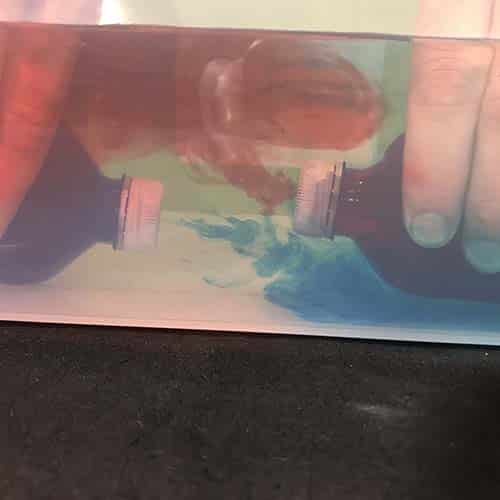
Does cold water rise above warmer water? Why do temperature layers form in our oceans? Learn about this all in this fun and cool experiment!
Adult supervision for setup
You will need
- One Kettle
- Oven mitts
- A Funnel
- One ice bath
- Two identical plastic jars with plastic screw-top lids
- Something to make a hole with (e.g. a nail or a drill)
- Red and blue food colouring
- Adult supervision and help
Method
-
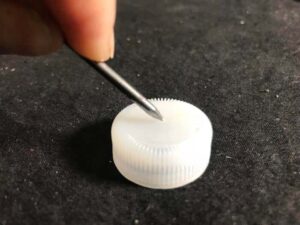
Carefully bore two holes on opposite areas of each of the plastic lids. The larger the hole, the faster the result of the experiment.
SAFETY: If children are to do this, please ensure that hand drills used are not electrically. Alternatively, hand drill the lids prior to children commencing the experiment, or use stretched balloons with holes instead.
-
Fill the 5 litre container with 3 litres of room temperature water.
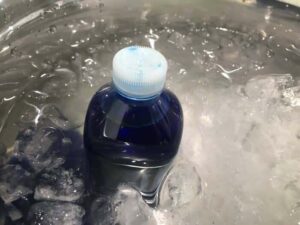
Fill one of the plastic jars with water, add blue food colouring, screw on the lid and stand it in the ice bath for five minutes.
-
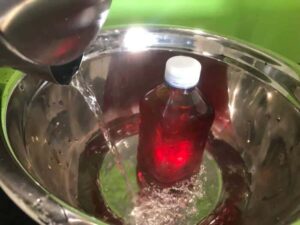
SAFETY: Adults only. Boil the kettle and allow to cool briefly. Carefully pour the hot water into the other plastic jar and add red food colouring. Screw the lid on whilst wearing the oven mitts for your safety.
-
Gently lower both jars to the bottom of the 5 litre container, making sure that each jar has the holes in the same vertical position as each other.
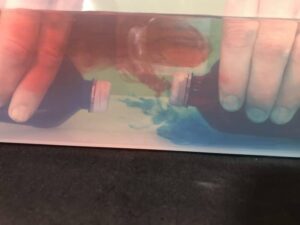
Allow the coloured water to seep into the surrounding water. You can speed the process by gently squeezing the sides of the jars. However, be careful not to disturb the main body of water.
-
School science visits since 2004!
– Curriculum-linked & award-winning incursions.
– Over 40 primary & high school programs to choose from.
– Designed by experienced educators.
– Over 2 million students reached.
– Face to face incursions & online programs available.
– Early learning centre visits too!
-
Get the Unit of Work on Heat Energy here!
- What actually is heat?
- How does heat move through different materials?
- How does heat change the properties of materials and more!
Includes cross-curricular teaching ideas, student quizzes, a sample marking rubric, scope & sequences & more

-

The science behind it
Why Does This Happen?
The Science of Temperature and the Density of Water
The relationship between temperature and density is a fundamental concept in oceanography and limnology (the study of inland waters). When water is heated, the molecules gain kinetic energy and move more vigorously, pushing each other further apart. This causes the water to expand and become less dense, allowing warm water to float on top of cold water.
In lakes and reservoirs, this creates a phenomenon called thermal stratification. The water separates into distinct layers:
- Epilimnion: The top, warmer layer that circulates due to wind and solar-driven convection.
- Hypolimnion: The bottom, colder layer that remains still and dense.
- Thermocline (Metalimnion): The transition layer where the temperature changes rapidly with depth.
This stratification has a massive impact on aquatic life. Cold water is actually better at holding dissolved oxygen than warm water, which is why many deep-water species thrive in the hypolimnion. However, in polar regions, complex currents often disturb these layers, mixing nutrients and oxygen throughout the water column.
Variables to test
Find out more on variables here.
-
Salinity and Density
What happens if you use salty water? Salt adds mass to the water without significantly increasing its volume. Does a warm, salty layer still float above cold, fresh water? -
Fluid Dynamics
Change the size of the opening of the bottle. Does a smaller opening slow down the rate of mixing between the two temperature layers? -
Viscosity and Liquid Type
Does it matter which type of liquid you use? Try oil or syrup. How does the molecular structure of different liquids change how they react to temperature changes? -
Thermal Energy Gradient
What happens if the temperature difference is small (e.g., 5°C) versus large (e.g., 40°C)? Does a larger temperature gradient make the layers stay separated for longer?
To keep your experiment valid, try to use food colouring to clearly see where the layers meet. Remember to only change one variable at a time to see its specific effect!

Teacher's note
Curriculums change, and so does the way you implement them in your classroom. Please use your own experience and knowledge of your students to use these resources to best effect for student learning.
Still want the curriculum links?
Here are the suggested links:
Australian Curriculum (ACARA) Science:
NSW Science syllabuses:
Victorian Curriculum Science:
Want this experiment — and many more — running in your classroom?
Have us visit your school — every student gets three hands-on experiments in 60–90 minutes with a qualified presenter.








