
Why are sunsets red?
Learn why sunsets are red with this easy science experiment. All you need is some milk, water, a container and a spotlight in a dark room. Learn more…
Adult supervision for setup
You will need
- One large clear container filled with 5 litres of water
- 50 mL Milk
- A strong source of light (e.g., spotlight, projector lamp)
- A darkened room
Method
-
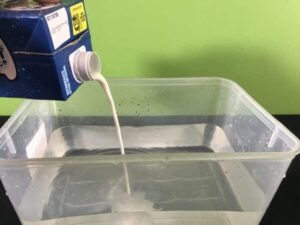
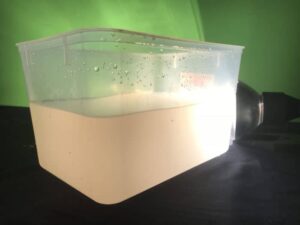
Pour about 50 mL of milk into the water. It is often best to use only a little at first, trying the following steps out and only adding more if the intended effect is not apparent.
-
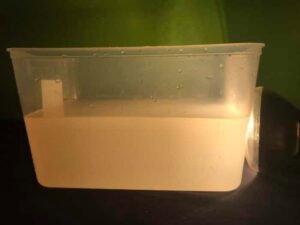
Turn the spotlight on and darken the room.
-
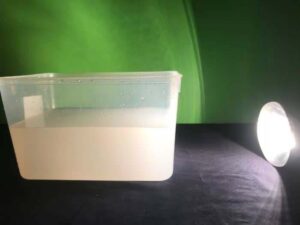
Face the light towards the milky water.
-
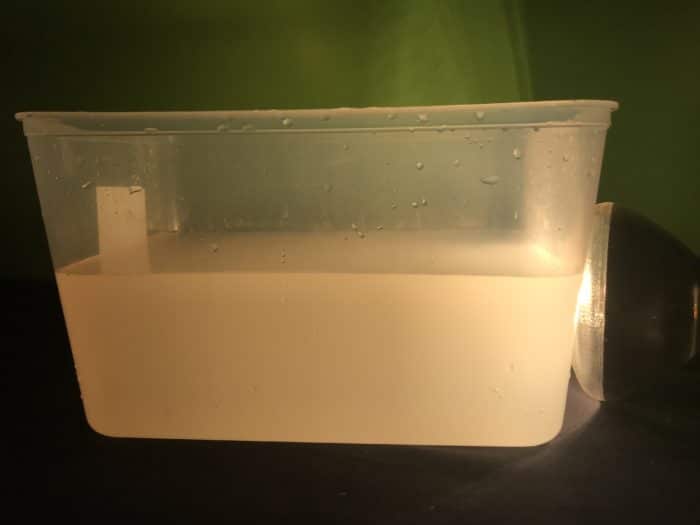
The mixture near the torch will look white, yet if you look on the other side of the container, the colour should be a mixture of orange and red. Something has happened to the light as it passed through milk solution!
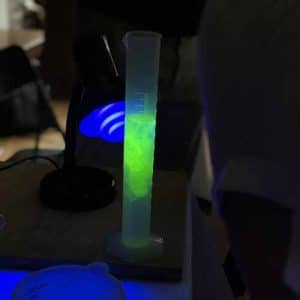
-
School science visits since 2004!
– Curriculum-linked & award-winning incursions.
– Over 40 primary & high school programs to choose from.
– Designed by experienced educators.
– Over 2 million students reached.
– Face to face incursions & online programs available.
– Early learning centre visits too!
-

-
Get the Unit of Work on Light & Colour here!
- What is colour addition vs subtraction?
- What is opacity, translucence & transparency?
- What is the difference between refraction & reflection?
- Explore UV light, lenses, thermochromism and more!
Includes cross-curricular teaching ideas, student quizzes, a sample marking rubric, scope & sequences & more
The science behind it
What is going on?
The Science of Sunsets and Scattering
Why is the sky blue during the day but fiery red at dusk? The answer lies in how sunlight interacts with the Earth’s atmosphere. White light is actually a mixture of all the colours of the rainbow, and as this light travels through gases and particles, it undergoes a process called Rayleigh Scattering.
Rayleigh Scattering
The different colours of light have different wavelengths. Blue and violet light have shorter, high-energy wavelengths, while red and orange have longer, lower-energy wavelengths.
- Daytime Sky: When the sun is overhead, sunlight travels a relatively short distance through the atmosphere. The nitrogen and oxygen molecules in the air are just the right size to scatter the shorter blue wavelengths in every direction, which is why the sky looks blue.
- Sunset Sky: At sunset, the sun is lower on the horizon. The sunlight has to travel through a much thicker layer of the atmosphere to reach your eyes. By the time the light gets to you, most of the blue light has been scattered away, leaving only the longer-wavelength reds and oranges to pass through.
The Iceberg Connection
The same principles of light absorption and scattering explain why icebergs can be different colours:
- White Icebergs: Most icebergs are full of trapped air bubbles. These bubbles scatter all wavelengths of light equally, making the iceberg appear white to our eyes.
- Blue Icebergs: Deep-sea ice formed under immense pressure has very few air bubbles. In this dense ice, the lower-energy red wavelengths are absorbed by the water molecules, while the higher-energy blue light passes through, giving the ice a brilliant blue glow.
Variables to test
Find out more on variable testing here.
-
Colloid Density
Does it matter if you use full cream or light milk? Higher fat content means more suspended particles—does this scatter the blue light faster? -
Alternative Mediums
What about soy or oat milk? These have different particle sizes than dairy—how does this change the intensity of the red “sunset” at the end of the tank? -
Thermal Effects
Does hot or cold water make a difference? Temperature affects the viscosity and movement of particles; test if this changes the scattering rate. -
Wavelength Interaction
Try using different coloured lights. If you use a green light source, can you still produce a “red” effect, or does the absorption spectrum prevent it?

Teacher's note
Curriculums change, and so does the way you implement them in your classroom. Please use your own experience and knowledge of your students to use these resources to best effect for student learning.
Still want the curriculum links?
Here are the suggested links:
Australian Curriculum (ACARA) Science:
NSW Science syllabuses:
Victorian Curriculum Science:
Want this experiment — and many more — running in your classroom?
Have us visit your school — every student gets three hands-on experiments in 60–90 minutes with a qualified presenter.








