
Wave demonstrator
Create a wave demonstrator that transfer waves easily. This fun science activity is part of over 150 free science experiments!
Adult supervision for setup
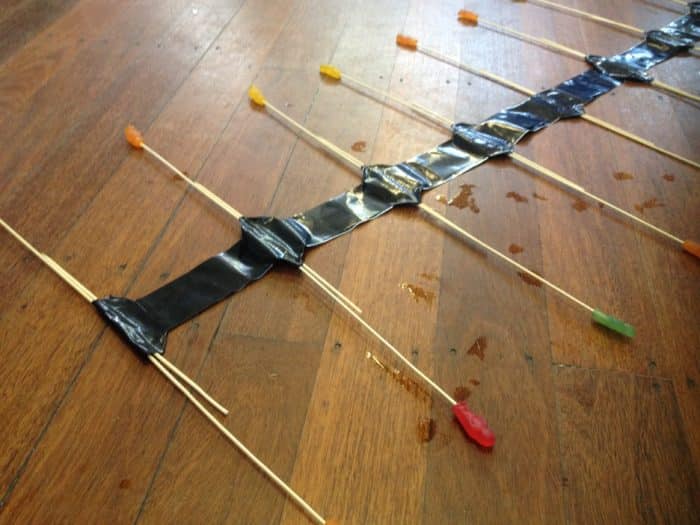
You will need
- Kebab sticks
- String
- Gaffa tape
- Jelly babies
- Somewhere to safely hang the wave demonstrator (out of the wind)
Method
-
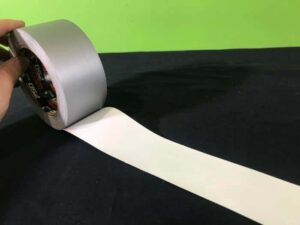
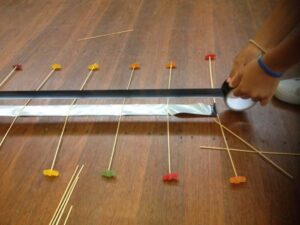
Roll out at least three-meters of Gaffa tape onto the floor.
-
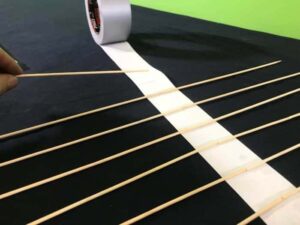
Add many rows of 2 wooden kebab sticks along the sticky part of the gaffa tape. We gave our rows a bout a 10cm spacing.
-
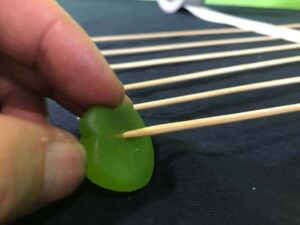
Spike Jelly babies onto the ends of the kebab sticks.
-
Roll out another three-meter length of Gaffa tape and cover the first length to secure the kebab sticks and to stop the wave demonstrator from being sticky.
-
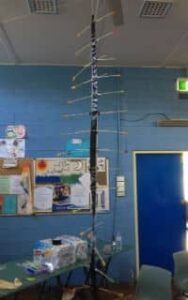
Carefully hang the wave demonstrator from the ceiling so that it dangles downward without touching the floor or hitting anything else.
-
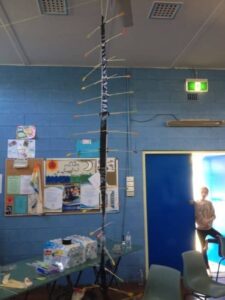
Give the wave demonstrator a 360-degree twist at the bottom of the tape, let go and watch the waves travel up and down the demonstrator!
-
School science visits since 2004!
– Curriculum-linked & award-winning incursions.
– Over 40 primary & high school programs to choose from.
– Designed by experienced educators.
– Over 2 million students reached.
– Face to face incursions & online programs available.
– Early learning centre visits too!
-

-
Get the Unit of Work on Sound here!
- What is amplitude?
- What is frequency?
- How does sound travel and what does it look like and more!
Includes cross-curricular teaching ideas, student quizzes, a sample marking rubric, scope & sequences & more
The science behind it
Why Does This Happen?
The Science of the Wave Demonstrator
The wave demonstrator is a hands-on tool for visualising how energy moves through a system. It takes advantage of momentum, leverage, and the constant conversion of energy to show that while the wave moves from one end to the other, the actual material stays in place.
Potential and Kinetic Energy
The magic happens in the relationship between the tape and the weights (like Jelly babies) on the ends of the sticks.
- Potential Energy: When you twist the tape at one end, you are storing elastic potential energy. The tape wants to return to its original flat shape.
- Kinetic Energy: As the tape unwinds, it releases that stored energy, converting it into kinetic energy (movement). This energy travels along the stick to the weights at the end.
- Momentum: Once the Jelly babies are moving, they have momentum. Their weight causes them to over-rotate, which twists the tape again. This new twist then releases energy into the next stick in the line.
Energy, Not Matter
This is a perfect demonstration of how waves work in nature, such as sound or water waves. The kebab sticks and Jelly babies simply twirl around — they don’t travel to the other end of the room. Only the energy pulse moves through the system until it eventually dissipates due to friction and air resistance.
Variables to test
Find out more on variable testing here.
-
Mass Distribution
Try different weights on the end of the sticks. Does adding heavier “Jelly babies” slow down the wave? (Hint: More inertia means it takes more energy to get the wave started!) -
Torsional Rigidity
Try different types of tape (electrical tape vs. duct tape). A more elastic tape might store and release energy differently, changing the speed of the wave. -
Leverage and Torque
Does the length of the sticks matter? Longer sticks provide more leverage—how does this affect the amplitude (height) of the wave? -
Spacing
What happens if you place the sticks closer together or further apart? Does the wavelength or frequency of the energy pulse change?

Teacher's note
Curriculums change, and so does the way you implement them in your classroom. Please use your own experience and knowledge of your students to use these resources to best effect for student learning.
Still want the curriculum links?
Here are the suggested links:
Australian Curriculum (ACARA) Science:
NSW Science syllabuses:
Victorian Curriculum Science:
Want this experiment — and many more — running in your classroom?
Have us visit your school — every student gets three hands-on experiments in 60–90 minutes with a qualified presenter.








