
Coathanger gong
In this crazy weird and fun experiment all you're gonna need is a coathanger and some string! Learn about how sound travels and have your mind blown!
Adult supervision for setup
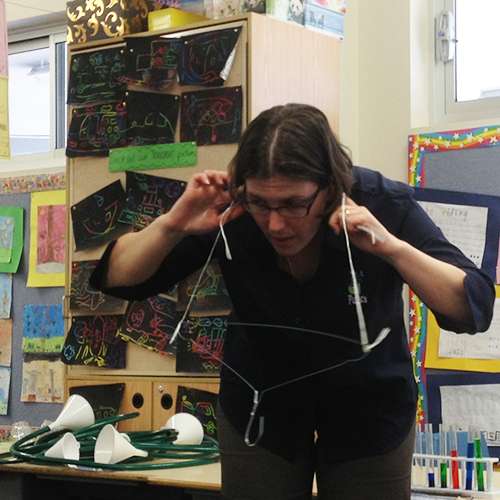
You will need
- One metal coat hanger
- Two pieces of string (around 30cm in length)
Method
-
Tie each of the strings to the corners of the coat hanger.
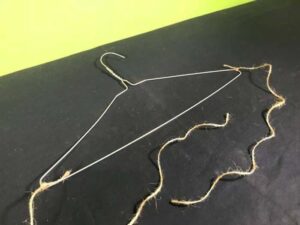
-
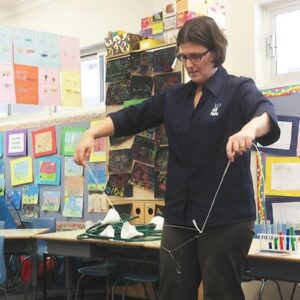
Wrap your right index finger around one of the strings and wrap your other index finger around the other string. Hold the end of the string so that the coat hanger hangs between your hands.
Gently knock the coat hanger on a hard surface. What do you hear? Is the sound loud or soft?
-
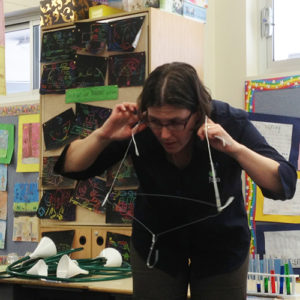
Put your fingers in your ears and gently knock the coat hanger on a hard surface.
Does the sound get louder? Why?
-
School science visits since 2004!
– Curriculum-linked & award-winning incursions.
– Over 40 primary & high school programs to choose from.
– Designed by experienced educators.
– Over 2 million students reached.
– Face to face incursions & online programs available.
– Early learning centre visits too!
-

-
Get the Unit of Work on Sound here!
- What is amplitude?
- What is frequency?
- How does sound travel and what does it look like and more!
Includes cross-curricular teaching ideas, student quizzes, a sample marking rubric, scope & sequences & more

The science behind it
Why Does This Happen?
The Science of the Coathanger Gong
The “Coathanger Gong” is a perfect way to experience how sound travels through different states of matter. While we usually hear sounds traveling through the air (a gas), this experiment allows you to hear sound traveling through a solid.
Conduction of Sound
Sound is a mechanical wave produced by vibrations. These vibrations need a medium—like air, water, or metal—to travel through.
- Particle Density: In a solid (like the metal coathanger and the string), the molecules are packed much more tightly together than in a gas (air). Because the particles are so close, the vibrations can be passed from one molecule to the next much more efficiently and quickly.
- Energy Loss: When sound travels through open air, the energy spreads out in all directions and fades quickly. By using the string, you are channeling the vibrations directly to your ears, which is why the “gong” sounds so loud and clear compared to just hitting the hanger normally.
- Seismic Connections: This same principle is why earthquakes can be detected thousands of kilometers away. The energy travels as seismic waves through the solid rock of the Earth’s crust much more effectively than it would through air or water.
Variables to test
Find out more on variables here.
-
Material Density
What happens when you use a plastic coathanger? Plastic is less dense and less elastic than metal—does the sound “ring” as long, or does it sound muffled? -
Transmission Medium
Vary the type of string. Try wool, cotton, or fishing line (monofilament). Which material carries the vibrations to your ears the best? -
Impact Surface
Does the surface you hit the coathanger against make a difference? Compare hitting a wooden table to a metal pole or a carpeted floor. -
Object Mass
Try tying other metal objects to the string, like a large spoon or a cooling rack. How does the size and shape of the object change the pitch of the “gong”?
To learn more about how scientists detect vibrations through the Earth, visit Geoscience Australia.

Teacher's note
Curriculums change, and so does the way you implement them in your classroom. Please use your own experience and knowledge of your students to use these resources to best effect for student learning.
Still want the curriculum links?
Here are the suggested links:
Australian Curriculum (ACARA) Science:
NSW Science syllabuses:
Victorian Curriculum Science:
Want this experiment — and many more — running in your classroom?
Have us visit your school — every student gets three hands-on experiments in 60–90 minutes with a qualified presenter.








